
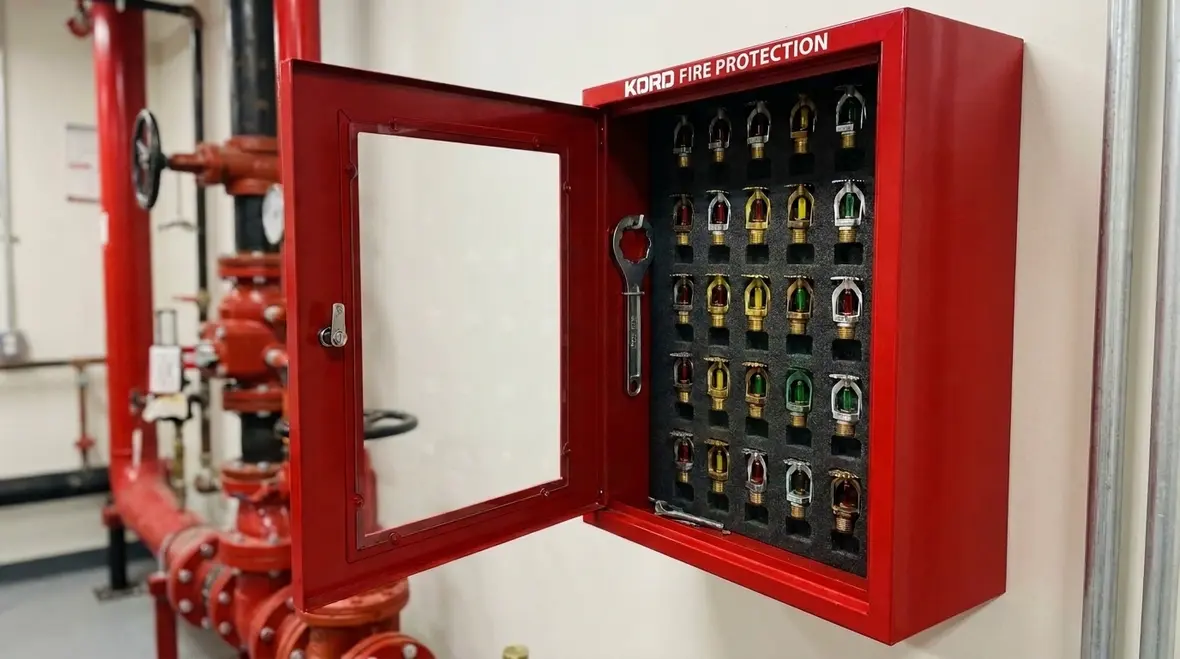
NFPA 16 Section 6.13: Stock of Spare Sprinklers in Foam-Water Installations
Quick Answer: NFPA 16 Section 6.13 requires maintaining an appropriate stock of spare sprinklers for foam-water fire protection systems. The intent is to preserve system readiness when sprinklers are damaged, removed for maintenance, or replaced after activation. Facilities must manage the quantity, labeling, and replacement timing.
Facilities managing these systems often pair spare inventory planning with foam fire suppression system maintenance and testing so replacement parts, inspections, and corrective actions stay aligned with actual field conditions.
What NFPA 16 Section 6.13 is trying to prevent
NFPA 16 Section 6.13 addresses a practical risk that many commercial facilities underestimate: downtime caused by the inability to replace the exact sprinklers that the foam-water system was designed to use. Foam-water installations rely on specific sprinkler types, temperature ratings, orifice characteristics, and K factors. If damaged sprinklers are replaced with incorrect components, performance can degrade.
That is why the “stock of spare sprinklers” is not treated as a casual parts drawer. It functions as a controlled readiness program that supports inspection findings, corrective actions, and post impairment repairs.
Where the “stock of spare sprinklers NFPA 16” requirement applies
The requirement applies to foam-water sprinkler systems installed in accordance with NFPA 16. In day to day terms, this includes commercial, industrial, and retail occupancies where foam-water protection is selected for hazards that demand special discharge characteristics and reliable water distribution.
Facilities typically need spare sprinklers for several recurring scenarios:
- Sprinklers replaced during routine inspection, reinstallation after maintenance, or component access work.
- Repairs after minor damage from building activity, equipment handling, or accidental impact.
- Corrective actions after a system impairment, including suspected leaks or nonconforming components found during verification.
- Post discharge replacement when a foam-water system activates or experiences inadvertent operation.
When facilities do not manage the stock of spare sprinklers NFPA 16 requirement, they often discover the issue during an emergency, when procurement lead times, sprinkler availability, and correct matching become the delay drivers.
How spare sprinklers support real inspection and maintenance workflows
NFPA 16 foam-water systems are maintained through a cycle of inspection, testing, and corrective action. Spare sprinklers integrate into that cycle in three key ways: identification, replacement readiness, and documentation quality.
1) Identification and matching to the exact installation
Sprinklers are not interchangeable. The spare stock must match the installed sprinkler characteristics required for the system. Commercial maintenance teams typically validate matching by verifying data such as:
- Manufacturer and model designation
- Temperature rating
- Orifice and K factor
- Thread or connection type
- Finish and protective characteristics relevant to the environment
- Any system specific configuration requirements
Without strict matching controls, facilities risk a subtle noncompliance that might not be obvious during installation but can affect discharge performance.
2) Replacement readiness during impairments
Foam-water systems can experience impairments during maintenance of piping, valves, control components, or drainage related components. When a sprinkler is removed, replaced, or physically damaged, the spare stock acts as a buffer to prevent prolonged outages while waiting for parts.
Good practice includes staging spares by zone, floor, or hazard area so the correct temperature rated and spec matched sprinkler is readily identifiable.
3) Documentation and traceability
Compliance is not only about having the parts. It is about showing that the facility can replace them correctly and quickly. Documentation commonly includes:
- Current inventory list of spare sprinklers
- Installed locations and corresponding spare identification
- Receipts or batch information and manufacturing traceability
- Records of any replacements made during inspection or corrective actions
These records reduce administrative friction during AHJ or insurance reviews and shorten the time to demonstrate corrective action closure.
Common compliance challenges that show up during audits
Field experience shows that spare sprinkler programs fail in predictable ways. The issues tend to fall into inventory control, environmental suitability, and maintenance communication.
Spare sprinklers are present but not maintained as an actionable stock
Some facilities accumulate spare sprinklers from initial installation but stop updating the count. Changes to the piping layout, hazard reconfiguration, or renovation can leave the remaining spares mismatched to what is actually installed.
Environmental suitability is overlooked
Foam-water areas can involve corrosive or damaging environments depending on the occupancy. If spares are stored without attention to finish and protective requirements, they may not be appropriate for the same area where they are expected to be installed.
Maintenance teams cannot locate the correct components quickly
Even when correct spares exist, poor labeling and unmanaged storage delays replacement. That delay can extend an impairment beyond acceptable windows and complicate compliance reporting.
No clear ownership for replacement decisions
When responsibility is unclear between facilities, contractors, and the testing organization, spare inventory can be depleted without timely replenishment. The stock of spare sprinklers NFPA 16 requirement must be supported by a defined process for reorder triggers and verification after each replacement event.
Operational procedures for a dependable spare sprinkler program
A robust program turns the requirement into a repeatable maintenance task, not a one time procurement exercise. The following operational practices align with how commercial facilities manage compliance:
Create an inventory plan tied to the system configuration
Map the installed sprinkler types by hazard area and temperature rating, then maintain the corresponding spares. Store them in a controlled location with protective packaging and clear labeling. Ensure the inventory list matches system drawings and current field condition.
Define reorder triggers and replenish immediately
Set a reorder trigger that activates after any sprinkler is removed, used, damaged, or replaced. Use a standard lead time buffer appropriate for the facility’s risk profile. Maintain spare stock continuity so the facility does not “fall off” compliance between replacements.
Verify spares during inspection events, not only during emergencies
During planned inspections, verify that the inventory matches the installed system. If renovations or head replacements occurred, update the spare stock plan and inventory records. This approach prevents late discovery of mismatched components.
Coordinate with the inspection and testing organization
Kord Fire Protection recommends that the organization performing inspection, testing, and maintenance coordinate with facilities staff on spare management. This reduces confusion over what was removed, what was replaced, and what is still available to support timely corrective actions.
For broader NFPA 16 context and facility implementation considerations, refer to: NFPA 16 standard overview and application guidance.
Why professional service matters for foam-water compliance
Foam-water systems involve specialized components and discharge behavior. Even when a facility believes it has sufficient spare parts, the key compliance factor is correctness and traceability. Professional review helps confirm that spares match the installed configuration, inventory levels reflect real replacement history, and documentation supports audit readiness.
Kord Fire Protection supports commercial facilities with compliance centered inspection, testing, documentation, and ongoing maintenance support. This service model helps facilities maintain reliable system readiness and manage impairments without unnecessary delays.
If your team is reviewing readiness more broadly, foam fire suppression inspection requirements and service offers additional context that fits naturally with spare inventory planning.
Frequently Asked Questions
Take action now
Review your foam-water system’s sprinkler inventory and confirm that the stock of spare sprinklers NFPA 16 requirement is supported by correct matching, clear labeling, and replenishment procedures. If your records are incomplete or you are unsure whether spares reflect recent field changes, schedule a compliance assessment with Kord Fire Protection to validate readiness, documentation, and maintenance processes before an impairment or emergency exposes gaps.

Join Our Newsletter!
Get the latest fire safety tips delivered straight to your inbox From our Newsletter.



