
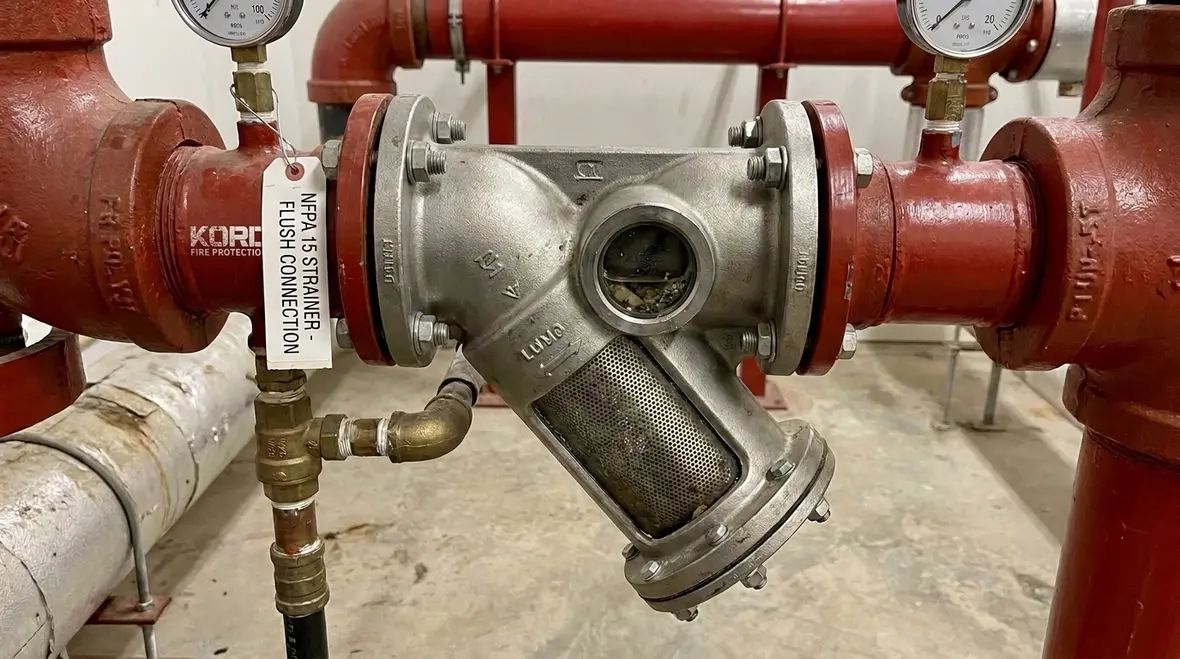
NFPA 15 Section 5.9 Strainers: Sizing, Perforations, and Flushing Connections
Quick Answer
NFPA 15 Section 5.9 strainers protect water spray systems from debris while maintaining required discharge performance. Correct strainer sizing, proper perforation area, including 1/8 inch perforations where applicable, and correctly installed flushing connections reduce blockage risk and support reliable inspections and maintenance.
If you are reviewing broader component requirements alongside strainer performance, it also helps to look at NFPA 15 general system components requirements, since strainers do not work in isolation and the surrounding valves, piping, and controls all have a say in how the system behaves in the real world.
Why NFPA 15 5.9 strainers determine spray system performance
In water spray fixed systems, strainer integrity directly affects flow distribution, spray density, and system response. Under-sizing can restrict hydraulics and reduce spray application. Oversizing can fail to capture debris effectively. Mismanaging perforations can cause partial blockage zones or uneven water delivery. Even when the system passes commissioning, long term performance can degrade if flushing connections are missing, improperly connected, or not routinely used.
Facilities that operate across multiple risk modes such as warehouses, retail backrooms, processing plants, and commercial kitchens often see debris migration from valves, pipe joints, construction residue, and ongoing maintenance activities. NFPA 15 5.9 strainers 1/8 inch perforations flushing connection requirements exist to manage that real world debris load while preserving the engineered hydraulic profile.
How to size strainers under NFPA 15 Section 5.9
Proper strainer sizing supports both compliance and operational stability. The primary objective is to ensure the strainer provides the required flow area and retention performance without creating excessive pressure loss. That balance matters because strainer restriction can force pumps to work outside expected curves, alter discharge patterns, and delay system flow.
Sizing drivers that commonly cause field nonconformance
- Insufficient net free area: Perforation pattern and mesh details must achieve the effective open area needed for design flow.
- Mismatched strainer type and service: Some facilities reuse strainers intended for different systems, or install nonrated components during renovations.
- Incorrect orientation: Inlet and outlet positioning can affect how debris accumulates on the strainer surface.
- Pipeline strain and alignment: Misalignment may distort housings and reduce effective opening area over time.
Practical sizing approach for commercial facilities
During design reviews and retrofit planning, engineers and field teams should confirm three items before purchase or installation: required flow capacity at the design operating pressure, strainer net open area for the specified perforation pattern, and the pressure loss acceptance criteria for the system configuration. For compliance, the installed configuration should match the basis of design, including any filtration element dimensions and orientation.
For ongoing assurance, Kord Fire Protection supports commercial owners with inspection readiness and maintenance documentation so facilities can demonstrate that strainer performance remains consistent after debris loading and water quality changes. Learn more about water spray system reliability here: NFPA 15 water spray fixed systems performance and compliance.
Perforations: what 1/8 inch perforations must accomplish
Perforation size influences how debris is captured while still allowing design flow. NFPA 15 5.9 strainers 1/8 inch perforations flushing connection considerations generally focus on maintaining adequate net open area and ensuring debris does not quickly blind the strainer surface. When perforations are too restrictive or the perforation pattern results in low effective open area, pressure loss increases and sprays may underperform.
What field teams need to verify during acceptance and periodic inspection
- Perforation geometry and uniformity: Variations caused by improper replacement screens can create localized flow restriction.
- Material and corrosion resistance: Water chemistry and ambient conditions can degrade components, enlarging openings or causing partial collapse.
- Screen thickness and support: If the support structure reduces open area, the system may not meet hydraulic intent.
- Debris loading patterns: Fine debris can pack quickly even when perforations appear adequate at installation.
Common failure points related to perforations
- Wrong replacement element: Maintenance crews replace a failed strainer with an equivalent-looking component that does not match effective open area.
- Post-construction debris not removed: Construction sediment and pipe scale can rapidly block screens and remain lodged despite partial flushing.
- Inadequate cleaning technique: Cleaning that does not restore original screen surface condition can leave packed debris that reduces open area.
Because perforations and effective open area behave together, compliance is not only about hole diameter. It is about how the screen, supports, and housing contribute to net flow capacity over time.
Flushing connections: ensuring debris removal without system disruption
Flushing connections support controlled cleaning of the strainer element. Proper piping arrangement and valve control allow maintenance teams to remove accumulated debris while maintaining safe, repeatable procedures. When the flushing connection is absent, blocked, misrouted, or cannot be operated as designed, debris accumulation accelerates and the strainer becomes a long term restriction.
What the “flushing connection” must enable
- Access for cleaning: Maintenance can flush and verify debris removal without bypassing engineered protection.
- Repeatable operation: Facilities can perform flushing at scheduled intervals and at inspection cycles.
- Safe discharge: Flushing flow routes to an appropriate drain or containment arrangement to prevent flooding and slip hazards.
- Consistency with system hydraulics: Flushing should not introduce air management problems or cause unintended pressure transients.
Operational compliance challenge: flushing that “works” but does not restore performance
Many facilities flush based on time, not results. A strong flushing flow can dislodge loose debris while leaving packed fine sediment that remains embedded near perforation edges. That issue can lead to gradual performance loss and can be difficult to detect until the system is stressed or inspected under flow conditions.
Commercial owners reduce that risk by using a performance centered maintenance procedure. After flushing, the strainer element must be examined, and debris removal should be verified visually where permitted by site safety procedures. Kord Fire Protection coordinates these checks so the facility can demonstrate sustained readiness through documented maintenance and test support.
For additional context on water based fire protection practices and industry resources, see Fire Pumps and Water Based Fire Protection resources.
Inspection, maintenance, and documentation that withstands scrutiny
NFPA 15 strainer compliance is not a one time install event. It becomes a lifecycle program: inspection to detect early restriction, maintenance to restore design intent, and documentation to confirm continued readiness. This matters for commercial, industrial, and retail facilities where operations generate debris, and where inspections must align with internal risk assessments and local jurisdiction expectations.
Inspection and maintenance workflow commonly used in commercial settings
- Visual verification: Confirm flushing connections and valves are accessible, labeled, and not capped or blocked.
- Debris condition assessment: Evaluate the strainer element condition to determine cleaning urgency.
- Flushing procedure: Flush using the designed connection to remove accumulated debris.
- Screen verification: Inspect perforation condition for loading, deformation, or corrosion damage.
- Reinstallation controls: Confirm correct gasket seating, orientation, and secure fastening to restore original hydraulic behavior.
- Recordkeeping: Document cleaning, observations, and any component replacements.
Maintenance practices that prevent repeat failures
- Use matched replacement elements: Replace strainer elements only with components that meet the original perforation and net open area intent.
- Coordinate with water quality conditions: If water chemistry or source changes, increase inspection frequency.
- Confirm strainers stay within design pressure loss limits: Persistent restriction indicates debris, incorrect component selection, or system imbalance.
By building strainer maintenance into facility operations, commercial owners reduce the risk of blocked strainers, degraded spray patterns, and noncompliant performance during inspections.
Frequently Asked Questions
Conclusion and Call to Action
NFPA 15 Section 5.9 strainers require more than correct installation. They demand correct sizing, perforation performance, and reliable flushing connections that allow real debris removal over time. Kord Fire Protection helps commercial owners keep water spray systems inspection ready through documented maintenance, component matching, and performance focused verification. Schedule a strainer compliance review and maintenance plan so your facility protects design intent, reduces downtime risk, and strengthens inspection confidence.

Join Our Newsletter!
Get the latest fire safety tips delivered straight to your inbox From our Newsletter.



