
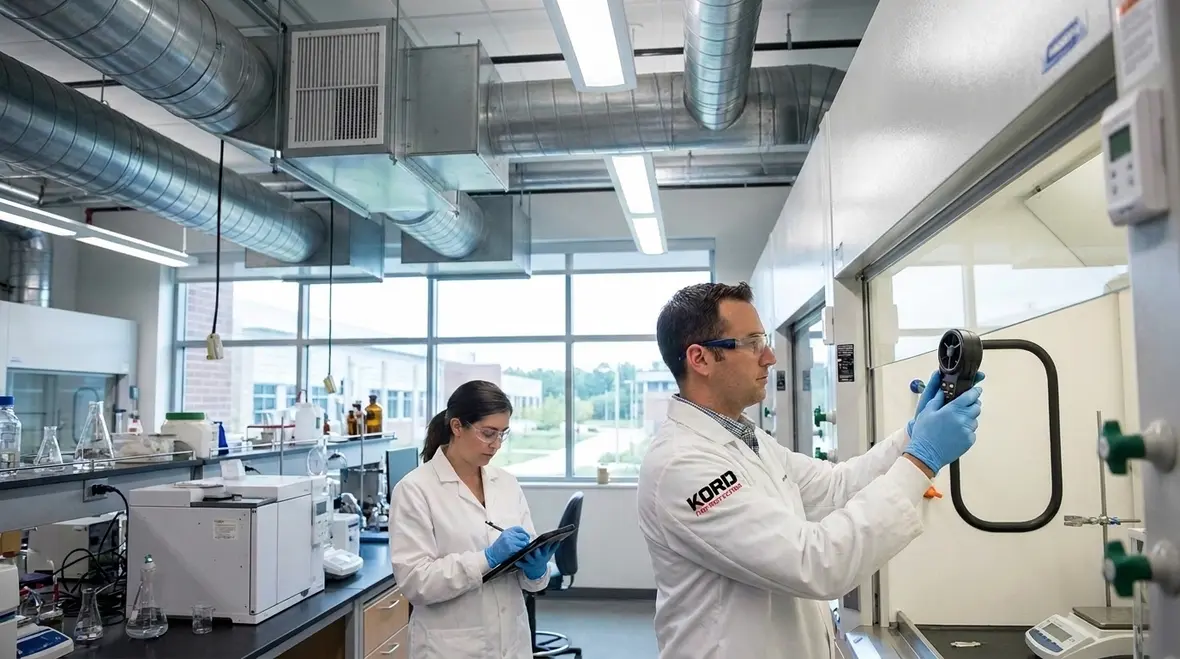
NFPA 45 Section 7.1 General: Overview of the Lab Ventilation Chapter
Quick Answer
NFPA 45 Section 7.1 establishes the foundational intent for laboratory ventilation requirements, focusing on safe airflow control, proper system performance, and structured compliance. It frames how labs should design, operate, inspect, and maintain ventilation systems to manage hazardous vapors, fumes, and contaminants.
For facilities building out stronger documentation and maintenance workflows, Kord Fire Protection’s full lifecycle of fire protection servicing offers a useful related look at how inspection, testing, and maintenance programs stay organized across critical systems.
What does NFPA 45 Section 7.1 cover, and why it matters?
NFPA 45 laboratory ventilating systems general requirements begin with the premise that ventilation systems in laboratories protect people, processes, and the environment. Section 7.1 provides the “how to think about it” foundation for the chapter, before facility-specific details are addressed elsewhere in the document. In practice, this section sets expectations that ventilation equipment must operate as intended, that airflow and containment performance must be maintained, and that the facility must apply disciplined procedures for operation and upkeep.
For commercial, industrial, and retail settings that support laboratories (for example, health services facilities, research wings in manufacturing, or educational and corporate R and D spaces), Section 7.1 becomes a key reference point when teams respond to questions from facilities management, auditors, and insurers: What does the code require in principle, what must be verified in the field, and how should deficiencies be handled?
How Section 7.1 shapes lab ventilation performance
Section 7.1 general oversight influences the entire ventilation lifecycle. That includes initial design intent, day to day operation, and verification that the system keeps hazardous materials controlled. While later sections typically address the specifics of equipment types and detailed performance, Section 7.1 establishes three practical compliance themes:
1) Ventilation must control hazardous contaminants
Laboratories often handle chemicals, aerosols, or byproducts that require engineered control. Section 7.1 emphasizes that ventilation systems must achieve and maintain the airflow control needed to limit release of hazardous substances. This is not limited to fume hoods. It extends to the overall approach to containment, pressure relationships, and the ability of ventilation to respond to operating conditions.
2) Systems must remain reliable and maintainable
A frequent compliance challenge in commercial facilities involves “as built versus as operated.” Over time, belt drives slip, dampers drift, filters load, sensors age, and ductwork accumulates debris. Section 7.1 sets the expectation that the ventilation system remains capable of performing its safety function throughout its service life. Maintenance programs become part of compliance, not an optional afterthought.
3) Verification and documentation must support code intent
Section 7.1 also supports a culture of verification. In real-world inspections, inspectors and safety officers look for evidence that performance is checked using appropriate methods and that records reflect the current system condition. This typically includes results of ventilation testing, inspection findings, corrective action tracking, and maintenance documentation.
What facilities get wrong during inspections and audits
Commercial facility teams often assume “ventilation is ventilation,” but NFPA 45 lab ventilation expectations demand specificity. Below are common failure points that tie back to the general intent expressed in Section 7.1:
Airflow assumptions without field verification
Facilities sometimes rely on design drawings or commissioning reports without confirming current performance. Changes such as modifications to duct runs, supply air balancing updates, occupancy changes, or reconfiguration of lab spaces can shift airflow patterns and undermine containment.
Control equipment that is out of calibration
Ventilation relies on sensors and controls that must match operating intent. Calibrations for monitoring points, damper position feedback, and airflow measurement drift can create conditions where the system looks normal but does not perform as required.
Inadequate response to filters, obstructions, and loading
When filters load or ductwork becomes partially obstructed, fans and dampers may not be able to maintain required airflow. Section 7.1 intent supports proactive maintenance to prevent ventilation degradation that can lead to ineffective contaminant control.
Operational practices that conflict with system design
Even when equipment is correct, operational habits can defeat performance. Examples include leaving access doors open, blocking airflow paths, improper hood sash settings, or inconsistent use of local exhaust equipment. Auditors often evaluate whether operational training and procedures align with the ventilation strategy.
Operational procedures that support compliance with Section 7.1
Section 7.1 is fundamentally about safe ventilation management. Facilities that treat ventilation as a living system, rather than a static asset, typically perform better in inspections. A practical compliance approach includes the following:
Establish clear operating modes and responsibility
Commercial labs need defined operating schedules, setpoints, and assigned responsibilities for normal operations, shutdowns, and after hours conditions. Facilities should ensure that staff understand how the ventilation system should run during typical workflows and during unusual chemical processes.
Implement routine inspection and preventive maintenance
Preventive maintenance should cover fan performance checks, damper operation, control system health, filter status, and duct integrity. For labs, the goal is to identify performance degradation early, before contaminant control becomes unreliable.
Use performance testing to validate code intent
Because ventilation safety depends on airflow performance, validation testing should be performed at scheduled intervals and after system modifications. A robust program treats test reports as a compliance tool, not as paperwork after the fact.
Commercial partner support: where Kord Fire Protection fits
Compliance success depends on consistent execution, not just code knowledge. Kord Fire Protection supports commercial facilities with the maintenance and testing workflows needed to maintain ventilation system performance in line with NFPA 45 laboratory ventilation expectations. This includes helping organizations translate Section 7.1 general intent into practical inspection schedules, documentation practices, and corrective action management that stand up to internal reviews, third party assessments, and regulatory scrutiny.
For facilities seeking additional guidance on fire and life safety compliance workflows, Kord Fire Protection can also support related systems and documentation strategies. Learn more here: Kord Fire Protection.
Frequently Asked Questions
Conclusion and next steps
Facilities should treat NFPA 45 Section 7.1 as a compliance strategy for ongoing ventilation performance, not a one time check. Start by verifying current system behavior against design intent, tighten inspection and preventive maintenance practices, and ensure documentation reflects the present condition. Engage a qualified commercial service partner such as Kord Fire Protection to support testing, maintenance, and corrective action workflows that keep laboratory ventilation credible to auditors and safe for occupants.

Join Our Newsletter!
Get the latest fire safety tips delivered straight to your inbox From our Newsletter.



