
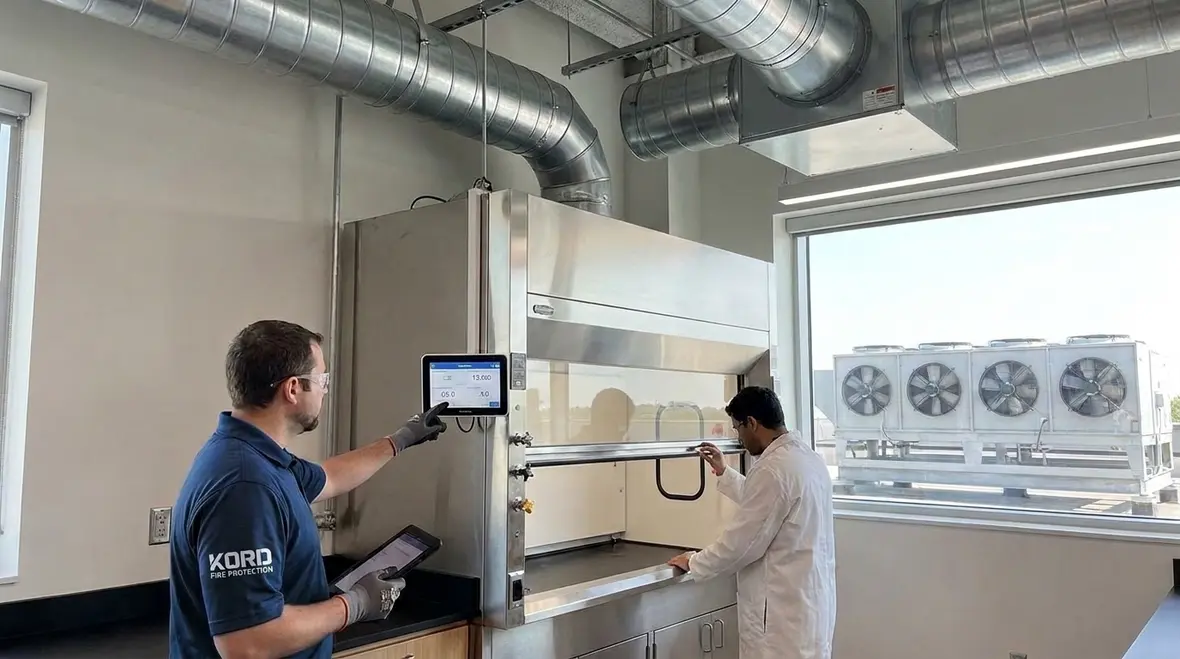
NFPA 45 Section 7.2: Basic Requirements for Laboratory Ventilation
Quick Answer: NFPA 45 Section 7.2 establishes the baseline design and operational expectations for laboratory ventilation. It focuses on maintaining appropriate airflow control, proper ventilation performance, and ongoing checks to ensure hazardous atmospheres do not accumulate. Facilities must also plan for reliable operation, monitoring, and maintenance.
For facilities that need a broader compliance partner, Kord Fire Protection services can support inspection readiness, testing coordination, and maintenance planning across life safety systems.
What NFPA 45 laboratory ventilation basic requirements require in practice
NFPA 45 Section 7.2 sets the core framework that commercial and industrial laboratory spaces rely on to control flammable, combustible, and toxic hazards. Facilities applying the NFPA 45 laboratory ventilation basic requirements typically use the section as the baseline for airflow direction control, ventilation system reliability, and the management of laboratory conditions that change during daily operations. Because laboratory activities shift frequently, the biggest compliance risk is not the initial design, but the steady state performance drift that occurs when systems are not verified, balanced, and maintained.
For teams responsible for safety management, the practical interpretation is straightforward: ventilation must work as intended, it must keep working while conditions change, and it must be documented and verified through a repeatable inspection and maintenance program.
Key compliance outcomes under Section 7.2
Although laboratory layouts vary, Section 7.2 expectations generally converge on the same operational outcomes. The ventilation system must maintain protective air movement patterns, support safe fume control, and provide dependable operation of exhaust and make up air components where applicable. In commercial, industrial, and retail lab environments, these outcomes are often challenged by occupancy changes, after hours use, renovation work, and recurring equipment wear.
1) Controlled airflow direction and containment
Laboratory ventilation performance begins with containment. Airflow direction control helps limit the spread of hazardous vapors and aerosols into occupied areas. Common real world failure points include improperly set pressure relationships, miscalibrated controls, and ductwork modifications that were made without rebalancing.
2) Ventilation capacity that matches operating conditions
Ventilation systems must provide adequate exhaust and, where required, appropriate make up air to sustain intended performance. Capacity shortfalls usually show up after filter loading, motor degradation, damper position drift, or changes in exhaust hood usage patterns.
3) System reliability and operational continuity
Section 7.2 emphasizes the need for ventilation systems that perform consistently during laboratory use. Reliability depends on proper fan operation, correct damper actuation, stable control strategies, and disciplined maintenance.
How laboratories prove compliance: verification, checks, and maintenance
NFPA 45 compliance becomes defensible when facilities can demonstrate that ventilation performance remains within safe operating parameters over time. The verification methods should not be limited to design documentation. They must include routine checks that reflect how the system actually performs during daily use.
Operational verification that matters to inspectors
-
Airflow confirmation: Measure and record airflow performance indicators that match the laboratory’s hazard control strategy, including fume hood exhaust verification where used.
-
Control system review: Confirm that sensors, setpoints, and control sequences are calibrated and stable. Drift in building automation systems can degrade ventilation performance without obvious alarms.
-
Component inspection: Inspect fans, dampers, belts or drives, duct penetrations, and vibration impacts. Worn components often create reduced airflow and inconsistent damper positions.
Maintenance actions that prevent common breakdowns
Commercial lab environments typically experience the same repeat problems: filter loading, duct contamination, loose duct connections, and control failures that do not trigger immediate shutdown. A strong maintenance program reduces these risks by scheduling work based on measured performance trends rather than calendar dates alone.
Kord Fire Protection supports commercial customers with ventilation compliance support planning, inspection readiness, and ongoing testing and maintenance coordination so that systems remain aligned with safety objectives and operational reality. For more on comprehensive compliance approaches, see fire pump testing requirements.
Common compliance challenges in commercial labs
Section 7.2 baseline requirements can be undermined by everyday operational changes. In retail connected labs, university or corporate research spaces, and industrial pilot facilities, these are the most frequent gaps that drive corrective actions.
1) Renovations and tenant improvements
Therapy of ventilation system changes is a frequent weak point. Even a “minor” duct reroute or hood relocation can shift balancing requirements and airflow direction. Compliance fails when modifications are made without documented commissioning or re verification.
2) Deferred maintenance and performance drift
Reduced exhaust performance may go unnoticed until odors, visible fumes, or complaints occur. By then, safe containment can already have been compromised. Deferred filter replacement and slow control sensor drift can also mask the issue.
3) Inadequate documentation for audits
Inspection readiness depends on traceable records. Facilities often struggle with incomplete calibration logs, missing test reports, and unclear accountability for who verifies performance and when.
Operational best practices for facilities managers and lab supervisors
Meeting the spirit of NFPA 45 Section 7.2 requires alignment between engineering systems and day to day lab behavior. Facilities benefit from clear procedures that guide users and maintain consistent outcomes.
Set clear operating rules for hoods and ventilation modes
-
Define when ventilation must run, including during start up, after hours, and during scheduled high hazard operations.
-
Require checklists for hood use and inspections when hazardous procedures change during the day.
-
Control “temporary” duct or hood bypass practices, because these often become permanent.
Train staff to identify ventilation red flags
Training should be practical and linked to reporting. Staff should know how to document suspected hood performance issues and escalate to maintenance before conditions escalate into an incident.
Use a continuous improvement loop
Ventilation performance should be reviewed based on test trends. Where measurements indicate drift, corrective actions should follow immediately, with documented verification after the work is complete.
Frequently Asked Questions
Next step: align your ventilation program with Section 7.2
Ensure your laboratory ventilation program can demonstrate ongoing performance, not just initial installation compliance. Kord Fire Protection can help commercial facilities plan verification, coordinate inspection readiness, and support testing and maintenance so your ventilation systems continue to meet NFPA 45 expectations. Contact Kord Fire Protection today to review your current program and identify practical improvements before an audit or incident forces costly rework.

Join Our Newsletter!
Get the latest fire safety tips delivered straight to your inbox From our Newsletter.



