
NFPA 40 Section 3.3: Key Cellulose Nitrate Film Terms Defined
Quick Answer: NFPA 40 Section 3.3 defines essential nitrate film terminology used throughout the standard. Clear understanding of these terms supports correct storage, handling, inspection, and impairment decisions in commercial facilities. This reduces compliance risk and helps fire protection teams document conditions accurately.
Why NFPA 40 general definitions nitrate film terminology matter in day to day operations
Nitrogen film compliance discussions often fail at the starting point: terminology. NFPA 40 general definitions nitrate film terminology establishes consistent meanings for film states, storage categories, and condition descriptors that influence inspection requirements, impairment thresholds, and documentation expectations. When facility teams use different words for the same film condition, they increase the likelihood of incomplete maintenance records, delayed corrective actions, and inconsistent inspection findings.
For commercial and industrial operators, the impact shows up quickly. Storage rooms, film vault workflows, and impairment response procedures depend on accurate classification. Retail and distribution sites with aging archive film also depend on consistent terminology to maintain safe handling boundaries and escalation triggers.
What Section 3.3 covers in NFPA 40
NFPA 40 Section 3.3 focuses on defined terms tied to cellulose nitrate film and its condition. These definitions support interpretation of later sections, including provisions that govern storage, control of hazards, and inspection practices. In practical terms, the definitions help inspectors and maintenance teams identify what they are looking at, what it means, and what actions follow.
Because Section 3.3 definitions underpin the rest of the code, teams should treat them as operational language rather than reference material. A compliance program should translate these definitions into internal checklists, labels, and job aids used by guards, warehouse staff, fire watch personnel, and qualified fire protection contractors.
Key cellulose nitrate film terms defined in Section 3.3: operational translation
Section 3.3 definitions typically revolve around nitrate film identification and condition descriptors. Facility teams should use the definitions to create clear decision points for segregation, movement controls, and maintenance or removal.
1) Film identification and classification
Correct identification of cellulose nitrate film drives the entire risk assessment. Even when film appears similar to other media, misclassification can result in storage layout errors, incorrect inspection frequency, and inappropriate protection measures.
Common compliance challenge: Teams discover nitrate film mixed with other formats during inventory audits. Without term consistent classification rules, staff may delay isolation and documentation.
2) Condition descriptors that trigger impairment action
Section 3.3 definitions include terminology for nitrate film condition states that relate to deterioration. These terms matter because deterioration progresses and can increase hazard severity. Facilities must apply defined condition language consistently during inspections, and they must tie those conditions to escalation procedures.
Common failure point: Inspectors describe deterioration with informal labels rather than the code terms. This creates gaps when management expects a corrective action plan mapped to the definitions.
3) Handling and storage boundary terms
Definitions support safe handling rules such as movement controls, separation expectations, and limits on what staff may do without authorization. When the facility uses the correct nitrate film terminology from Section 3.3, it supports clear workflows for transfers, staging, and temporary storage.
Commercial facility reality: Film handling often intersects with scheduling constraints, production workflows, and off hour access. Clear definitions help prevent informal “work around” behavior that can undermine safety controls.
How to apply Section 3.3 definitions during inspections, testing, and maintenance
NFPA 40 Section 3.3 definitions become useful only when they are embedded into daily inspection routines and maintenance documentation. Facilities should expect these requirements to show up in room tours, impairment assessments, and contractor reports.
For related guidance on practical fire protection program implementation, facilities can also review fire sprinkler services from Kord Fire Protection.
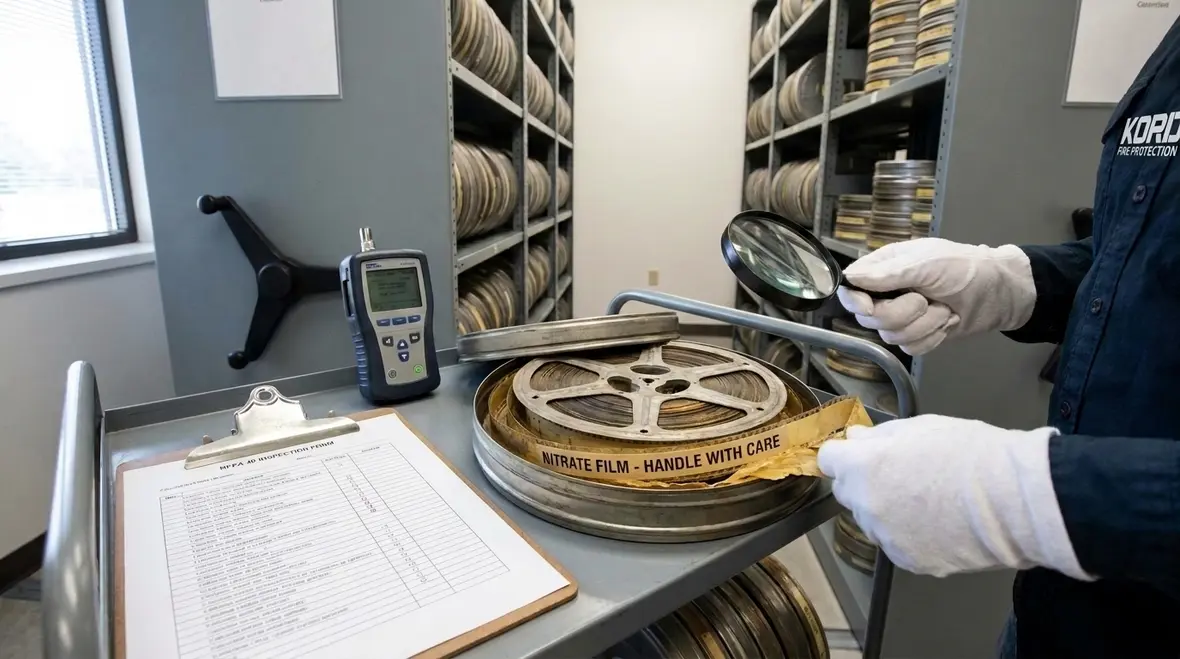
Build definition driven checklists for storage areas
- Create inspection forms that require staff to select code aligned condition terms, not free form descriptions.
- Include a field for “classification basis,” such as label verification, container markings, or prior impairment records.
- Require clear segregation notations when terms indicate deterioration states.
Standardize labels and internal signage
Commercial facilities benefit from physical and administrative alignment. When container labels mirror Section 3.3 terminology, staff can perform consistent identification and segregation. This reduces ambiguity during shift changes and during contractor access.
Document impairment response actions
When conditions align with impairment definitions, documentation should show the condition term, the location, the observed evidence, and the corrective action status. Maintenance teams should connect response actions to impairment procedures and confirm that segregated film remains controlled until disposition is complete.
For organizations that need ongoing support to keep these workflows audit ready, Kord Fire Protection supports commercial facilities with compliance planning, inspection preparation, and maintenance coordination. When code language drives the checklists and reporting structure, inspections become repeatable and defensible.
Where facilities commonly get tripped up with nitrate film terminology
Even capable teams struggle when they treat definitions as static reference text. The following issues regularly appear in commercial inspections and internal audits.
Inconsistent wording between departments
Operations staff may label film based on storage appearance, while fire protection staff label based on condition descriptors. Without a shared vocabulary tied to NFPA 40 Section 3.3, reports conflict and corrective actions slow down.
Training that focuses on procedures but not definitions
Training that teaches “what to do” without aligning “what to call it” produces inconsistent findings. Staff may perform correct actions, but the documentation can still fail audit expectations because terminology does not match the code defined terms.
Uncontrolled mixing during inventory updates
During inventory reconciliation, facilities may repackage film, update container labels, or consolidate holdings. If the facility does not apply Section 3.3 definitions during these transitions, film can return to storage under incorrect classifications.
How Kord Fire Protection supports compliance with NFPA 40 defined terms
Compliance success depends on operational translation. Kord Fire Protection helps commercial, industrial, and retail facilities implement NFPA 40 terminology into practical inspection and maintenance systems. This includes supporting standard operating procedures that align with code language so teams document nitrate film conditions consistently.
When facilities standardize terminology, they reduce ambiguity in contractor reports, streamline corrective action tracking, and strengthen readiness for internal and external audits. This supports safer storage decisions and more reliable impairment response planning.
Teams looking to align their nitrate film program with broader code based planning may also find helpful context in NFPA 40 Section 1.2 fire protection goals for nitrate film operations.
Frequently Asked Questions
Conclusion and call to action
NFPA 40 Section 3.3 turns nitrate film terminology into a compliance tool. Facilities that implement the definitions in checklists, labels, and training improve decision making for storage, handling, and impairment response. Kord Fire Protection can help commercial teams build a repeatable process that supports audit readiness and safer operations. Schedule a compliance review to align your inspection language and maintenance documentation with NFPA 40 expectations.

Join Our Newsletter!
Get the latest fire safety tips delivered straight to your inbox From our Newsletter.



