
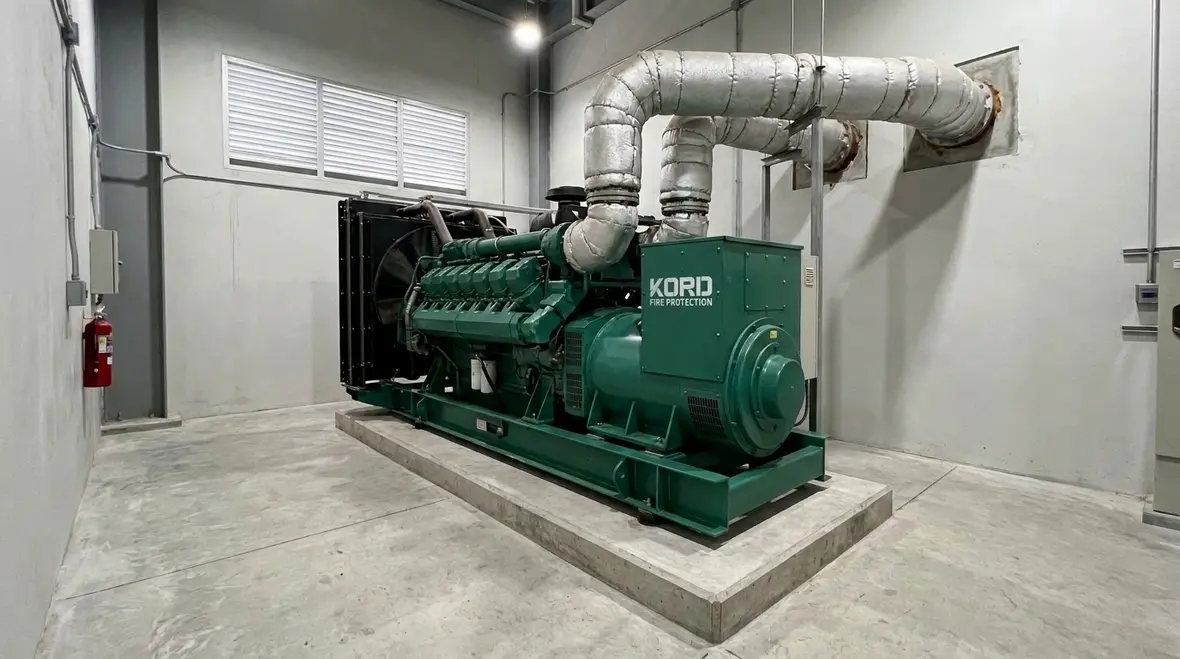
NFPA 37 Section 4.1: Location Rules for Stationary Engines
Quick Answer
NFPA 37 Section 4.1 sets location rules that control where stationary engines may be installed to reduce fire, explosion, and heat exposure risks. These engine location requirements stationary engines depend on ignition source hazards, ventilation conditions, proximity to combustibles, and the facility’s construction and operating layout.
If your building also includes generator room hazards or related suppression concerns, Kord Fire Protection has a helpful guide on generator room fire suppression options that fits naturally alongside engine location planning. For broader inspection and service support, you can also explore Kord Fire Protection’s fire protection services in Southern California.
What NFPA 37 Section 4.1 actually governs for engine placement
NFPA 37 Section 4.1 provides the foundational placement framework for stationary engines. In practice, compliance depends less on “where the engine fits” and more on “how the surrounding environment can fail.” Inspectors and insurance reviewers typically focus on ignition potential, heat transfer, fuel and exhaust hazards, and whether the installation allows safe access for operation and maintenance.
For organizations managing commercial, industrial, and retail facilities, the engineering work usually includes reviewing the installation plan against construction type, housekeeping expectations, normal and abnormal operating conditions, and maintenance realities. The goal is to prevent engine-related ignition sources from contacting flammable vapors, dust accumulations, or combustible storage.
NFPA 37 engine location requirements stationary engines: the compliance concepts
To meet the intent behind the NFPA 37 engine location requirements stationary engines, facilities must ensure that the engine location controls ignition hazards under both steady state and upset conditions.
1) Ignition source control: exhaust, heat, and electrical components
Stationary engines create ignition potential through hot exhaust gases, elevated engine surface temperatures, and electrical components such as starters and wiring terminations. NFPA 37 Section 4.1 location rules typically require separation from combustibles and careful placement so that heat and sparks cannot reach hazardous materials.
- Exhaust routing and discharge direction must not impinge on combustible storage or allow hot exhaust to accumulate in enclosed spaces.
- Enclosures and separation distances must account for thermal effects, not just physical clearance.
- Electrical enclosures and conduit entries must not create new ignition pathways into adjacent hazardous areas.
2) Ventilation and air movement: avoiding flammable vapor pockets
Many real-world failures occur when ventilation assumptions do not match actual airflow patterns. Poor ventilation can allow flammable vapors to pool near an ignition source, even when the general area appears “open.” Where the facility handles fuels, solvents, or other volatiles, the engine location selection and ventilation planning must prevent the accumulation of flammable atmospheres around the engine.
- Airflow must support dilution and removal under normal and during maintenance conditions.
- Openings, doors, and HVAC modes can change vapor distribution and must be considered in operating procedures.
3) Separation from combustibles: storage, materials, and waste
NFPA 37 Section 4.1 emphasizes that the engine location must account for combustible loads that exist now and may exist later. This includes routine storage, seasonal stock, packaging materials, cardboard waste, pallets, and debris that can collect during cleaning cycles.
Common site issue: the engine was installed with adequate clearance at commissioning, but adjacent storage practices later changed. Compliance must be managed operationally, not only at initial inspection.
Location planning for commercial buildings: where projects commonly get stuck
Stationary engine placements in commercial and retail facilities introduce coordination challenges between engineering, operations, and fire protection. NFPA 37 Section 4.1 requirements often collide with practical constraints such as limited plant room area, ongoing tenant improvements, and shared loading docks.
Plant rooms, generator enclosures, and shared spaces
Many sites use a dedicated generator room or engine enclosure. Even when an enclosure exists, location rules still require that the surrounding area does not undermine safety through heat buildup or combustible adjacency. Facilities must also confirm that doors, access pathways, and ventilation openings support safe operation and maintenance.
Inspection frequently flags:
- Blocked ventilation openings or improperly maintained louver screens
- Combustible storage in or near maintenance clearances
- Improper exhaust discharge locations that reintroduce heat to intake areas
Retail and light commercial: housekeeping and tenant variability
Retail operations may appear low risk because they do not handle large volumes of flammable liquids. However, the ignition risk becomes significant when daily housekeeping does not control combustible waste. NFPA 37 engine location requirements stationary engines must integrate with facility housekeeping plans and contractor access rules.
A common failure point is “contractor works nearby” scenarios where temporary staging materials accumulate too close to the engine installation.
Operational and maintenance controls that keep the installation compliant
NFPA 37 compliance does not end with a one-time site check. The engine location rules rely on the installation continuing to perform as intended. Maintenance and operational controls protect separation distances, ventilation paths, and exhaust effectiveness over time.
Maintenance activities that can change risk
Routine work can unintentionally defeat location protections. These changes typically involve exhaust components, fuel system integrity, or ventilation function.
- Exhaust system deterioration or misalignment that changes discharge points
- Fuel line leaks that introduce flammable vapors near ignition sources
- Failed gaskets, loose fittings, and blocked airflow paths
Inspection readiness: what reviewers expect to see
Fire inspectors and insurance representatives generally look for evidence that the installation remains in a controlled condition. Facilities should maintain records for installation changes, maintenance completion, and corrective actions. They should also verify that operational procedures maintain clearances and do not introduce combustible staging near the engine.
How Kord Fire Protection supports NFPA 37 engine location compliance
Commercial facilities often need ongoing support beyond initial commissioning because NFPA 37 engine location requirements stationary engines depend on both physical placement and operational discipline. Kord Fire Protection helps facilities maintain compliance through structured inspections, documentation support, and practical recommendations that align with day-to-day site operations.
If the facility also manages other life safety and fire protection systems, Kord Fire Protection can help coordinate compliance efforts to reduce duplicate work and close gaps before inspection events.
Learn more about Kord Fire Protection and explore support for related systems such as fire protection system backup power for life safety.
Frequently Asked Questions
Conclusion and call to action
Stationary engine compliance under NFPA 37 Section 4.1 depends on more than meeting placement on paper. Facilities must verify exhaust heat effects, ventilation performance, separation from combustibles, and long-term maintenance controls that preserve the original risk assumptions. If the installation predates current operating practices or has experienced tenant or storage changes, schedule a compliance review with Kord Fire Protection to confirm your engine location remains inspectable, defensible, and reliable.

Join Our Newsletter!
Get the latest fire safety tips delivered straight to your inbox From our Newsletter.



