
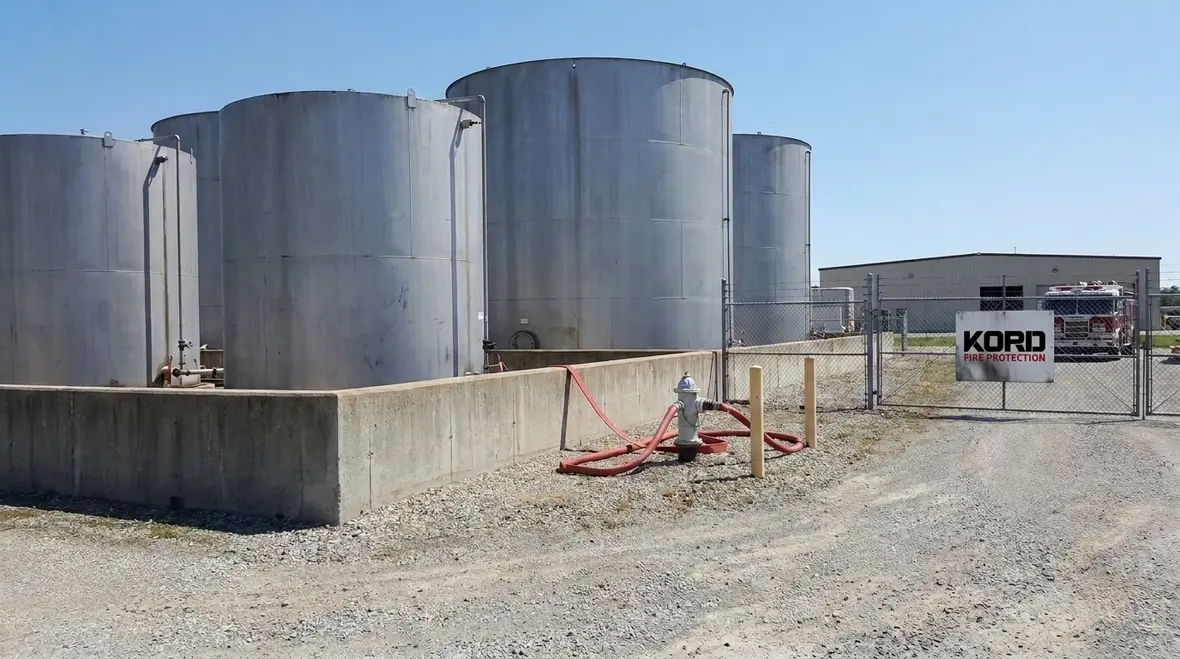
NFPA 36 Section 5.2: Location and Siting of Bulk Solvent Storage
Quick Answer
NFPA 36 Section 5.2 requires facilities to site bulk solvent storage to reduce ignition risk, limit fire and vapor exposure to people and property, and support safe operation. This includes managing distance, exposure controls, and the practical realities of installation, access, and inspection readiness.
For facilities coordinating broader fire protection planning, fire pump testing requirements are also worth reviewing early because inspection readiness tends to fall apart when life safety systems are treated like separate islands that never need to talk to each other.
What NFPA 36 Section 5.2 is trying to prevent
NFPA 36 focuses on hazards created by bulk solvent storage, especially vapor release, ignition sources, and fire growth potential. In practice, the NFPA 36 bulk solvent storage location siting requirements aim to keep flammable and combustible liquid hazards from becoming an escalation event for the entire facility. That goal shows up in how the code treats siting variables such as nearby buildings, property lines, ventilation impacts, vehicle access, spill control expectations, and how quickly fire response can occur.
Commercial sites also face operational constraints that inspection teams evaluate. Tank farms, bulk totes, solvent rooms, and loading areas must remain consistent with the approved plan. When layout changes, contractors relocate equipment, or maintenance creates new ignition potential, the facility can drift out of compliance even if tank hardware has not changed.
Key siting controls that drive compliance
NFPA 36 Section 5.2 addresses where bulk solvent storage can be located and how that location must support safe operation. While exact distances and thresholds depend on the solvent classification and storage configuration, compliance teams consistently verify the same practical control themes.
1) Separation from ignition sources and high occupancy areas
Fire safety professionals evaluate the entire “hazard map,” not only the tank footprint. Common ignition source risk comes from electrical equipment, hot work zones, vehicle traffic, heaters, HVAC air intakes, and instrumentation that can generate a spark. Siting must also consider nearby process equipment and employee exposure areas. Facilities often underestimate how quickly routine operations can turn an “isolated” storage area into a frequent traffic and work zone.
2) Separation from buildings, property lines, and exposures
Bulk solvent storage location siting must reduce flame impingement and radiant heat effects on adjacent exposures. Inspectors also look for how the site layout affects vapor travel. Even when distances are met on paper, prevailing winds, terrain, and obstructions can redirect vapor plumes toward buildings or egress routes.
3) Spill behavior and containment performance
Fire protection compliance does not stop with siting lines. The area around the storage must support safe containment and cleanup. Secondary containment, dikes, and curbing arrangements must keep released liquid within designed limits. Inspectors check whether containment capacity matches the installation intent, and whether drains and sumps remain controlled in a way that prevents unintended discharge.
4) Firefighting access and emergency response practicality
A compliant site is one responders can reach and operate. Storage locations must preserve access routes for emergency vehicles and equipment, and allow deployment without exposing firefighters to unnecessary hazards. Facilities must maintain clearance around valves, manual release points, monitoring equipment, and shutoffs.
Operationally, many failures occur when the site is “functional” day to day but not actually workable during an emergency. That includes blocked access due to pallets, parked vehicles, stacked materials, or temporary fencing that prevents rapid entry.
Common installation and maintenance failure points
NFPA 36 compliance depends on how the installation performs after the project ends. The most frequent siting-related issues typically arise during changes in operations, modifications, or inadequate maintenance of the hazard control features.
Shift from “as-built” to “as-operated” layout
Facilities frequently add equipment, reroute traffic patterns, or relocate ignition-prone processes closer to bulk solvent storage without a formal fire code review. For example, adding a temporary staging area, moving a generator, or installing new electrical fixtures can alter the ignition landscape. Inspectors evaluate whether those changes require documented review and updated fire safety measures.
Obstructions that break access and inspection routes
Even when the storage tank remains in the approved position, the operational environment can drift. Blocked access to emergency equipment, blocked labeling, and difficult-to-maintain instrumentation reduce inspection effectiveness and can delay response. Maintenance teams also sometimes store items in the siting safety area because the space “seems unused.” That assumption becomes a compliance risk.
Containment and drainage not maintained to intent
Secondary containment must remain capable and controlled. Over time, debris, corrosion, or improper drainage control can reduce containment effectiveness. Facilities sometimes connect drains incorrectly or allow water to enter containment, then fail to address how that affects spill response. Inspections often focus on whether the containment system matches the original design intent and operational procedures.
Vapor management assumptions that do not hold up
Vapor movement can defeat “line-of-distance” reasoning when the site has airflow patterns, roof overhangs, or localized wind effects. If the facility uses ventilation fans or relies on natural ventilation, maintenance and functional testing become critical. A fan that is offline, misdirected, or missing in operation can turn a safe siting concept into a risky vapor scenario.
Documentation and inspection readiness for commercial facilities
Audits under fire code enforcement typically evaluate both the physical installation and the management system supporting it. For NFPA 36 bulk solvent storage location siting, the compliance package should be practical for field use.
Maintain an “evidence-based” layout record
Facilities should keep drawings that reflect the current site condition, including tank coordinates, containment boundaries, access routes, emergency shutoffs, and nearby exposure points. If contractors adjust the site, the facility should update the layout record quickly and document the reason for change and the impact on hazard controls.
Inspection routines must verify performance, not just presence
Maintenance teams should check that key components that support safe siting remain functional. That includes valve operability, labeling legibility, secure access, spill response readiness, and any suppression or detection systems associated with the hazard control strategy. Where applicable, periodic testing of ventilation and emergency equipment must align with internal procedures and code expectations.
Train operations teams on siting consequences
Operators need to understand how daily actions influence siting compliance. Training should cover traffic flow restrictions, hot work permitting near the hazard area, housekeeping expectations for access and containment surfaces, and procedures for abnormal conditions such as leaks or unusual vapor observations.
How Kord Fire Protection supports ongoing NFPA 36 compliance
NFPA 36 compliance does not stay static. Kord Fire Protection helps commercial and industrial facilities maintain confidence that the approved bulk solvent storage arrangement continues to perform as intended. Support can include inspections, testing coordination, documentation assistance, and maintenance planning that aligns with operational realities.
To explore service options for your facility, visit Kord Fire Protection to discuss inspection readiness, risk-based planning, and code-aligned documentation.
Frequently Asked Questions
Next step: verify your siting controls now
Schedule a focused compliance review of your bulk solvent storage arrangement to confirm that the NFPA 36 bulk solvent storage location siting controls still match today’s operations. Kord Fire Protection can help validate site access, ignition source separation, containment readiness, and inspection evidence so you can reduce enforcement surprises and maintain operational confidence. Contact Kord Fire Protection to start with a practical gap assessment.

Join Our Newsletter!
Get the latest fire safety tips delivered straight to your inbox From our Newsletter.



