
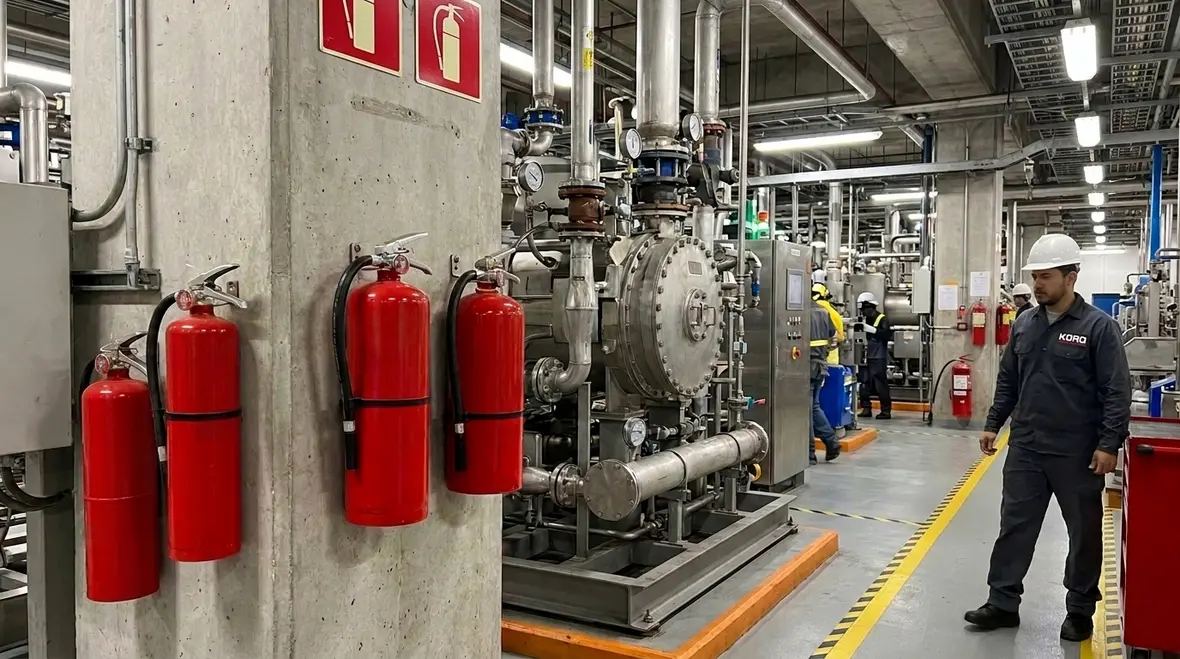
NFPA 34 Section 9.11: Portable Fire Extinguishers for the Processes
Quick Answer
NFPA 34 Section 9.11 sets performance, placement, and readiness expectations for portable fire extinguishers used in process areas. The requirements focus on selecting the correct extinguishing agent, ensuring proper mounting, maintaining serviceability through inspections, and following the standard’s maintenance and replacement intervals to support rapid employee response.
If you are tightening up your extinguisher program overall, Kord Fire Protection fire extinguisher services can help connect inspections, maintenance, and documentation before small gaps turn into ugly audit surprises.
Why NFPA 34 portable fire extinguisher requirements matter in process facilities
Process environments introduce unique fire and risk dynamics. Ignition sources, flammable liquids, combustible dusts, energized equipment, and rapid fire growth can combine in ways that standard office or light commercial guidance does not cover. NFPA 34 portable fire extinguisher requirements address how portable units integrate into the facility’s emergency response plan, including correct extinguisher selection and readiness in locations where employees must act before the fire escalates.
Commercial facilities that follow NFPA 34 typically still face operational gaps in the real world: extinguishers mounted where access is blocked, incorrect hazards matched to the agent, missing tamper seals, outdated maintenance tags, and pressure loss that goes unnoticed until a routine check is overdue. Kord Fire Protection helps facilities close these gaps through programmatic inspection, documentation, and corrective service.
What Section 9.11 expects from portable extinguishers in processes
NFPA 34 Section 9.11 focuses on ensuring portable fire extinguishers assigned to processes are suitable for the hazard and remain available and functional. In practice, the section drives four core outcomes: proper hazard coverage, correct distribution and mounting, verified readiness, and reliable maintenance.
1) Hazard matching and agent selection
Portable extinguishers must be selected based on the types of fires likely in the process areas. Facilities often underestimate how fast hazard profiles can change during operations such as maintenance, transfer, sampling, or startup and shutdown. Even within one building, the “process side” may have different fuels, ventilation conditions, or ignition risks than storage corridors or office spaces.
From an operational standpoint, compliance requires more than “having extinguishers.” It requires mapping extinguisher classes and ratings to the hazards present, then verifying that employees can realistically use them as intended.
2) Placement that supports immediate access
Section 9.11 expectations tie into the facility’s ability to reach an extinguisher without delay. Common failure points include extinguishers installed behind open doors, obstructed by equipment, stored in cabinets that are not accessible, or located too far from the hazard area for practical first response.
Commercial and industrial sites also change layouts more often than they realize. Temporary staging, new workstations, or reconfigured process lines can move the “practical access” location even when the extinguisher mount points remain unchanged.
3) Readiness through verified condition
“There is an extinguisher” does not equal “it is ready.” Section 9.11 drives the concept of continuous readiness, including verifying visible indicators such as pressure gauge position and tamper seal integrity where applicable.
Operational compliance: inspection, testing, and maintenance routines that hold up
Portable extinguishers work only when they are maintained to an expected standard. Many facilities treat extinguisher service as a calendar task rather than a lifecycle system, which increases the risk of missing early degradation signals.
For a practical companion read, Kord Fire Protection’s annual fire extinguisher inspection guide pairs nicely with this topic and helps translate compliance language into what actually gets checked in the field.
Routine inspection: what employees and facility staff typically must verify
Facilities generally rely on a combination of staff checks and contractor inspections. The checks should confirm that extinguishers are in place, unobstructed, and show no obvious damage. Tamper seals and indicators must be intact, and gauges must show the operating range required for the unit type.
In process environments, inspection programs must also account for vibration, heat exposure, and corrosive atmospheres that can accelerate wear. That means the visual check becomes more than a simple “tag exists” activity.
Hydrostatic testing and internal maintenance: common failure points
Over time, pressure vessels can experience deterioration that requires periodic testing and servicing. The most common commercial compliance issues include missing test history, incomplete documentation, outdated maintenance records, and service intervals that do not match the extinguisher type and manufacturer instructions.
When facilities do not align maintenance to the correct extinguisher design and dates, extinguishers may remain mounted but no longer meet the confidence level required for first response. Kord Fire Protection supports documentation accuracy and ensures service events align with NFPA expectations and extinguisher design needs.
Documentation and traceability for audits and incident readiness
Operational audits often focus on traceability: can the facility demonstrate that each extinguisher in scope has an accurate inspection and maintenance history? A strong program includes an extinguisher inventory, location mapping, service logs, and a clear workflow for removing out-of-service units.
Where facilities get tripped up during real installations and process changes
NFPA 34 Section 9.11 requirements can be technically clear, but execution is where failures occur. The following issues repeatedly show up in commercial, industrial, and retail process-adjacent environments.
1) Layout drift from operational changes
Process areas often evolve. A new transfer line, a temporary enclosure, or relocated materials can affect both hazard presence and access pathways. If extinguisher locations do not reflect current operations, the facility can fall out of practical compliance even when the mount location “was correct” during a prior review.
2) Incorrect agent assumptions during renovations or contractors’ scope changes
During remodels, different contractors may bring different assumptions about what fire extinguishers “should be.” If procurement uses generic packages rather than a hazard-based selection, extinguishers may not match the actual risk profile in the processes.
3) Blocked access and cabinet misuse
Process environments introduce racks, carts, forklifts, and staged materials. If extinguishers are installed in locations that become blocked during normal operations, the extinguishers do not function as intended. The solution typically requires both physical adjustment and an access rule that operators follow consistently.
4) Maintenance backlogs hidden behind “annual” scheduling
Annual inspections can mask overdue internal servicing or testing if dates are not tracked at the unit level. A backlog increases the likelihood that a facility will discover multiple noncompliant units at the same time, which can disrupt production and increase emergency risk.
How Kord Fire Protection supports ongoing compliance
Meeting NFPA 34 portable fire extinguisher requirements requires more than periodic servicing. It requires a managed process that links hazard review, extinguisher inventory control, inspection verification, maintenance scheduling, and documentation.
Kord Fire Protection provides commercial service capabilities that align the extinguishers in process areas with real operational conditions. Facilities often benefit from extinguisher inventory mapping, maintenance tracking, and corrective action workflows that reduce the chance of inaccessible or out-of-date units remaining in service.
For more information on extinguisher program support, see: Kord Fire Protection fire extinguisher services.
Frequently Asked Questions
Next step: confirm your process-area extinguisher readiness
Review your process-area extinguisher inventory against current hazards and real access conditions, then verify that each unit has current inspection and service documentation. If you want confidence before an audit, a production shutdown, or a seasonal operations change, contact Kord Fire Protection for extinguisher inspections, maintenance coordination, and compliance documentation support.

Join Our Newsletter!
Get the latest fire safety tips delivered straight to your inbox From our Newsletter.



