
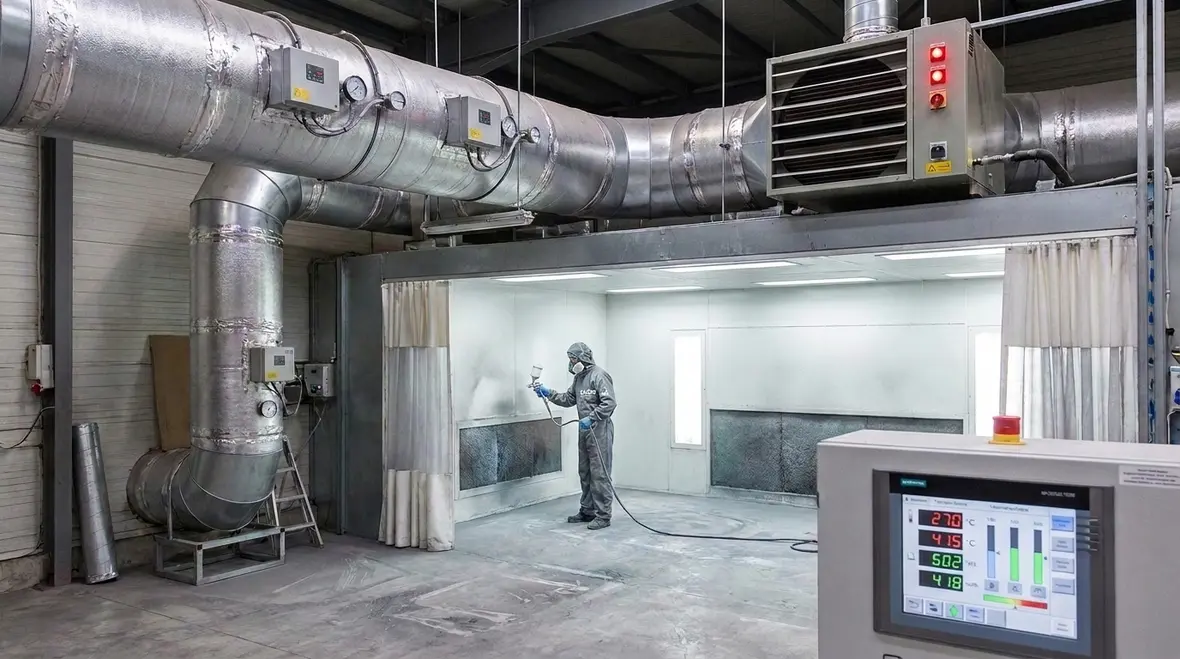
NFPA 33 Section 7.6: Heating Recirculated Air Safely in Spray Operations
Quick Answer: NFPA 33 Section 7.6 requires facilities to control ignition hazards when heating and recirculating air in spray operations. The standard emphasizes preventing ignition of flammable vapors, maintaining safe temperatures, and ensuring reliable controls, maintenance, and inspection practices for compliant NFPA 33 heating recirculated air spray operations.
Facilities managing spray hazards may also want to review spray booth fire suppression for safer paint operations for related inspection and maintenance considerations around paint booth risk control.
Why Section 7.6 matters for NFPA 33 heating recirculated air spray operations
In spray finishing environments, vapors generated during coating, cleaning, or solvent handling can form flammable atmospheres. Heating systems that recirculate air can inadvertently increase ignition risk by raising vapor temperature, concentrating contaminants, or defeating ventilation effectiveness. NFPA 33 heating recirculated air spray operations therefore rely on engineered controls that limit temperature, manage airflow, and prevent ignition sources from energizing within hazardous locations.
Compliance frequently fails not because the concept is misunderstood, but because installation details, control logic, and maintenance practices drift over time. Commercial and industrial facilities that recirculate heated air often experience issues such as sensor miscalibration, damaged duct insulation, blocked intake paths, and failed interlocks that allow heating to operate under unsafe conditions.
What Section 7.6 expects: hazard control through design and controls
Section 7.6 centers on reducing the likelihood that heated recirculated air contributes to ignition. In practice, the safety strategy typically combines four elements: (1) preventing flammable vapor accumulation, (2) limiting temperatures and energy available to ignition, (3) ensuring reliable interlocks between spray and heat, and (4) maintaining equipment to preserve the designed safety margins.
Key control objectives operators must verify
- Temperature management: Heating elements, ducts, and mixing zones must not reach conditions capable of igniting air vapor mixtures. Facilities must confirm design limits and verify that controls prevent overheating during steady state and upset conditions.
- Airflow integrity: Recirculation must not undermine local exhaust ventilation. If recirculation reduces effective removal of overspray or solvent vapor, ignition risk increases.
- Interlock reliability: Heating should activate only when the system is proven to be safe, such as when ventilation is operating as designed and spray operations are in the correct mode.
- Energy source control: Heating hardware must be installed, guarded, and protected so it does not become an unintended ignition source, especially within ducting or plenums.
Operational safeguards: how facilities should run the system day to day
NFPA 33 heating recirculated air spray operations cannot rely on “it worked last year.” They require operational discipline, because recirculating heated air interacts with solvent loading, occupancy patterns, and maintenance backlogs.
Start-up, shutdown, and mode control
Facilities should implement clear operating sequences that align heating and recirculation with spray activity and exhaust performance. The most common operational failure points include heating activation during abnormal ventilation conditions and delayed shutdown that allows residual vapors to persist while heat continues to energize.
- Start-up: Heating must not energize until airflow proof and exhaust operation meet the required criteria.
- During spray: Controls should modulate heating output without creating temperature spikes that exceed safe limits.
- Shutdown: The heating system should de-energize quickly enough to avoid heating residual vapors in ducting or within recirculation pathways.
Common commercial facility pitfalls
- Duct contamination: Overspray deposits and residue can insulate heating surfaces, elevate local temperatures, and change thermal behavior.
- Sensor and controller drift: Temperature sensors and airflow switches may drift or fail, allowing heating to operate outside design assumptions.
- Damper misalignment: If dampers or actuators stick, recirculation can become uncontrolled or exhaust can become ineffective.
- Bypass wiring: Technicians may bypass interlocks during troubleshooting and forget to restore them, creating an ongoing noncompliance condition.
Inspection and maintenance: what compliance programs should include
A strong compliance program for NFPA 33 heating recirculated air spray operations ties operational checks to documented inspection and maintenance. The goal is to detect deterioration before it becomes an ignition hazard.
Inspection focus areas
- Temperature control devices: Verify calibration, placement, and response time. Confirm that controller logic correctly enforces maximum temperature limits.
- Airflow proof switches and interlocks: Confirm correct setpoints and functional response. Inspect wiring integrity and confirm interlock logic is intact.
- Ductwork condition: Inspect for insulation damage, corrosion, overspray buildup, and obstructions that can alter airflow or cause localized overheating.
- Heater operation and guarding: Confirm that heater components are installed as designed and protected against contact with deposits or inadvertent ignition sources.
Maintenance tasks that reduce risk
- Cleaning and residue management: Establish a cleaning schedule based on coating type, solvent volatility, and observed buildup. Verify cleaning procedures do not damage insulation or protective components.
- Preventive damper and actuator service: Lubrication and inspection for sticking conditions should align with the facility’s operating hours and environmental conditions.
- Verification after repairs: Any modification to controls, ducting, wiring, or sensors should trigger rechecks of ventilation proof, heating activation criteria, and temperature limit enforcement.
How Kord Fire Protection supports NFPA 33 compliance in spray facilities
Compliance for NFPA 33 heating recirculated air spray operations depends on performance, not paperwork. Kord Fire Protection helps commercial, industrial, and retail facilities evaluate heating and recirculation systems, document condition-based findings, and support ongoing maintenance and testing workflows. This includes assistance with inspection readiness, risk-driven recommendations, and verification support so facilities can sustain safe operation between planned service cycles.
For broader fire and life safety support in industrial settings, facilities can also review Kord Fire Protection’s fire suppression services or explore Kord Fire Protection.
Frequently Asked Questions
Next step: build a defensible compliance and maintenance plan
If your spray area uses recirculated heated air, confirm interlocks, temperature control limits, duct condition, and cleaning practices before an inspection finds drift. Contact Kord Fire Protection to assess system performance, identify practical nonconformance risks, and establish a maintenance and verification approach that supports ongoing NFPA 33 heating recirculated air spray operations. Act early, document decisions, and reduce ignition exposure.

Join Our Newsletter!
Get the latest fire safety tips delivered straight to your inbox From our Newsletter.



