
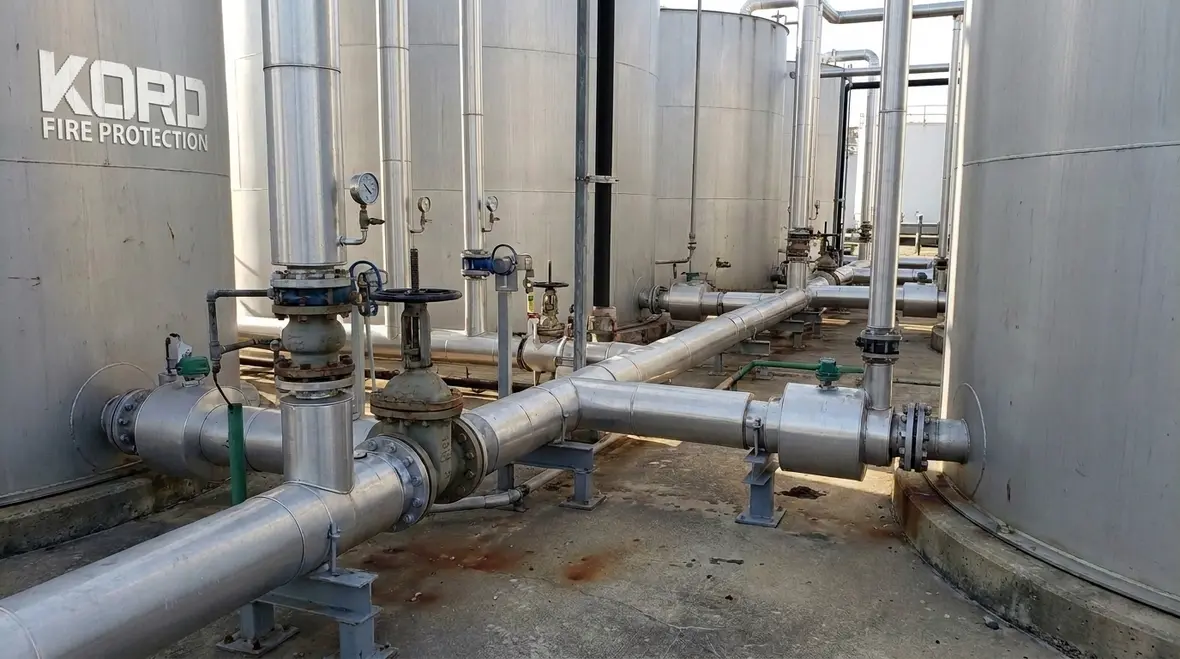
NFPA 31 Section 8.9: Piping for Cross-Connected Tanks
Quick Answer
NFPA 31 Section 8.9 governs how piping connects multiple storage tanks so fuel can be transferred safely and reliably. The requirements focus on preventing unsafe pressure conditions, limiting flow to the intended pathways, and supporting inspection and leak detection. Proper design, installation, and ongoing maintenance are essential.
If your site also needs broader code-compliant support for inspections, maintenance, and system planning, Kord Fire Protection’s fire protection services in Southern California fit naturally into the bigger compliance picture.
What NFPA 31 cross-connected tank piping is trying to prevent
Commercial facilities that rely on oil burning equipment often use multiple storage tanks to support demand, redundancy, or phased upgrades. When tanks are cross connected, NFPA 31 cross-connected tank piping rules aim to control hazards that increase with interconnections, such as unintended siphoning, flow imbalance, overpressure during transfer, and undetected leaks traveling between tanks and headers.
Practically, the goal is not just to “connect pipes,” but to ensure the cross connection behaves predictably under normal operation, abnormal conditions, and maintenance states. That includes how valves position under fault conditions, how air and vapor movement is handled, and how the system is inspected for tightness over time.
Where Section 8.9 fits in your facility’s fuel system
Section 8.9 sits within a broader NFPA 31 framework that addresses installation practices for oil burning equipment, storage, piping, valves, vents, and protection. In most commercial and industrial sites, the cross connected piping system affects:
- Delivery and transfer pathways between tanks, day tanks, and supply headers.
- Pressure and suction conditions during burner operation and fuel transfer cycles.
- Overfill and containment expectations where applicable to tank arrangements and site design.
- Commissioning and routine testing to confirm valve lineup and leak free performance.
Facilities in retail, light industrial, and commercial building categories often face the same operational problem: equipment vendors install components, but the site later changes usage patterns, consolidates tanks, or updates burners. Any update can alter flow paths and stress the cross connection in ways that were not accounted for during original commissioning.
Design and installation controls for cross connections
NFPA 31 cross-connected tank piping requirements typically drive several design and installation realities. While the exact detailing depends on the tank configuration and the facility’s operating scheme, installers must plan for the following control points.
1) Valves, valve access, and predictable lineup
Cross connections require control valves that support safe operation and controlled isolation. From a compliance perspective, the key is ensuring that valves can be positioned and verified without guesswork.
- Valves must be installed to maintain safe access for routine inspection, functional checks, and emergency isolation.
- Valve locations should support maintenance without requiring unsafe reach, removal of guards, or unsafe access to hot equipment areas.
- Systems must be designed so that a wrong lineup does not produce an unintended siphon effect or allow fuel to migrate where it should not.
2) Pipe routing and mechanical protection
Piping that interconnects tanks becomes a critical pathway. Even when the design intends safe transfer, installation quality determines long term reliability.
- Pipe supports must prevent sagging and stress on tank fittings.
- Routing must account for thermal expansion, vibration near pumps, and physical protection in traffic areas.
- Joints must be installed using acceptable methods for the fuel type and system design pressure, with attention to gasket and thread compatibility.
3) Air, venting behavior, and flow stability
Cross connected tanks can create complex air and vapor interactions. If air management is poorly planned, the system may experience unstable suction conditions, inconsistent transfer rates, or gurgling that can lead to nuisance trips and premature equipment wear. During inspections, technicians also pay attention to signs of air entrainment and abnormal burner behavior that indicate a piping control problem.
Operational failure points you should plan to inspect
Field experience shows that cross connected systems fail in predictable ways. These failure points often appear long after installation, especially after operational changes, replacement of components, or temporary bypasses during maintenance.
Unintended siphoning during shutdown
When valves are left in an incorrect state, or when check valve behavior changes due to debris or wear, fuel can move by gravity and pressure differentials. This can cause:
- Low fuel availability at the intended tank for burner operation.
- Unexpected tank level changes that complicate compliance reporting.
- Potential overflow risk if the arrangement includes fill or vent constraints.
Leak paths that do not stay localized
Cross connected piping increases the chance that a leak affects more than one tank. A small leak at a joint, a corroded section, or a compromised valve packing can become harder to detect because the system can redistribute fuel. Inspections should include checks at joints, flanges, valve stems, and accessible segments behind insulation.
Valve wear, sticking, and incorrect maintenance outcomes
Valves do not fail only by catastrophic breakage. They also fail by sticking, incomplete travel, or internal seat leakage. These issues can create slow transfer, difficult starting sequences, and intermittent burner lockouts. A robust maintenance program verifies both mechanical condition and functional performance, not just visual integrity.
Debris and degraded components in transfer lines
Debris migration from tank bottoms, sludge, or sediment can impair check valves, strainers, and seats. Even if burner performance appears normal at first, partial restrictions can increase pump load and promote cavitation. Over time, this accelerates mechanical wear and can damage seals and gaskets.
Inspection, testing, and documentation expectations
Commercial compliance success depends on consistent inspection methods and credible documentation. For NFPA 31 cross-connected tank piping, inspections typically focus on tightness, valve function, piping integrity, and evidence of safe operating behavior under normal and transition conditions.
- Valve verification: Confirm correct position, smooth operation, and evidence of seat integrity where applicable.
- Leak detection: Use suitable methods for visible leaks and investigate suspected dampness, odors, or residue trails.
- Piping integrity checks: Look for corrosion, mechanical damage, loose supports, and degraded insulation that hides leaks.
- Operational behavior: Validate that transfer behavior and burner start sequences match the system design intent.
Because facilities often undergo equipment upgrades, Kord Fire Protection commonly supports recurring compliance programs that align inspection timing with operational risk. This can include review of modifications, post installation commissioning verification, and periodic reassessment when tanks or burner systems change. For a broader installation perspective related to oil burning systems, see this practical reference: NFPA 31: A Practical Guide to Oil Burning Equipment Installation.
How to choose a compliance partner for cross-connected systems
Cross connected systems require technicians who understand fuel transfer mechanics and the documentation trail needed for ongoing assurance. When scope includes multiple tanks, pumps, valves, strainers, and burner equipment, the inspection plan must be coordinated rather than component by component.
Kord Fire Protection helps commercial and industrial sites manage NFPA 31 compliance with a practical focus on:
- Repeatable inspection routines that reduce missed access points and hidden leak paths.
- Maintenance alignment so valve service and piping repairs support correct system behavior, not just restored continuity.
- Clear reporting to support facility managers, contractors, and compliance audits.
For sites across Australia, Kord Fire Protection teams support ongoing testing and maintenance planning to keep fuel systems operating safely and in line with NFPA 31 expectations. If your facility has installed or intends to modify cross connections, early involvement reduces rework and clarifies compliance intent before the first turnover.
Frequently Asked Questions
Call to action
If your facility has cross connected tanks or is planning modifications, contact Kord Fire Protection to review your piping arrangement, valve lineup, and inspection plan. A focused site assessment helps confirm that NFPA 31 cross-connected tank piping is installed and maintained for safe operation over the full service life. Schedule a compliance discussion today to reduce rework, improve leak detection reliability, and strengthen audit readiness.

Join Our Newsletter!
Get the latest fire safety tips delivered straight to your inbox From our Newsletter.



