
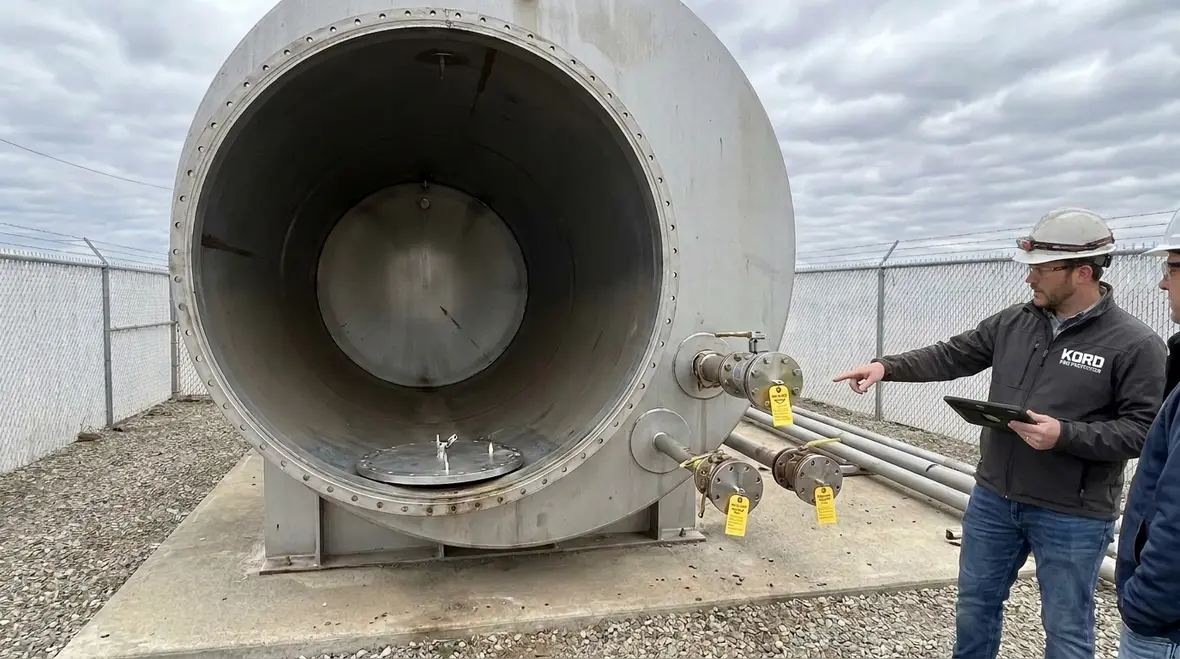
NFPA 31 Section 7.14: Permanently Taking Fuel Storage Systems Out of Service
Quick Answer
NFPA 31 Section 7.14 requires a controlled, documented decommissioning process when a fuel storage system will not return to service. The procedure focuses on safe isolation, complete removal or inerting of stored fuel, verification of no leakage or vapors, and ongoing compliance readiness.
If your team is reviewing broader fire protection impacts during equipment changes, Kord Fire Protection’s full lifecycle of fire protection servicing guide is a useful companion near the start of planning, especially when decommissioning decisions ripple into inspections, maintenance, and future readiness.
What NFPA 31 Section 7.14 actually expects during fuel storage system decommissioning
NFPA 31 Section 7.14 governs the steps and safeguards used when a commercial facility permanently removes a fuel storage system from service. NFPA 31 fuel storage system decommissioning is not a “close and forget” activity. The standard expects the owner and contractor to reduce ignition hazards and environmental risk by ensuring the tank and associated piping become incapable of releasing fuel, vapor, or pressure-forming components that could support combustion.
In practice, facilities frequently underestimate how many interconnected elements remain hazardous after “offline” status. An out-of-service tank room can still contain residual fuel, contaminated lines, trapped vapors, failed shutoff devices, and damaged vent or fill components. Section 7.14 drives the need for a verified end state, not just an operational decision.
Plan the end state first. Then control the hazards during removal
Before physical work begins, the facility should define what “permanently out of service” means for that specific installation. A compliant plan typically addresses the full fuel pathway: the storage tank, suction and fill piping, vents, relief or emergency vent arrangements, interstitial spaces, leak detection components, and any ancillary equipment that could hold or convey fuel.
1) Establish isolation boundaries
Workers must ensure that fuel cannot migrate into the tank system during decommissioning. This generally involves positive isolation of upstream supply, correct lockout and tagging, and confirmation that valves intended to remain sealed can be verified after disconnection. Common failure points include reliance on manual valves that later prove to be weeping, bypasses created during service disconnects, or reintroduction of fuel through cross connections.
2) Reduce ignition risk during cutting and draining
Fuel storage decommissioning can require venting, draining, and cutting. Each step can release combustible vapors. The safest approach uses a controlled process that limits oxygen enrichment in confined spaces and includes gas monitoring for flammable vapors. The facility should also confirm that hot work controls align with the site’s fire and hot work procedures.
3) Manage residues and contaminated components
Drained tanks often retain sludge, dissolved residues, and film in low points and internal baffles. Piping runs may hold fuel pockets at elbows and dead legs. If the facility does not address residues in inaccessible sections, vapors and contamination can re-emerge over time, undermining the “permanently” part of Section 7.14.
Control methods that typically satisfy Section 7.14 outcomes
Section 7.14 centers on ensuring the system cannot present a fuel hazard after decommissioning. While the exact method depends on tank type, configuration, and local requirements, commercial projects usually use one or more of the following verified end states.
Option A: Physical removal of the tank and piping
Where practical, complete removal provides the strongest path to eliminating future fuel release potential. A compliant project still verifies that connected piping, ancillary lines, and vents are addressed. Partial removal without clearing connected piping commonly leaves trapped fuel or vapors in remaining pipe segments.
Option B: Inerting and rendering the system incapable of containing fuel
Inerting approaches aim to prevent flammable atmosphere formation and eliminate the ability of the system to support combustion. This requires careful implementation and verification. Improper inerting can fail if air pockets remain, if inerting does not reach low points, or if vent pathways allow atmospheric exchange later.
Option C: Securing the system so it becomes nonfunctional
For some legacy assets, facilities may secure components through disconnection, blanking, or other nonfunctional modifications. The key compliance requirement is verification. “Disconnected” must mean there is no credible path for fuel or vapors to re-enter or accumulate. This typically includes documenting the configuration and confirming the status of vents, relief arrangements, and any leak detection circuits associated with the tank system.
Inspections and verification: how compliance gets proven, not assumed
Section 7.14 compliance depends on evidence. A robust closeout package usually includes testing results, photos, and system drawings updated to reflect the decommissioned state. Commercial facility teams should build verification into the work sequence so results support the “permanently out of service” claim.
Verification elements commonly required
Fuel and vapor clearance evidence: confirmation that flammable vapors are controlled and that no residual fuel remains in accessible system sections to the extent practicable.
Mechanical integrity checks: verification that disconnects, caps, blanks, and sealed interfaces cannot later permit fuel passage.
Vent and pressure component final status: documentation that vent and relief components have been addressed according to the final configuration, not left in ambiguous operating condition.
Electrical and interlock impacts: assessment of any monitoring, leak detection, alarm wiring, or control devices that may remain in place. Idle circuits can become nuisance alarms or, worse, fail to alert during unexpected conditions.
Updated diagrams and labels: updated PFD or piping schematic, tank system identification, and signage so future maintenance does not inadvertently reconnect the system.
Why commercial maintenance teams get tripped up
The most common operational issue after decommissioning involves human factors. Maintenance staff may later treat tagged equipment as safe because “it is out of service,” then perform work that reopens pathways. Clear documentation, durable labeling, and a controlled handover reduce the chance of reactivation by mistake.
Common failure points during NFPA 31 decommissioning projects
Even competent contractors can miss critical aspects of NFPA 31 fuel storage system decommissioning if the project focuses only on tank removal or line capping. The following failure points appear frequently in commercial, industrial, and retail facilities.
1) Residual fuel trapped in piping or low points
Fuel can remain in sediment traps, elbows, and sections below grade that are not accessible by typical draining methods. Without a defined residue handling plan, vapors can persist and create a future ignition risk.
2) Incomplete deactivation of vent pathways
Venting systems manage pressure and vapors during normal operation. If vent components remain in a partially functional state, the system may still exchange air and allow conditions that support flammable atmospheres under certain scenarios.
3) Reliance on shutoff valves as the only barrier
Valves can leak. Seats can degrade. Seals can be damaged during disconnection. NFPA 31 expects the system to be rendered incapable of delivering fuel as a permanent condition, not just controlled by a valve that could later fail.
4) Inadequate gas monitoring and hot work controls
Cutting and cleaning can introduce ignition sources in a vapor atmosphere. Facilities that do not integrate gas monitoring and hot work permit controls typically increase risk rather than reduce it.
How Kord Fire Protection supports safe closeout and ongoing compliance
Commercial fire safety compliance requires more than one time demolition oversight. Kord Fire Protection supports owners and facility managers through documentation, compliance readiness, and maintaining safe conditions around oil burning equipment interfaces. When a storage system changes state, downstream impacts can affect inspection routines, alarm and monitoring arrangements, and maintenance planning.
For teams managing related burner and oil heating system work, Kord Fire Protection also provides practical installation guidance here: NFPA 31 practical guide to oil burning equipment installation. Using that same practical approach helps teams maintain consistent compliance logic across installation, modification, and decommissioning phases.
Frequently Asked Questions
Next step: schedule a decommissioning compliance review
NFPA 31 Section 7.14 decommissioning succeeds when the project delivers a verified end state and a complete closeout record. Kord Fire Protection can review your installation configuration, identify likely hazard pathways, and support the documentation and readiness needed for safe ongoing operations. Contact Kord Fire Protection to plan your fuel storage system decommissioning approach before work starts.

Join Our Newsletter!
Get the latest fire safety tips delivered straight to your inbox From our Newsletter.



