
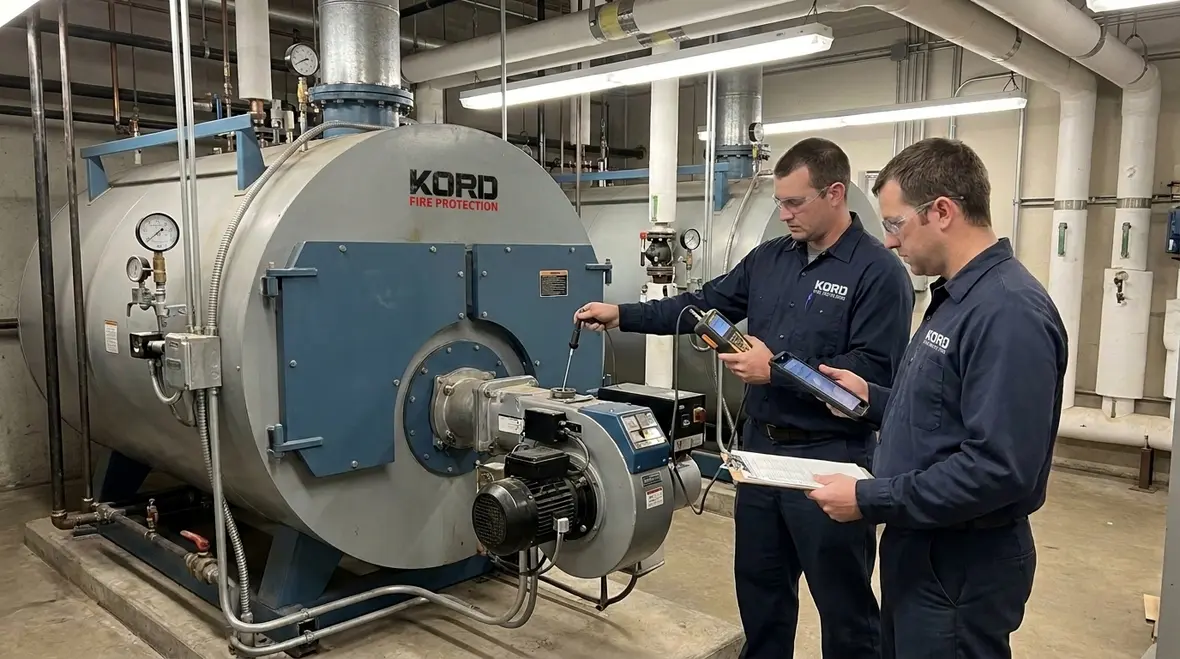
NFPA 31 Section 13.9: Testing Oil-Gas Appliances
Quick Answer: NFPA 31 Section 13.9 requires structured testing of oil and gas appliances to verify safe operation under real working conditions. Facilities should plan qualified inspections, document results, correct defects promptly, and repeat testing after repairs to maintain compliance and reduce ignition hazards.
If your team is tightening up testing workflows across the building, Kord Fire Protection’s fire protection services in Southern California offer a natural next step for inspection, testing, troubleshooting, monitoring coordination, and repairs. That broader service context fits well with appliance testing programs that need documentation discipline instead of crossed fingers and optimistic clipboard energy.
Why NFPA 31 oil gas appliance testing matters in commercial facilities
Commercial and industrial facilities rely on oil and gas fired appliances for comfort, process heat, and hot water production. NFPA 31 oil gas appliance testing is the verification layer that turns installation and maintenance work into measurable safety performance. Section 13.9 focuses on testing activities that confirm appliances operate correctly, control combustion reliably, and remain capable of safe ignition and shutdown.
In practice, the compliance challenge comes from variability: different appliance designs, mixed fuels, multiple operating modes, seasonal readiness, and maintenance cycles that can mask developing faults. This section supports a risk focused approach where testing confirms the appliance is safe after installation, after significant maintenance, and as part of ongoing program management.
What Section 13.9 expects from qualified testing
NFPA 31 Section 13.9 centers on testing oil-gas appliances to ensure safe, intended operation. While the standard is appliance and configuration dependent, testing generally verifies that combustion, controls, and protective features respond correctly to normal operation and abnormal conditions. A compliant testing program connects three elements: procedure, instrumentation, and results management.
A practical way to implement Section 13.9 within a commercial facility is to treat each appliance as a controlled system that must pass a defined sequence. The sequence typically includes:
- Pre test readiness checks, including serviceability of components and verification of setpoints.
- Execution of operational tests that confirm stable ignition and normal burner behavior.
- Verification testing of safety and control functions, including response timing and correct shutdown behavior.
- Post test actions such as recording, adjusting, and confirming that corrected conditions actually resolve the fault.
Facilities that treat testing as a one time event often miss recurring failure modes. NFPA 31 oil gas appliance testing should instead align with maintenance intervals, change management, and operational schedules for reduced downtime and better risk control.
How testing is executed on real appliances: procedures that hold up
Testing oil fired and gas appliances typically follows a repeatable operational workflow. The goal is to confirm performance across ignition, combustion stability, flame supervision, and safe shutdown. Many commercial compliance gaps occur not because the procedure is missing, but because the testing method does not isolate variables.
1) Pre test verification: eliminate false failures
Before any combustion or control test, technicians typically verify basic readiness. Common checks include gas train or oil supply integrity, electrical connections, control wiring integrity, and correct configuration for the fuel type. Where applicable, they confirm:
- Correct appliance model configuration and fuel setting.
- Clearances and access for safe operation during testing.
- Condition of burner assemblies, flame sensors or scanners, ignition electrodes, and mixing components.
- Ventilation and draft conditions consistent with the installation intent.
This step matters because blocked air passages, contaminated flame sensing elements, or incorrect draft can cause symptoms that look like safety control failures, leading to unnecessary part replacement. A controlled pre check improves the quality of the final NFPA 31 oil gas appliance testing results.
2) Operational tests: confirm ignition and stable combustion
During operational testing, technicians confirm ignition sequence timing and that the burner reaches stable combustion without abnormal cycling. Operational test focus typically includes:
- Ignition performance: reliable light off without delay or nuisance lockout.
- Flame signal verification: sufficient flame detection strength to prevent unsafe shutdown.
- Burner behavior: absence of persistent rumble, lift, or incomplete combustion patterns.
- Control response: correct response to thermostat or demand controls across operating ranges.
For commercial sites with variable loads, technicians also consider cycling conditions. A control that performs well at steady demand may fail during rapid cycling because flame detection or airflow conditions shift. Testing should therefore reflect the facility’s typical operating profile.
3) Safety and protective device testing: verify correct shutdown
Section 13.9 testing typically includes verifying that protective controls take appropriate action when conditions are outside the safe envelope. This may involve simulated fault conditions, confirmation of interlock sequences, and observation of shutdown behavior. Technicians verify that the appliance:
- Detects unsafe operating conditions through flame supervision and control logic.
- Initiates safe shutdown without unsafe restart behavior.
- Returns to a safe condition and, where applicable, enters correct lockout requiring manual reset or confirmed recovery steps.
Common failure points include degraded flame sensor sensitivity, misaligned ignition components, damaged gaskets at seals that disturb draft or mixing, and control relay drift. These issues can remain latent until testing forces the control logic to react.
Combustion performance, measurement discipline, and recordkeeping
Even when the testing focus is safety controls, commercial compliance requires measurement discipline. Many facilities fail audits because they document outcomes without describing how the appliance was tested and what conditions were observed. NFPA 31 oil gas appliance testing should include clear records that enable repeatability and traceability.
Measurement focus that supports compliance
Technicians typically use calibrated instruments to confirm combustion conditions, where required by the appliance configuration and testing scope. Measurement discipline should include:
- Instrument calibration status and suitability for the test duration.
- Stabilization time before readings are recorded, especially after burner start.
- Consistent operating points during data capture, including low fire and normal demand when feasible.
- Documentation of adjustments made to restore safe, stable combustion behavior.
Documentation that survives internal audits
Commercial facility managers need testing outputs they can use for risk reviews. Records should clearly show:
- Appliance identification and location.
- Test dates, technician details, and any pre test conditions.
- Observed behavior during ignition, steady operation, and shutdown events.
- Any corrections performed and re testing results after adjustments.
- Items requiring follow up, including parts replacement and recommended next intervals.
This level of documentation reduces downtime disputes and supports maintenance planning because it reveals trends such as recurring nuisance lockouts, drift in combustion stability, or repeating control faults.
What commonly goes wrong during NFPA 31 oil gas appliance testing
NFPA 31 oil gas appliance testing tends to uncover predictable issues that emerge from real world operation. The following failure modes frequently drive non conformances, extended outages, or repeated service calls.
- Flame sensing problems: contaminated scanners or sensors, incorrect positioning, weak flame signal, or wiring issues that cause intermittent shutdown.
- Ignition component degradation: misalignment, electrode wear, cracked insulators, or ignition transformer problems that delay light off.
- Air and draft instability: blocked air paths, improper venting behavior, pressure variations, or fans not operating as expected.
- Control logic and interlock misbehavior: faulty relays, incorrect setpoints, or miswired interlocks that skip intended safety sequences.
- Fuel supply variability: pressure changes, contaminated fuel, or regulators that do not hold stable values through cycling conditions.
- Maintenance shortcuts: incomplete cleaning, improper reassembly of burner components, or failure to verify corrected conditions through re testing.
Commercial sites that maintain multiple appliances often experience a “training gap,” where maintenance teams handle basic service but do not run full testing sequences. The result is partial compliance. A robust testing program closes that gap with defined procedures and repeatable test execution by competent service personnel.
Linking installation quality to successful test outcomes
Testing results reflect installation and commissioning quality. When appliance piping, burner assemblies, venting, and fuel controls are incorrect from the outset, testing can produce persistent faults that return after every reset. For teams responsible for upgrades or new installations, Kord Fire Protection recommends using practical commissioning and installation guidance to reduce later testing failures.
Reference: NFPA 31 practical guide to oil burning equipment installation. This resource supports the upstream work that makes NFPA 31 oil gas appliance testing faster, more accurate, and more likely to pass without recurring corrective cycles.
Frequently Asked Questions
Conclusion and next step
NFPA 31 oil gas appliance testing under Section 13.9 protects occupants and operations by confirming safe, reliable appliance performance. Commercial facilities reduce repeat faults by pairing a repeatable testing sequence with disciplined measurement and documentation, then correcting issues with verified re testing.
For practical compliance support, Kord Fire Protection can help your team plan appliance testing, close gaps found during inspections, and maintain an auditable record set. Contact Kord Fire Protection to schedule a site assessment and testing program.

Join Our Newsletter!
Get the latest fire safety tips delivered straight to your inbox From our Newsletter.



