
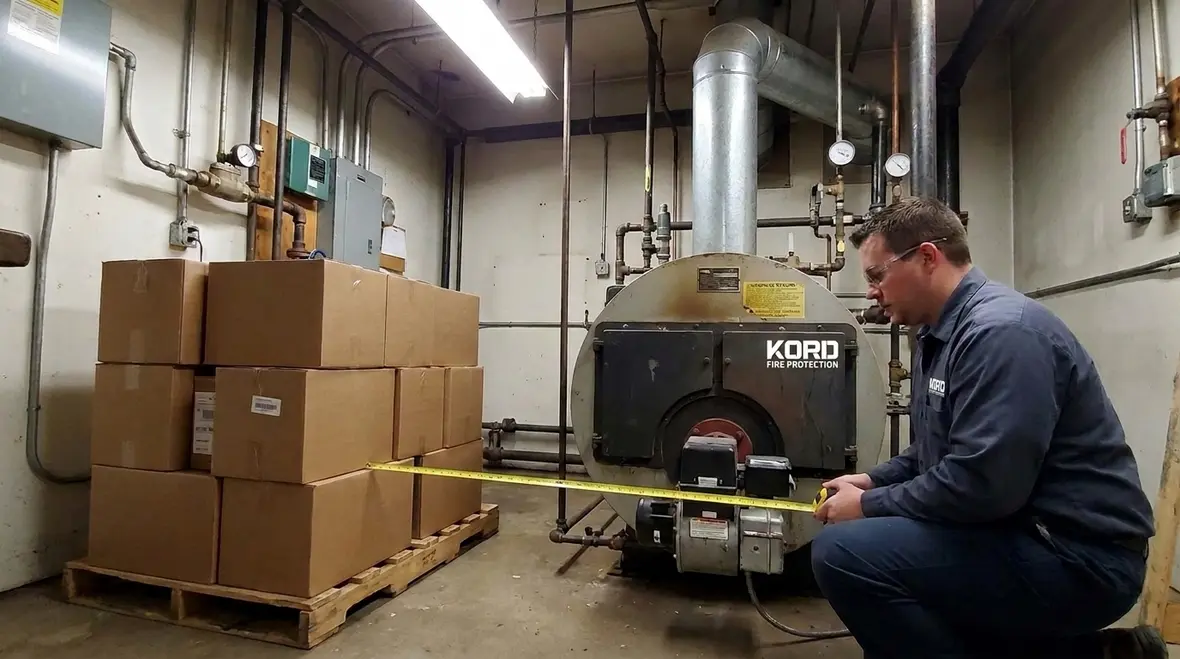
NFPA 31 Section 13.4: Combustible Clearances for Oil-Gas Appliances
Quick Answer: NFPA 31 Section 13.4 establishes minimum clearance requirements between oil gas appliances and combustible materials to reduce ignition risk from heat, flames, and hot flue products. Compliance requires verifying manufacturer listings, measuring installed distances, and controlling drapes, stored items, and insulation placement.
What NFPA 31 Section 13.4 actually controls
NFPA 31 does not treat clearance as a “best practice” recommendation. Section 13.4 sets enforceable requirements intended to prevent ignition of combustibles caused by operating temperatures, radiant heat transfer, and the potential for hot gases to impinge on nearby surfaces. In commercial, industrial, and retail settings, these clearances become a recurring compliance task because tenant fit outs, storage changes, ceiling renovations, and maintenance access can gradually reduce working space around heaters, boilers, and other listed oil gas appliances.
For facilities seeking to manage NFPA 31 oil gas appliance clearances combustible material risk, the most successful programs treat clearances as a monitored lifecycle control. They incorporate installation verification, documentation, inspection routines, and corrective actions when housekeeping, shelving, ductwork, or electrical conduits shift the clearance envelope.
If your team is also tightening up broader compliance workflows, fire protection services in Southern California can help connect inspection planning, deficiency correction, and ongoing maintenance into one practical service path.
Where the clearance problem shows up during inspections
Even when a system was installed to spec at commissioning, clearances frequently drift for predictable reasons. Fire safety professionals typically see the following failure points in the field:
- Stored combustibles creep inward: Pallets, cardboard, packaging, seasonal displays, and maintenance materials accumulate near the appliance room or vestibule and reduce the effective clearance around radiant surfaces.
- Tenant and contractor changes: New ceilings, soffits, cable trays, cable raceways, and insulation retrofits can alter the “measured” distance to combustibles.
- Inadequate maintenance access: Filters, burner access doors, and inspection panels require clearance. If contractors place combustible drop cloths, blankets, or temporary storage for convenience, they may unknowingly violate clearances during service.
- Incorrect interpretation of “combustible”: Many facilities overlook composite materials, treated wood products, plastics, foam insulation, and certain coatings that can behave as combustibles depending on construction and listing.
- Hot flue and venting effects: Clearance rules address not only the burner casing but also areas affected by hot gases, draft hood operation, or the behavior of flue components during normal firing and cycling.
Commercial compliance teams often need to translate Section 13.4 intent into a practical measurement method. That method should define where measurement begins and ends, who performs it, and how temporary conditions during maintenance get controlled.
How to verify clearances correctly (and document it)
Verification starts with the equipment itself. Listed oil gas appliances usually have manufacturer requirements that must be met. Section 13.4 supports those controls by setting a compliance baseline for clearances to combustibles. A practical verification workflow should include:
1) Confirm the installed appliance is the listed configuration
Many clearance disputes arise after modifications such as changed burners, altered draft setups, reconfigured flue connections, or swapped vent components. Clearances should be rechecked whenever appliance configuration changes, even if the appliance model name matches.
2) Measure from the appliance surfaces that create ignition potential
Clearance measurements generally need to account for radiant surfaces and areas impacted by heat flow and hot products of combustion. Inspectors should focus on zones near the burner, casing, access openings, and regions where hot gases may exit or travel. Measurements must reflect the final installed condition, including protective covers that may alter heat transfer.
3) Identify what “combustible material” includes on your site
In commercial environments, the “combustible inventory” often includes more than bare wood. Compliance programs typically document common combustible categories near oil gas appliance locations:
- Stored cartons, packaging, and palletized goods
- Ceiling tiles made of combustible materials
- Flexible hoses, tarps, and temporary insulation materials
- Foam panels and duct insulation within the clearance envelope
- Plastic cable trays and nonmetal conduits where applicable
4) Use a repeatable documentation package
A strong inspection record includes labeled photos, a marked measurement diagram, equipment tag numbers, and the date and conditions of measurement. For facilities managing multiple tenants or multiple heating rooms, consistent documentation supports trending and reduces repeat findings.
For a practical installation and compliance perspective that aligns with these clearance verification realities, facilities can reference Kord Fire Protection’s guide to NFPA 31 oil burning equipment installation for installation-focused details that directly support clearance compliance work.
What to do when clearances do not meet requirements
When inspections identify inadequate NFPA 31 oil gas appliance clearances combustible material separation, corrective actions should prioritize fire performance and operational continuity. Common corrections include:
- Remove or relocate combustibles: Establish and enforce a “no storage zone” around oil gas appliances, including routine housekeeping controls.
- Modify routing and supports: Reposition cable trays, service lines, and ductwork components that encroach into clearance space.
- Replace combustible construction: Swap combustible panels, foam insulation, or nonmetal components within the clearance envelope with materials that meet the required rating and construction intent.
- Restore the original listing arrangement: If vent components or flue connections changed, restore the configuration to the listing and manufacturer instructions before remeasuring clearances.
- Control temporary maintenance conditions: Implement a written permit-like approach for maintenance that forbids temporary storage of combustibles in clearance zones during service and shutdown.
In many commercial facilities, the most effective strategy uses proactive management. That includes training maintenance crews on measurement points, marking boundaries on the floor or wall, and creating a controlled materials staging area that never intersects the clearance envelope.
Why clearance compliance depends on ongoing maintenance
Clearances are not a one time checklist item. Oil gas appliances experience operational heat cycles, burner adjustments, and combustion tuning changes over time. These factors can influence surface temperatures, burner flame patterns, and how heat transfers into nearby structures. A lifecycle approach includes:
- Scheduled inspections: Periodic verification ensures that housekeeping, tenant modifications, and contractor activity have not changed the installation environment.
- Combustion and burner condition checks: Poor combustion, soot accumulation, or burner instability can change heat distribution and raise surface temperatures.
- Vent and flue integrity: Leaks, misalignment, or deteriorated insulation can introduce hot gas leakage pathways that increase ignition risk near combustibles.
- Component replacement discipline: Replacement parts must match the appliance listing and manufacturer instructions so clearance assumptions remain valid.
Kord Fire Protection supports commercial teams by treating clearance compliance as part of a broader NFPA 31 lifecycle program. That includes practical site verification, documentation that stands up to audits, and maintenance coordination that reduces the chance of clearance encroachment caused by routine work.
Frequently Asked Questions
Take action now: protect compliance and reduce ignition risk
Clearance compliance under NFPA 31 Section 13.4 protects people, assets, and operating continuity. A documented clearance verification, combined with a lifecycle maintenance and site control program, prevents common real world drift. Contact Kord Fire Protection to schedule a practical clearance assessment, receive prioritized corrective recommendations, and build an inspection and maintenance plan aligned with your facility’s operational needs.

Join Our Newsletter!
Get the latest fire safety tips delivered straight to your inbox From our Newsletter.



