
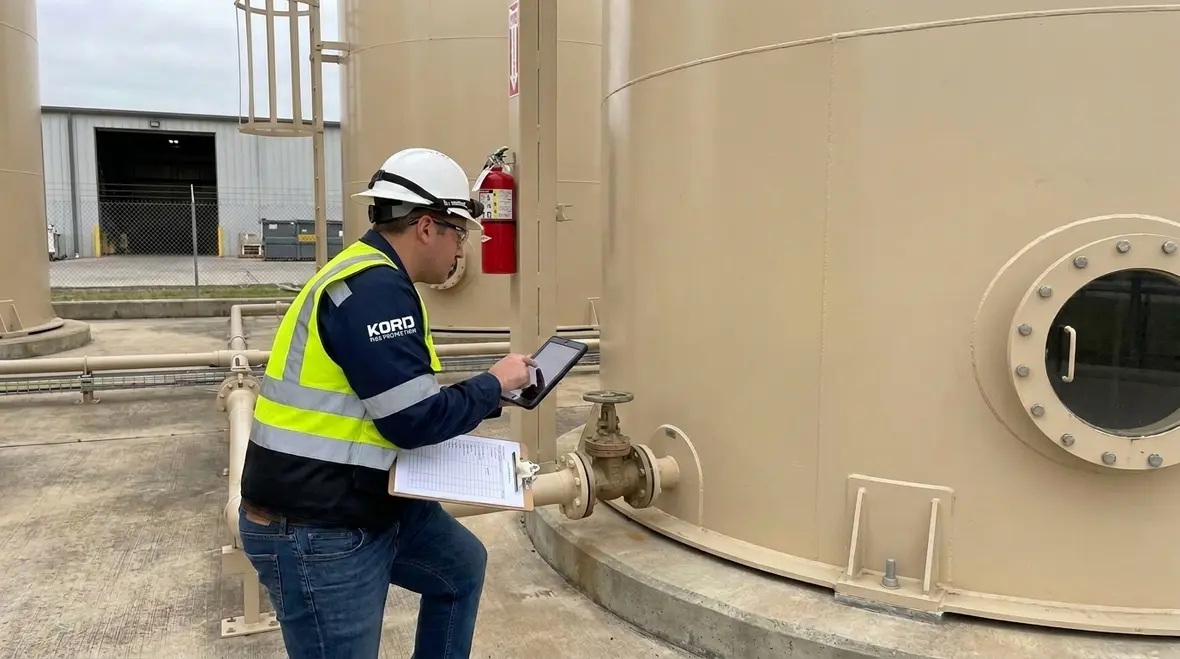
NFPA 30 Section 22.3 General Requirements for Aboveground Tanks: Compliance Guide
Quick Answer: NFPA 30 Section 22.3 sets baseline safety requirements for aboveground tanks handling flammable or combustible liquids. It addresses inspection, construction and installation expectations, protection of tank openings, and ongoing operational controls to reduce release, fire exposure, and ignition risk.
What NFPA 30 Section 22.3 general aboveground tank requirements cover
Facilities rely on NFPA 30 Section 22.3 general aboveground tank requirements to establish consistent minimum safeguards for aboveground storage. The section functions as a baseline framework that supports more specific subsections for tank design, venting, piping, fire protection systems, and operating procedures.
For commercial, industrial, and retail sites, the practical challenge involves applying these general requirements to real equipment, real maintenance workflows, and real operational deviations. Compliance stays achievable when facilities treat Section 22.3 as a living program that drives inspection intervals, documentation, and corrective actions rather than a one time installation checkbox.
For additional context on how NFPA 30 regulates flammable liquids across the storage lifecycle, review: How NFPA 30 regulates flammable liquids.
How facilities interpret “general requirements” in daily operations
Section 22.3 general requirements typically get translated into site rules that govern tank readiness, inspection evidence, and control of ignition sources. In practice, auditors and inspectors look for alignment between the written fire safety program and how tank systems perform in the field.
Facilities dealing with broader flammable liquid risks often benefit from pairing tank compliance work with a stronger protection strategy, especially where suppression planning supports higher hazard areas. A related resource worth reviewing is fire suppression systems support for high risk spaces.
Key interpretation areas
- Tank condition control: Facilities must prevent deterioration that can lead to leaks, failed seals, damaged fittings, or compromised coatings and supports.
- System integrity: Venting, emergency relief components, grounding practices, and connected piping require operational integrity so the tank does not become a release source during normal or upset conditions.
- Management of changes: Even small modifications, such as pump reroutes, new fittings, altered vent routing, or adjusted operating practices, can change fire and release behavior.
- Operational housekeeping: Leaks are often discovered through early signs. Facilities maintain controls that support early detection rather than delaying response until a visible release occurs.
Because these elements touch multiple trades, successful compliance depends on coordinated work between operations, maintenance, electrical, mechanical, and fire protection.
Installation, access, and inspection readiness: where compliance is won or lost
NFPA 30 Section 22.3 emphasizes practical readiness. Tanks exist in real yards with access constraints, vehicle traffic, and weather exposure. Inspectors expect facilities to maintain safe access and ensure components remain serviceable.
Common compliance gaps
- Restricted inspection access: Locked cabinets, obstructed manifolds, or stacked materials that prevent visual checks and safe crawling space near fittings.
- Missing or outdated documentation: Incomplete inspection records, unclear maintenance histories, or no ability to demonstrate corrective action completion.
- Impaired labeling: Unreadable placards, unclear fill points, or ambiguous identification of product type increases response time and escalation risk.
- Uncontrolled ground support and corrosion: Corroded supports, deteriorated coatings, and failing fasteners can create misalignment, vibration damage, and seal failure.
Operationally, facilities should plan inspection routes and method statements. A compliance program works when technicians can reach each critical point quickly, verify condition with consistent criteria, and document findings in a way that supports continuity during staffing turnover.
Tank openings, vents, and release prevention controls
Aboveground tanks rely on controlled interfaces. Openings, venting paths, and connected piping create the routes for both normal operating behavior and abnormal pressure or vapor movement.
Critical mechanisms inspectors focus on
- Protection of openings: Tanks require secure closure arrangements that prevent inadvertent release and support reliable containment during operations and weather events.
- Vent and relief behavior: Venting must remain unobstructed and aligned with design intent so vapor does not accumulate, overpressure does not develop, and relief does not discharge into unsafe locations.
- Connected piping integrity: Gaskets, flanges, valves, and hose assemblies must maintain tightness and mechanical stability. Weak points commonly include aging flexible connections, loose flange bolts, and degraded elastomer seals.
- Surface condition and corrosion control: Coatings and external protection slow corrosion. When coatings fail, pitting begins and can shorten service life rapidly.
A frequent failure mode occurs when maintenance activities disturb components without restoring vent alignment, valve positions, or sealing surfaces. Compliance improves when facilities use checklists that link each work order to Section 22.3 general requirements and the specific equipment manufacturer instructions.
Inspection and testing: building an auditable maintenance program
Section 22.3 general requirements are best supported by an inspection and maintenance program that creates traceability from hazard to mitigation. Auditors want to see how the facility manages degradation before it becomes a release event.
Operational procedures facilities should standardize
- Planned visual inspections: Check for wetting, discoloration, corrosion at fittings, deformation, and coating breakdown at regular intervals appropriate to product, environment, and operating cycle.
- Seal and gasket verification: Track leak repairs and confirm that replacement materials match chemical compatibility requirements and that installation torque or fitment practices follow accepted standards.
- Vent path checks: Confirm that vent terminations remain clear and that modifications have not redirected flow toward ignition sources.
- Corrective action closure: Document problem identification, risk assessment, repair method, verification testing where applicable, and evidence that the issue remains resolved.
For many sites, the real-world issue is not knowing what to check. The issue is sustaining consistent checks across rotating shifts and contractor changes. Kord Fire Protection supports ongoing compliance through coordinated inspection planning, documentation practices, and maintenance support that keeps aboveground tanks aligned with NFPA 30 expectations.
For facility managers who need an NFPA 30 focused compliance roadmap across flammable liquids, Kord Fire Protection can help map tank systems to the relevant standards and create a defensible inspection cycle. See kordfire.com.au for service coverage details.
Commercial facility realities: how to handle common risk situations
Commercial and retail settings frequently have constraints that increase the difficulty of compliance. Tight layouts, limited downtime windows, and frequent customer or staff foot traffic require disciplined risk management when performing maintenance and inspections.
Typical high-risk scenarios
- Seasonal extremes: Thermal expansion and contraction can stress fittings and supports. Freeze thaw cycles accelerate coating failure and corrosion at penetrations.
- Contractor variability: Third party technicians may perform repairs without the same checklist discipline. A robust permit and verification process prevents “temporary fixes” from becoming long-term hazards.
- Multiple products or batch operations: Switching products can require verification that residues, seals, and vent arrangements remain suitable for the new hazard profile.
- Nearby ignition sources: Pumps, electrical equipment, heaters, and vehicle operations can create ignition opportunities if a release occurs. Facilities reduce risk by maintaining equipment integrity and controlling release pathways.
In these scenarios, “general requirements” becomes a practical discipline: ensure physical condition, control openings and vent paths, maintain access for inspection, and demonstrate through records that the program functions.
Frequently Asked Questions
Conclusion and call to action
NFPA 30 Section 22.3 general aboveground tank requirements reduce risk by driving consistent inspection readiness, release prevention discipline, and auditable maintenance practices. The fastest path to dependable compliance is a program that connects operational realities to verifiable checks for openings, vent paths, fittings, and tank condition. Kord Fire Protection helps commercial facilities plan inspections, manage documentation, and keep aboveground tank systems aligned with NFPA 30 expectations. Contact Kord Fire Protection to review your current tank compliance program and inspection workflow.

Join Our Newsletter!
Get the latest fire safety tips delivered straight to your inbox From our Newsletter.



