
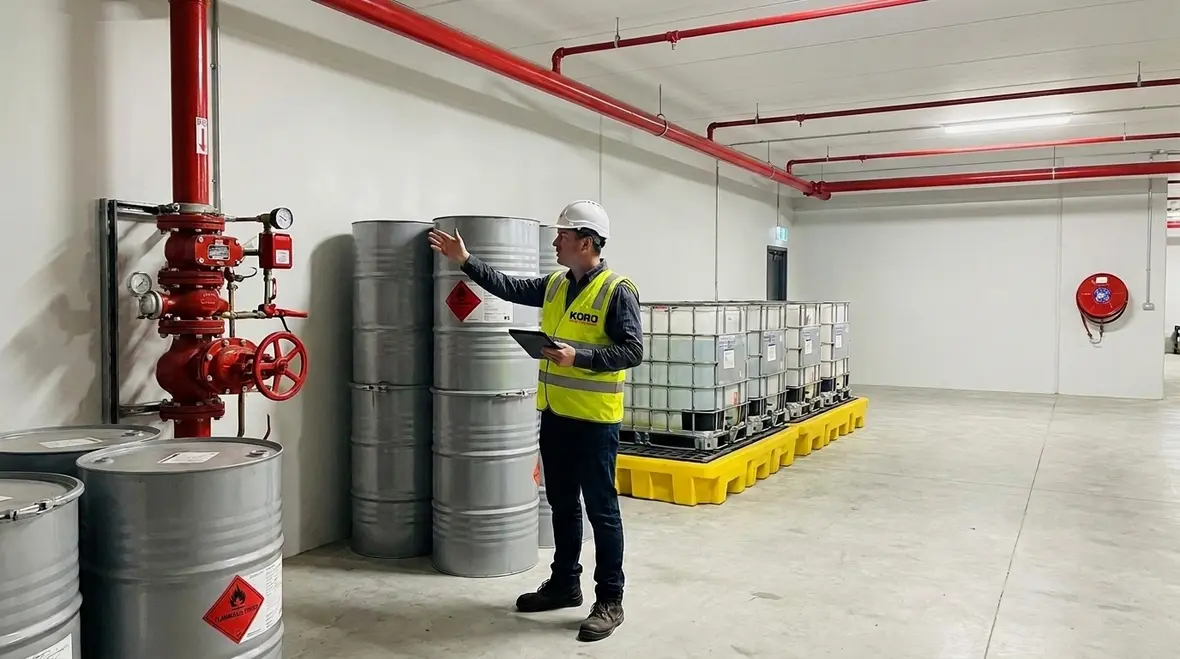
NFPA 30 Section 16.5: Fire Protection Design Criteria for Storage
Quick Answer
NFPA 30 Section 16.5 protection design criteria set the minimum fire protection expectations for storage systems handling flammable and combustible liquids. It connects design intent to safeguards like detection, separation, fire control features, and reliable operation, so facilities meet lifecycle safety needs, not just initial installation.
If your facility is reviewing adjacent liquid storage requirements too, it helps to compare this section with NFPA 30 Section 9.10 construction requirements for liquid storage rooms, especially where passive protection, inspection discipline, and storage room performance overlap. ([kordfire.com](https://kordfire.com/nfpa-30-section-9-10-construction-requirements-for-liquid-storage-rooms/?utm_source=openai))
What NFPA 30 Section 16.5 is really trying to prevent
NFPA 30 addresses fire safety for flammable and combustible liquid storage by requiring design measures that limit ignition likelihood, reduce fire growth, and protect exposures. In storage arrangements, the hazard is not only the liquid itself, but also the way the system fails under real world conditions such as valve damage, pump seal leakage, container deterioration, or obstructed egress routes for incident response.
In practice, NFPA 30 Section 16.5 protection design criteria focus on ensuring that the fire protection strategy stays effective across the full facility lifecycle. This includes commissioning, inspection routines, and ongoing maintenance that preserves the performance assumptions used in the original design.
Key requirements framework within storage design
Facilities typically encounter NFPA 30 Section 16.5 through a broader project scope that includes the storage arrangement, spill behavior, fire scenario development, and selection of protection features. The core idea is risk-based protection that remains functional when conditions shift.
1) Design must match the storage configuration
Protection design cannot treat “storage” as one uniform hazard. Tank farms, bulk cabinets, drum storage, piping corridors, and indoor warehouses each produce different fire patterns. Designers and fire safety teams must align protection features with credible fire scenarios such as a small leak becoming a spill, or a localized release escalating due to radiant heat and vapor generation.
2) Fire protection performance must be maintained
NFPA 30 Section 16.5 protection design criteria are not satisfied by initial equipment installation alone. Common compliance gaps arise when systems drift out of acceptance due to blocked drains, obstructed discharge paths, corrosion of structural supports, degraded seals, or delayed detection that reduces available intervention time.
3) Protection must consider exposures and access
Storage fire protection relies on controlling spread and protecting adjacent assets. This includes maintaining required clearances, ensuring access for fire department operations, and verifying that protective features remain effective even if primary equipment is partially compromised.
How facilities apply the criteria during design and installation
Most teams apply NFPA 30 Section 16.5 protection design criteria through documentation, hardware selection, and verification testing. The best commercial outcomes come from a tight connection between the design assumptions and the commissioning plan.
Step 1: Define credible storage fire scenarios
Designers should translate storage quantities, container types, and site layout into scenario-based hazards. This includes identifying likely leak points, potential spread paths, and where vapors can accumulate. Operational realities matter, such as transfer procedures, housekeeping practices, and normal traffic patterns that can impact obstruction or mechanical damage.
Step 2: Select protection features that fit the release behavior
Depending on the storage arrangement, protection may include detection and alarm, manual and automatic actuation concepts, fire control systems, and features that mitigate escalation. The mechanism matters. For example, passive features that rely on unobstructed discharge routes fail when a floor drain is blocked, or when spill controls cannot function due to accumulated debris.
Step 3: Commission, document, and prove operation
Commercial and industrial facilities often fall short at the commissioning stage. A compliant paper design must be validated. Typical validation items include verifying alarm and actuation timing, checking water or agent delivery where applicable, confirming that valves and controls move to the intended state, and ensuring that operating sequences match the intended response plan.
Where compliance breaks down most often in storage
In the field, NFPA 30 Section 16.5 protection design criteria are frequently compromised by recurring failure points. These issues may not be visible during walk through inspections but they show up during functional testing or real operational stress.
Common failure points
- Blocked or ineffective spill management: Impaired containment, clogged sumps, and obstructions that prevent drainage or dispersion control.
- Valve and control deterioration: Corrosion, incorrect handle orientation, or valves that do not reach required positions under tested conditions.
- Detection gaps: Devices installed but not maintained, misaligned, or operating outside acceptable sensitivity parameters.
- Inadequate maintenance records: Absence of documented inspection, testing, and corrective action history.
- Housekeeping and operational drift: Container condition changes, debris accumulation, and transfer equipment behavior that alters release likelihood.
- Access and obstruction: Storage areas become congested, limiting response and delaying fire control.
These breakdowns create a mismatch between the original design intent and the actual protection capability. Kord Fire Protection supports facilities by aligning inspection planning, testing execution, and corrective actions to the safety assumptions used in design.
Inspection, testing, and maintenance for ongoing protection
NFPA 30 Section 16.5 protection design criteria depend on continuing reliability. Commercial facilities must treat fire protection for storage as a managed system, not a one time project.
What proactive maintenance should cover
- Periodic functional testing: Verify that protection features initiate and perform as intended, with results documented and actionable.
- Condition checks on critical components: Inspect equipment for corrosion, mechanical damage, and degradation of seals, connectors, and supports.
- Verification of clearances and access routes: Confirm storage layout, signage, and access pathways remain aligned with the fire protection strategy.
- Corrective action control: Track deficiencies to closure and confirm that repairs restore the tested operating state.
Maintenance documentation that inspectors expect
Inspections typically look for evidence that equipment was maintained and tested within defined schedules, with clear records of defects and rectification. Kord Fire Protection assists teams in building compliance ready documentation and repeatable maintenance workflows, which reduces audit friction for retail, industrial, and commercial occupancies.
To strengthen context on how NFPA 30 regulates flammable liquids across storage arrangements, review this resource: how NFPA 30 regulates flammable liquids.
Commercial implementation tips for industrial and retail sites
Storage hazards show up in unexpected places in retail and light industrial environments, including maintenance supply rooms, distribution areas, and service bays. Practical compliance improves when teams coordinate design, operations, and maintenance from day one.
Operational controls that protect the design assumptions
- Transfer and dispensing discipline: Require procedures that limit uncontrolled release and ensure containers and fittings remain in service condition.
- Leak detection response: Set clear responsibility for shutting down pumps, isolating systems, and initiating a controlled response when releases occur.
- Housekeeping standards: Maintain spill control pathways and keep the area clear of obstructions that can block fire protection features.
- Training and drills: Ensure responders understand the storage layout and the intended activation concepts.
Kord Fire Protection works with facilities to keep NFPA 30 Section 16.5 protection design criteria aligned to real operations through ongoing inspection, testing, and maintenance support.
Frequently Asked Questions
Take the next step with Kord Fire Protection
Facilities that handle flammable and combustible liquids benefit from an inspection and maintenance plan built around NFPA 30 Section 16.5 protection design criteria. Kord Fire Protection helps teams verify operational readiness, document compliance, and correct recurring failure points before they become audit findings or real incident problems. Contact Kord Fire Protection to review your storage fire protection systems and establish a practical, schedule driven testing and maintenance workflow.

Join Our Newsletter!
Get the latest fire safety tips delivered straight to your inbox From our Newsletter.



