
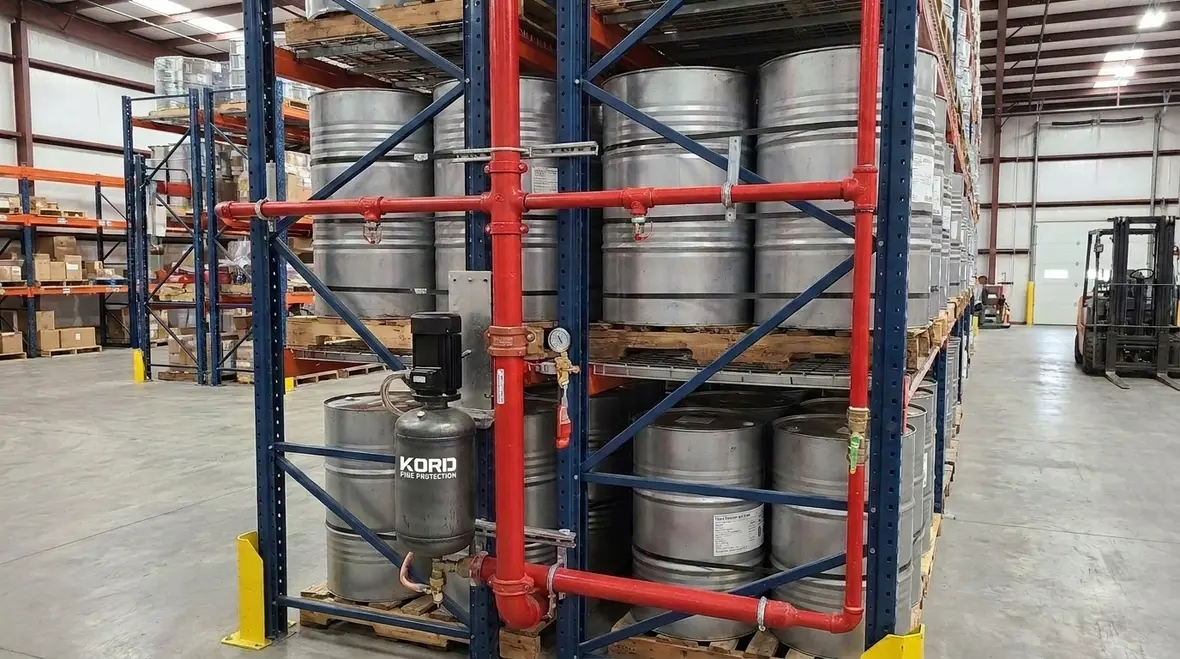
NFPA 30 Section 16.4: Sprinkler and Foam-Water Systems for Storage
Quick Answer: NFPA 30 Section 16.4 sets performance and design expectations for sprinkler and foam-water systems protecting storage hazards involving flammable and combustible liquids. It focuses on how systems control fire growth, apply foam effectively, and remain reliable through installation, inspection, and ongoing maintenance.
Commercial storage facilities often rely on engineered fire protection to manage rapid fire development. When the storage hazard involves flammable or combustible liquids, NFPA 30 Section 16.4 sprinkler foam-water storage systems drive practical requirements that affect system selection, water supply performance, foam concentrate performance, and inspection readiness.
Facilities reviewing liquid storage protection strategies often pair code interpretation with broader fire suppression system services so foam, sprinklers, and inspection planning stay aligned with the actual hazard.
What NFPA 30 Section 16.4 actually requires for storage protection
NFPA 30 Section 16.4 addresses sprinkler and foam-water protection for liquid storage hazards, with the intent that the system can reliably deliver the correct extinguishing or controlling agent to the fuel surface and the surrounding fire environment.
In practice, compliance is not only about having a system on paper. It is about meeting functional performance under realistic service conditions, including water supply characteristics, foam proportioning accuracy, and operational readiness of valves, pumps, and detection or actuation components.
For commercial, industrial, and retail occupancies that store liquids in tanks, totes, drums, or palletized packaging, the most common compliance friction points arise when the facility changes storage layout, increases liquid loading, or modifies storage arrangements without a formal fire protection review.
How sprinkler and foam-water systems work together on liquid storage
NFPA 30 Section 16.4 aligns sprinkler concepts with foam-water protection to address different fire phases and hazard exposures. Sprinklers often support control of ambient fire spread, while foam-water systems work to extinguish or suppress burning liquids by forming a blanket that reduces vapor release.
1) Water delivery and pressure stability
System reliability starts with water supply performance. Foam-water systems depend on correct flow rates to achieve foam concentration and expansion characteristics. Pressure fluctuations can cause proportioning errors, delayed actuation, or incomplete agent application.
Facilities commonly face issues such as undersized or hydraulically incompatible pumps, aging strainers and check valves, and water supply changes that reduce residual pressure. These failures tend to show up during annual flow or acceptance testing, or during periodic inspections when supply data no longer matches design assumptions.
2) Foam concentrate proportioning and expansion
Foam-water systems require accurate foam concentrate proportioning so that the system generates the designed foam quality. Proportioning errors can occur when concentrate tanks are replaced with non-equivalent products, wrong type concentrates are introduced during service, or proportioners drift out of calibration.
Expansion characteristics also matter because foam that does not achieve the expected expansion may not blanket and seal effectively. That reduces protection performance for liquid surface fires and increases the chance of re ignition after partial control.
3) Application mechanism and coverage
Successful foam application depends on proper discharge and distribution. Common application failures include blocked discharge nozzles, obstructed piping routes after storage rack changes, corroded piping causing reduced flow, or frozen sections in colder climates.
Even when the system functions during a test, incomplete coverage in real hazard configurations can occur if storage geometry changes after commissioning. This is why inspections should include a physical verification of hazard arrangement against the assumptions used in the system layout.
Common compliance challenges for commercial facilities
Commercial facilities frequently encounter the same repeatable issues when aligning operations with NFPA 30 Section 16.4 sprinkler foam-water storage systems expectations.
Operational changes that invalidate the original hazard analysis
Relocation of liquid storage areas, increased quantities, upgraded packaging, or new storage heights can change hazard exposure characteristics. A fire protection system may still technically operate, yet fail to deliver required performance for the revised hazard.
Maintenance gaps that reduce foam system reliability
Foam systems demand more specific maintenance than water-only sprinkler arrangements. Concentrate can degrade over time if improperly stored. Proportioners can drift. Valves can seize. Strainers clog. Discharge devices can accumulate debris.
Facilities often rely on routine sprinkler inspection schedules alone. That creates a gap, because foam-water components and proportioning accuracy require their own periodic testing and verification approach.
Documentation and inspection readiness
Compliance depends on evidence. That includes maintenance records, test results, foam concentrate documentation, proportioner calibration evidence, and updated plans reflecting as built conditions.
During compliance reviews, incomplete records often become the main driver of remedial action, even when the system hardware appears serviceable.
Coordination with flammable liquid risk context
Understanding how flammable liquid hazards are regulated helps align sprinkler and foam strategies with facility risk control. Kord Fire Protection provides additional context on how NFPA 30 regulates flammable liquids, including key themes that influence storage hazard classification and protection strategy: how NFPA 30 regulates flammable liquids.
Inspection, testing, and maintenance that keep systems compliant
Section 16.4 expectations translate into recurring service tasks that must be documented and executed by qualified personnel. The highest value inspections look beyond basic operability and confirm that foam-water delivery remains consistent with design intent.
What to prioritize during inspections
- Physical condition of foam system components: check for corrosion, leaks, and environmental damage to piping, proportioners, valves, and discharge devices.
- Operational readiness: verify that actuating components, indicating devices, and manual controls align with the documented operating sequence.
- Hazard configuration verification: confirm that storage layout, rack spacing, and obstruction risks have not changed since commissioning.
- Water supply fitness for purpose: confirm that fire pump or pressure sources remain aligned with hydraulic design requirements.
Testing focus areas during acceptance and periodic service
- Proportioning performance: confirm foam concentrate accuracy and consistent delivery under expected flow conditions.
- Discharge integrity: evaluate nozzle or outlet condition, distribution patterns, and blockage risks based on the hazard area coverage needs.
- Valve and control functionality: ensure correct actuation response, full travel, and reliable indication.
- Strainer and flow path maintenance: confirm that strainers and check valves remain free of restrictions that can reduce delivery performance.
For facilities that store liquids continuously, system downtimes must be controlled. Kord Fire Protection supports planning that reduces operational disruption while still meeting inspection and testing expectations for commercial readiness.
Why Kord Fire Protection supports NFPA 30 Section 16.4 compliance
Commercial systems under NFPA 30 Section 16.4 sprinkler foam-water storage systems requirements involve both fire engineering and hands-on maintenance control. Kord Fire Protection positions as a dependable service partner for ongoing compliance because it addresses the two biggest real-world risks: performance drift over time and documentation gaps during audits.
Typical support includes system verification, maintenance execution, and compliance record management that aligns technical service work with inspection outcomes. That combination helps facilities keep protection reliable, limit business downtime during service windows, and reduce repeat corrective actions.
Frequently Asked Questions
Get your storage protection program validated
Facilities that manage flammable and combustible liquid storage need more than routine checks. Arrange a targeted review of your sprinkler and foam-water systems against the intent of NFPA 30 Section 16.4, including hazard configuration, proportioning performance, water supply stability, and maintenance record readiness. Kord Fire Protection can help identify risk gaps early and support practical compliance actions before audits and operational disruptions.

Join Our Newsletter!
Get the latest fire safety tips delivered straight to your inbox From our Newsletter.



