
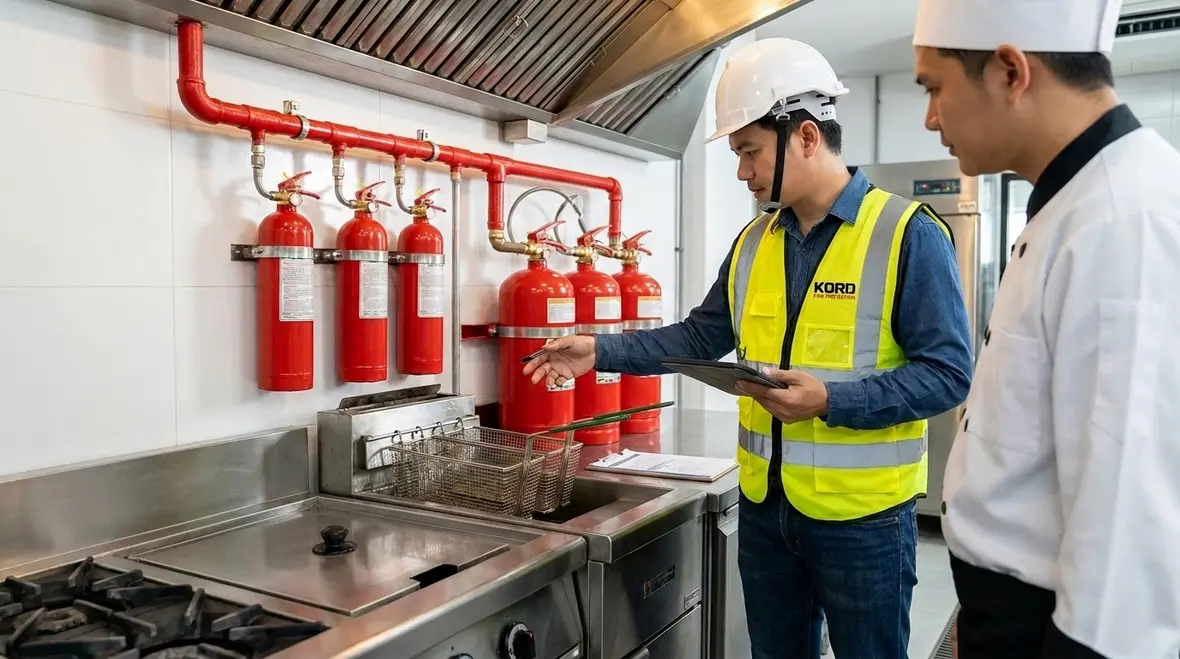
NFPA 17A 7.2 Review and Certification Process for Wet Chemical Systems
Quick Answer
NFPA 17A section 7.2 establishes how authorities, installers, and service organizations verify and document compliance for wet chemical fire extinguishing systems. The process focuses on system integrity, correct installation of listing components, and completion of required inspections, tests, and certification paperwork after acceptance.
What NFPA 17A 7.2 Requires for Review and Certification
NFPA 17A 7.2 review and certification wet chemical installation actions ensure a wet chemical system performs as designed during fire conditions. The certification review process typically covers the as-built configuration, component listing and approvals, installation alignment with design requirements, and the completion of acceptance testing and maintenance readiness. Commercial facilities such as restaurants, retail kitchens, industrial break rooms, and mixed-use occupancies often experience compliance delays when documentation, tag histories, or device settings do not match the approved design.
In practice, the “review” phase validates that the system that exists on site matches the design intent and required installation standards. The “certification” phase then confirms that the work is complete, tests were performed correctly, and the responsible parties have documented the results in a format that can withstand audit and inspection scrutiny.
Step by Step: How the NFPA 17A 7.2 Review Usually Works on Site
Before certification work gets too far down the road, it helps to understand how wet chemical fire suppression for commercial kitchens is expected to function in real facilities, because review only works when the installed system and the actual kitchen hazard still agree with each other.
1) Confirm the system design basis and installation documentation
Before any certification sign off, the reviewing party must verify that the system documents correspond to the installed equipment. This includes the approved drawings, hydraulic or agent distribution basis, cylinder or container arrangement, piping routes, nozzle location intent, valve configurations, and any interface equipment such as detection and release components.
Common commercial failure points include the following:
- As-built piping differs from the approved plan due to field routing changes.
- Nozzle spacing or nozzle selection does not match listing requirements.
- Release and actuation components are substituted without documented equivalency.
- Device labels, system identification, and valve charts do not match what is installed.
Facilities often attempt to close out “paper compliance” without confirming physical alignment to drawings. NFPA 17A 7.2 emphasizes that certification ties directly back to installation truth, not just submitted documents.
2) Verify component listing, approvals, and compatibility
Wet chemical extinguishing systems rely on specific, listing grade components. The review phase checks that cylinders, valves, strainers where applicable, nozzles, piping, detection or actuation devices, and release controls are compatible and approved for the system’s configuration. Even when components appear similar, compatibility matters for pressures, discharge patterns, and operation sequence.
Commercial kitchens and industrial cook lines frequently undergo remodels, equipment swaps, or ceiling modifications. When that happens, the risk increases that listed components no longer match the design criteria. A formal review should treat remodeling changes as a trigger for revalidation and documentation updates.
3) Inspect system physical readiness and install integrity
During the on site inspection, the reviewer confirms installation integrity. This includes secure mounting, corrosion and damage protection, proper identification of the hazard zone, and correct placement of nozzles and distribution components relative to cooking appliances or protected areas. The review should also include checks for proper piping support, hangers, and restraints, plus verification that all accessible components are installed for safe service access.
4) Validate acceptance and required operational checks
Certain checks are meant to prove the system can perform its intended function. The review and certification process typically confirms that acceptance testing or operational verification steps have been completed and documented. This is where many wet chemical installations lose time, because field teams may start commissioning but fail to capture evidence in a consistent way for the final certification record.
For additional background on wet chemical system concepts and practical compliance considerations, see Kord Fire Protection’s resource: Enhancing Fire Safety with NFPA 17A Wet Chemical Extinguishing Systems.
What “Certification” Looks Like After Review: Records, Tags, and Evidence
Certification under NFPA 17A 7.2 generally requires credible records that demonstrate the installation and acceptance activities align with required standards. For commercial facility stakeholders, certification documentation must be audit-ready. It should clearly show what was installed, when it was installed, and what tests or inspections were completed.
Documentation that typically supports certification
- As-built drawings or clearly reconciled redlines from the approved design
- System component identification, serial numbers where relevant, and cylinder or container details
- Functional acceptance documentation, including any operational verification results
- Correct labeling and hazard identification in the protected space
- Inspection and test records for release and detection interfaces when applicable
For many commercial owners, the biggest risk is incomplete evidence. A wet chemical installation can look correct during walkthroughs, yet still fail certification review because paperwork does not match the installed condition or because the test and inspection evidence is not traceable.
Service organizations like Kord Fire Protection support ongoing compliance workflows that reduce audit friction by maintaining maintenance and testing histories that can be used year after year across remodel cycles and tenant turnover. For more on commercial fire suppression system programs, refer to: Fire Suppression Systems.
Common Compliance Challenges in Wet Chemical Installations
Commercial environments tend to add complexity that increases the risk of issues during the NFPA 17A 7.2 review certification wet chemical installation process. The most frequent challenges come from changes to cooking equipment layouts, ventilation-driven movement in kitchen areas, and inconsistent service access for maintenance activities.
1) Appliance changes and layout drift
When an operator changes grills, fryers, ranges, or hood configurations, the hazard geometry can shift. Even small changes can affect coverage and discharge performance. A review should confirm that nozzle placement still matches the protected equipment footprint and that any obstructions remain within the rules of the design basis.
2) Incorrect nozzle targeting or distribution mismatch
Nozzles must deliver wet chemical agent in a pattern that supports suppression of cooking oils and fats. Field modifications, ceiling interferences, and unplanned structural changes can cause misalignment. Review and certification should specifically verify nozzle and discharge orientation.
3) Valve and actuation issues that block reliable release
Actuation failures rarely come from a single cause. More often, a chain of small installation problems exists, such as incomplete wiring checks, incorrect interface settings, or improper release sequence verification. Certification documentation should reflect the correct functional outcome, not just that “power was present.”
4) Maintenance readiness gaps
Even when acceptance is initially successful, future maintenance requirements must be supported by the installation. Clearance for servicing cylinders and access to valves, nozzles, and inspection points can determine whether inspections remain thorough or become skipped due to safety constraints. This is a critical commercial driver, because maintenance delays compound compliance exposure.
For system integration context and broader life safety coordination, fire pump and water supply considerations often interact with suppression system performance. If your facility uses water supply infrastructure alongside fire suppression systems, the overview at Fire Pumps can help align expectations about supporting systems during review planning.
Operational Mechanisms: Why Review Details Matter for Performance
Wet chemical performance depends on the system’s ability to properly discharge the correct agent quantity at the correct pressure and in the correct distribution across the hazard. NFPA 17A 7.2 review certification wet chemical installation process emphasizes that documentation and physical installation details directly influence real discharge outcomes.
Discharge performance and distribution integrity
Nozzle placement and piping integrity drive the uniformity and coverage needed for suppression. Reviewers must consider the installed piping system, checks for obstructions, and whether the agent path supports the design flow requirements. Any mismatch can reduce discharge effectiveness and increase reflash risk during suppression.
Release sequence reliability
Where detection and release integration exists, the review process should confirm that the release mechanism operates as intended. Certification evidence should demonstrate correct sequencing, control interfaces, and that the system can perform reliably under alarm conditions.
Agent containment and system integrity over time
Wet chemical systems also require that agent containment remains intact and that components operate within their intended limits. Review and certification should anticipate maintenance activities such as inspection, verification, and servicing intervals. If an installation makes servicing difficult, it increases the odds that future compliance checks become incomplete.
How Kord Fire Protection Supports NFPA 17A 7.2 Compliance Readiness
Commercial owners and facilities need a repeatable compliance program, not one-time sign offs. Kord Fire Protection supports the end-to-end compliance lifecycle, including installation review support, documentation reconciliation, acceptance readiness, and recurring maintenance and testing aligned with NFPA expectations and facility standards.
Because tenant operations, appliance layouts, and kitchen infrastructure change over time, a proactive service partner reduces compliance drift. That means fewer last-minute fixes during review windows, better audit outcomes, and stronger reliability across annual and long-term inspection cycles.
To align wet chemical suppression readiness with your facility’s maintenance and compliance goals, Kord Fire Protection can help you build a stable, documentation-driven process for ongoing NFPA 17A performance.
Frequently Asked Questions
Call to Action
If your facility is preparing for NFPA 17A review and certification, partner with Kord Fire Protection to verify as-built alignment, reconcile documentation, and support acceptance readiness for wet chemical installations. Start early to prevent last-minute nozzle, valve, or record mismatches. Contact Kord Fire Protection now to schedule a compliance-focused review and build a maintenance plan that supports long-term audit-ready performance.

Join Our Newsletter!
Get the latest fire safety tips delivered straight to your inbox From our Newsletter.



