
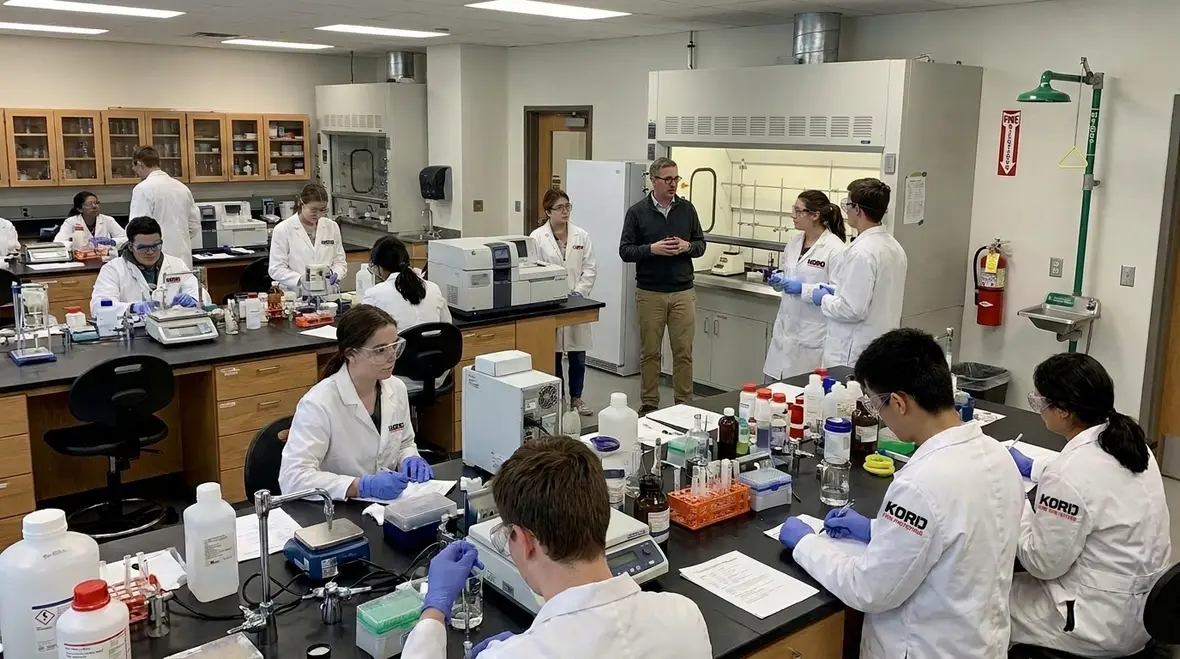
NFPA 45 Section 12.4: Other Requirements for Educational Labs
Quick Answer: NFPA 45 Section 12.4 identifies additional life safety and fire protection obligations for educational laboratory operations beyond the general lab provisions. It focuses on practical controls, documentation, and maintainable safeguards that support safe experimentation, emergency readiness, and ongoing compliance in commercial and academic facilities.
For facilities reviewing related campus fire protection concerns, Kord Fire Protection also outlines practical system planning in school fire suppression systems for classrooms and labs, which fits naturally alongside Section 12.4 expectations for changing educational environments.
What NFPA 45 Section 12.4 requires in educational laboratories
NFPA 45 educational laboratory other requirements apply to laboratory spaces where training, research, and hands on instruction occur. Section 12.4 is not just a checklist of “extra rules.” It typically captures the gap between broad lab requirements and the day to day reality of how educational labs operate: changing experiments, mixed chemical inventories, frequent student turnover, and variable equipment use. The intent is simple: fire protection systems and procedures must remain effective as the lab changes.
In practice, compliance teams often encounter repeat issues tied to maintainability, oversight, and documentation. Many facilities can meet the initial install condition, but struggle to keep the protective measures aligned with evolving instructional activities, non routine hazards, and inspection records.
How Section 12.4 fits with overall lab compliance
Section 12.4 “Other Requirements” works as an add on layer to the broader NFPA 45 laboratory framework. The section generally supports three outcomes:
- Operational readiness: Controls and emergency functions must be available and usable when experiments change or a student activity creates an unexpected hazard.
- Maintainable safeguards: Systems, features, and protective measures must remain in acceptable condition through testing, servicing, and corrective action.
- Accountability for education environments: Personnel turnover and frequent procedural changes require training alignment, clear responsibilities, and enforceable practices.
For commercial, industrial, and retail settings that host educational programs, vendor training, or workforce development labs, Section 12.4 is a reminder that the “educational” label does not reduce fire safety expectations. The built environment still requires reliable detection, suppression where applicable, hazard control, and documented procedures.
Core compliance challenges that trigger NFPA 45 educational laboratory other requirements findings
1) Variable experiment scope and housekeeping drift
Educational labs run multiple experiments, often with short turnaround times. This increases the likelihood that waste handling, storage locations, ignition source controls, and containment practices do not match the lab’s current operating plan. Section 12.4 style requirements are frequently enforced through the lens of operational control: whether the facility can demonstrate that safe conditions continue as the instructional activity changes.
Common failure points:
- Improper waste segregation at student workstations
- Accumulated combustibles near burners, hot plates, or electrical panels
- Storage that is “temporary” but lasts for weeks
- Inconsistent labeling for containers and waste streams
2) “Installed” does not mean “maintained”
Many safety elements in laboratory spaces involve ongoing verification, such as alarm interfaces, doors and latching features, emergency egress pathways, and other engineered safeguards. Section 12.4 expectations align with the idea that inspection and maintenance must be active and traceable, not periodic in name only.
Common failure points:
- Maintenance records that do not clearly connect inspection results to corrective actions
- Out of service tags that remain after repairs
- Delayed restoration of impaired detection or suppression equipment
- Improper testing intervals for critical components
3) Training and supervision gaps during student turnover
Educational labs often experience rapid turnover across classes, semesters, and shifts. Even well engineered spaces can fail when procedures are not enforced consistently. Section 12.4 supports stronger accountability, typically requiring that personnel understand the hazards of their experiments and the safeguards that protect them.
Common failure points:
- Training provided once per term but not reinforced when procedures change
- No clear oversight plan for high risk activities
- Inconsistent response instructions across instructors or teaching assistants
Operational procedures and inspection behaviors that hold up under scrutiny
To satisfy NFPA 45 educational laboratory other requirements, facilities should align procedures, verification, and correction cycles. The objective is not only to pass an inspection, but to prevent recurring conditions that degrade safety over time.
Documentation that is usable during real operations
Inspection readiness depends on documentation that reflects current conditions. Facilities should maintain:
- Up to date inventory and risk categorization practices for instructional chemicals
- Emergency response and evacuation guidance for lab occupancies
- Inspection and testing records that show completion status and corrective action closure
- Impairment management practices for any equipment that must be taken out of service
Routine verification and corrective action speed
NFPA 45 compliance in educational settings typically becomes fragile when corrective action lags. A facility may accept minor deficiencies during busy academic schedules, but those conditions can grow. Effective programs include:
- Defined responsibility for identifying and reporting hazards
- A short time window for addressing critical issues
- Clear escalation paths to facilities management and safety leadership
- Follow up confirmation that repairs restored required performance
Equipment considerations and maintenance mechanisms for educational labs
Section 12.4 style “other requirements” often drive attention to how lab equipment interacts with fire protection features. Educational labs frequently add or reconfigure equipment, which can alter risk patterns. Facilities should plan maintenance around these change cycles.
Detection, alarm interfaces, and response coordination
Fire alarm and detection systems should remain dependable despite increased nuisance conditions, frequent lab door use, and equipment rearrangement. Facilities should verify that alarm response instructions are understood by instructors and teaching support staff, not only facility administrators.
Means of egress and lab layout changes
Educational labs commonly reconfigure benches and experiment stations. Safety teams should ensure that egress pathways remain clear, that doors required for fire protection remain functional, and that any temporary barriers or storage do not obstruct evacuation.
Fixed suppression and specialized protection components
Where suppression exists, maintenance practices should match the manufacturer requirements and the facility’s operating profile. In educational labs, activation testing and inspection intervals must consider realistic usage patterns, response times, and the likelihood of localized hazards.
Why Kord Fire Protection supports ongoing NFPA 45 compliance
For many institutions, compliance fails not at initial installation, but at sustained performance across semesters, seasonal facility changes, and evolving experiment plans. Kord Fire Protection helps commercial owners, industrial operators, and facility teams maintain operational fire protection through inspection, testing, service coordination, and documentation support.
If you want a practical starting point, review Kord Fire Protection’s guidance on commercial fire alarm services in Southern California to strengthen readiness and confirm that detection and alarm systems remain aligned with real operational needs in educational laboratory spaces.
Frequently Asked Questions
Conclusion and next step
NFPA 45 educational laboratory other requirements under Section 12.4 help facilities maintain fire safety when instructional activities, chemicals, and equipment change frequently. The most effective approach is to treat compliance as an operational system: verify safeguards, tighten training and oversight, and close corrective actions quickly. Contact Kord Fire Protection to assess current inspection and maintenance practices and build an ongoing program that supports consistent readiness across semesters and facility updates.

Join Our Newsletter!
Get the latest fire safety tips delivered straight to your inbox From our Newsletter.



