
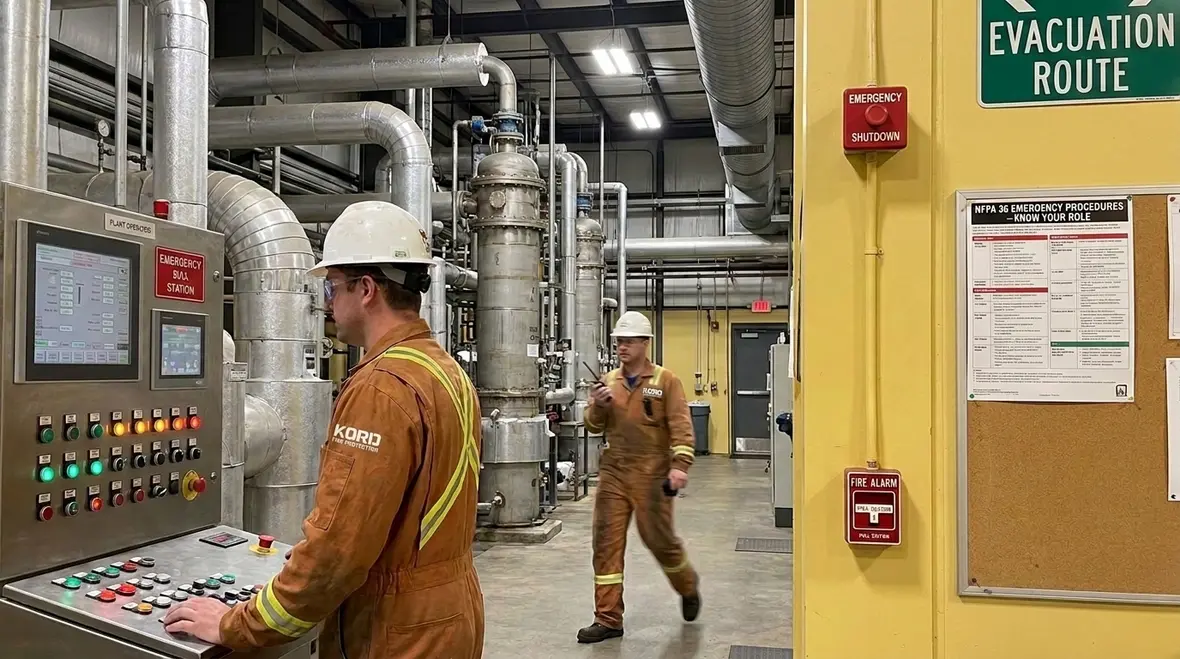
NFPA 36 Section 4.11: Emergency Procedures in the Plant
Quick Answer: NFPA 36 Section 4.11 requires solvent extraction facilities to maintain clear, trained, and tested emergency procedures tailored to hazards like flammable solvent releases, fire, injuries, and power or ventilation failures. Effective plans specify roles, alarms, evacuation, firefighting coordination, and post incident recovery.
For facilities building out stronger emergency planning workflows, it also helps to review building fire safety emergency planning for commercial facilities so the written response plan matches how people actually move, communicate, and react when the pressure is on.
What NFPA 36 Section 4.11 expects from emergency procedures
In a NFPA 36 emergency procedures solvent extraction plant, emergency preparedness focuses on preventing small events from escalating into major fire, explosion, or exposure incidents. Section 4.11 establishes the expectation that the facility will have documented procedures, communicate them effectively, and maintain them in working order through training, drills, inspections, and updates based on changes in processes, equipment, or building operations.
For commercial, industrial, and retail environments running solvent extraction operations under shared site services, the practical compliance challenge is consistency: the emergency plan must work across shifts, contractors, and evolving production conditions. The strongest programs align written procedures with the actual plant layout, detection coverage, fire protection systems, emergency power behavior, and the realities of how quickly staff can access valves, extinguishing equipment, and ventilation controls.
Build the plan around solvent hazards, credible scenarios, and clear roles
NFPA 36 emergency response planning should map hazards to actions. In solvent extraction operations, credible scenarios commonly include solvent vapor releases from connections, leaks at transfer points, abnormal heating, off normal ventilation performance, ignition of flammable atmospheres, and delayed recognition during shift changes. Procedures should explicitly cover what triggers an emergency response and who takes control when conditions deteriorate.
Define responsibilities that match the shift reality
Emergency procedures work only when the chain of command is clear. The facility should assign roles such as incident commander, alarm operator, controller for ventilation and process shutdown, first aid responders, and the person responsible for contacting fire services. Because solvent extraction plants often operate with rotating shift supervision and contractor coverage, the plan should include alternates and coverage rules for weekends, night shifts, and planned maintenance outages.
Specify response actions for each phase of the incident
- Discovery and verification: Confirm alarms, identify location and solvent involved, and determine if conditions require immediate evacuation.
- Notification and activation: Initiate alarms and communications to internal teams and external responders per the site plan.
- Control of hazards: Initiate shutdown steps, isolate sources, and coordinate ventilation and process controls.
- Firefighting coordination: Ensure procedures guide safe access, water or foam readiness where applicable, and coordination with arriving fire services.
- Evacuation and accountability: Guide routes, muster points, accounting method, and management of visitors and contractors.
- Post incident stabilization: Secure the area, prevent re ignition, preserve evidence, and document actions.
Training, drills, and communication that withstand real incidents
Compliance is not achieved by a binder. Emergency procedures must perform under stress: loud alarms, limited visibility, staff turnover, and concurrent maintenance activities. Facilities should standardize training so that every operational role can execute its tasks consistently.
Training topics that matter in solvent extraction plants
- Recognition of flammable solvent behavior, ignition sources, and vapor accumulation risks.
- Hands on familiarity with emergency shutdown controls, isolation valve locations, and interlocks.
- Use of evacuation maps and muster point procedures, including contractor and visitor accounting.
- How to report incident location details accurately to dispatch and incident command.
- Basic first aid coordination and spill control boundaries when applicable to the site.
Drills should test weaknesses, not only the script
Drills should vary in timing and conditions, including different shift staffing patterns and scenarios that test decision making. Common failure points include delayed recognition of solvent vapor conditions, unclear access to emergency controls, inconsistent shutdown execution, and radio or alarm acknowledgment problems. After each drill, the program should track corrective actions, assign owners, and verify closure through follow up training.
Equipment readiness: alarms, detection, ventilation, and emergency power
Emergency procedures depend on the plant’s ability to alert people, control hazards, and maintain critical functions. In a solvent extraction facility, emergency readiness often hinges on detection reliability, alarm audibility, ventilation behavior, and the proper operation of emergency power systems.
Alarm and notification performance
The facility should ensure that alarms used for evacuation and emergency response activate reliably and remain audible in typical background noise conditions. Procedures should include what to do when alarms malfunction, including escalation pathways and manual notification methods.
Detection and monitoring reliability
Flammable vapor detection and related monitoring should be maintained according to the manufacturer and applicable standards. A frequent operational gap is maintaining hardware while failing to verify calibration outcomes, alarm set points, and response times. Emergency procedures should include actions if detection is down, including increased supervision, alternative monitoring, and adjusted shutdown triggers.
Ventilation and process shutdown coordination
Where ventilation is part of the hazard control strategy, procedures should state how to transition from normal operation to emergency mode. The plant should confirm that controls function as intended during power loss or emergency power transfer, and that operators understand the expected sequence.
Emergency power behavior and critical circuits
Many emergency systems depend on emergency power, including alarm devices, critical monitoring, and selected controls. Testing should confirm that the emergency power system starts within expected timeframes and supports the required load. Procedures should reflect what happens if emergency power fails, including immediate shutdown and evacuation priorities.
Inspections, maintenance, and documentation that support continuous compliance
NFPA 36 emergency procedures solvent extraction plant programs succeed when maintenance, inspection, and documentation are treated as safety controls. The facility should maintain records that demonstrate the plan remains current with operational changes and equipment condition.
Operational change management
Documented procedures should be updated when the facility changes solvent types, modifies transfer piping, adds equipment, alters ventilation configurations, or changes staffing patterns. This is a common compliance blind spot during expansions, reroutes, or contractor driven commissioning.
Common failure points during audits
- Out of date contact lists for incident response and fire service coordination.
- Drill records that lack scenario variety or do not capture corrective action closure.
- Shutdown control ambiguity where multiple valves or switches exist without clear operator instruction.
- Incomplete maintenance evidence for alarm, detection, ventilation, and emergency power components.
- Inconsistent contractor onboarding that leaves temporary workers unfamiliar with evacuation routes and reporting methods.
For ongoing program strength, Kord Fire Protection supports commercial facilities with documentation, testing alignment, and maintenance planning so that emergency procedures remain reliable across seasons, staffing cycles, and equipment changes. For a broader view of fire protection system program practices, see Kord Fire Protection’s resource on fire protection services and compliance support.
How to make your emergency procedures operationally usable on day one
Many facilities fail because procedures do not translate into actions under pressure. A usable program provides quick reference guidance at the point of decision, while still maintaining full documentation for auditors and management review.
Practical job aids and field alignment
- Post clear evacuation maps near workstations and control rooms, aligned to actual routes.
- Provide concise emergency action cards that mirror the approved shutdown and isolation steps.
- Ensure supervisors carry the most current emergency contact and escalation guidance.
- Verify access to emergency controls during routine operations and during maintenance lockout conditions.
Integrate with site wide emergency response
For multi tenant or retail adjacent industrial sites, emergency procedures should coordinate with shared alarm systems, security response, and fire service entry routes. Consistency reduces confusion when responders arrive and when staff coordinate accountability at muster points.
Frequently Asked Questions
Call to action
NFPA 36 emergency procedures work when they are testable, maintainable, and aligned with how staff operate during real solvent hazards. Kord Fire Protection can help you strengthen compliance through targeted support for fire protection readiness, documentation alignment, and ongoing maintenance planning. Contact Kord Fire Protection today to review your emergency preparedness program and close the gaps before your next audit or high risk operating period.

Join Our Newsletter!
Get the latest fire safety tips delivered straight to your inbox From our Newsletter.



