
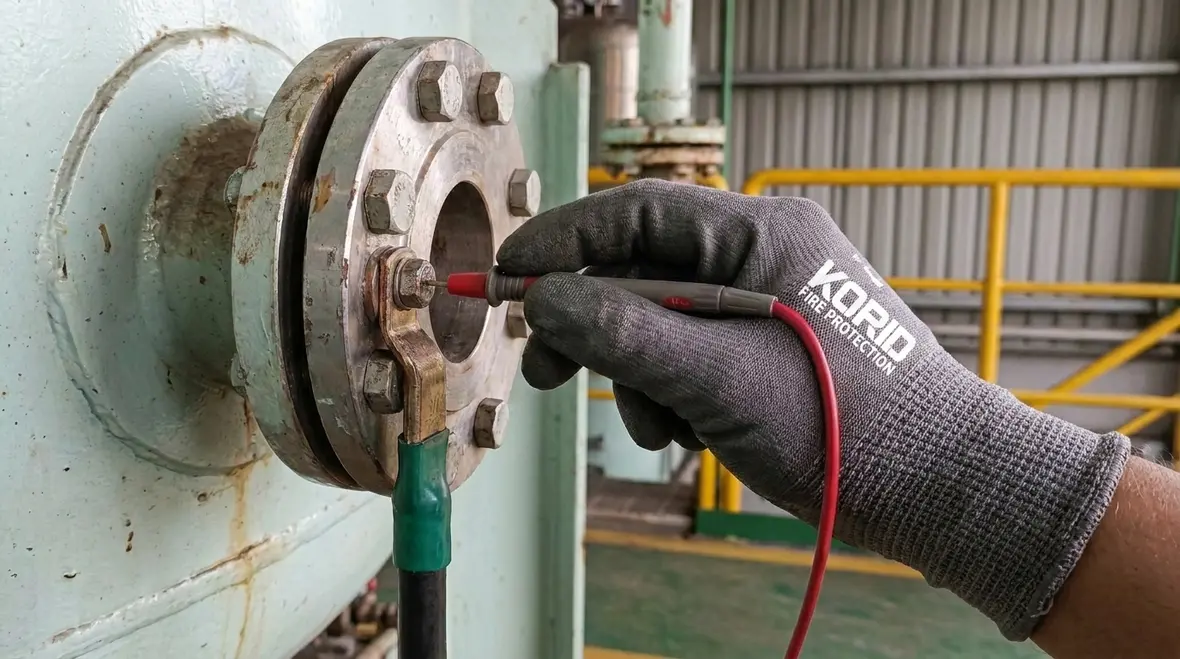
NFPA 35 Section 9.5: Static Electricity Hazards (Compliance-Ready Guide)
Quick Answer: NFPA 35 Section 9.5 requires controls to prevent ignition from static electricity in chemical, pharmaceutical, and related processing operations. Facilities must address bonding, grounding, equipment bonding continuity, material handling practices, and inspection and maintenance of protective systems.
For a broader look at how bonding integrity affects fire safety performance across facility systems, see fire safety electrical panel bonding for fault clearing. If your site also depends on pump reliability as part of its protection strategy, proactive maintenance for fire pump system reliability fits naturally into the same compliance conversation.
What NFPA 35 static electricity hazard control requirements focus on in real facilities
Static electricity can ignite flammable vapors or combustible dust when electrostatic charge generation and discharge occur without effective controls. In practice, NFPA 35 static electricity hazard control requirements target the entire ignition pathway: charge generation, accumulation, discharge energy, and the presence of an ignitable atmosphere. Section 9.5 integrates engineering controls and operational discipline so that charge cannot reach hazardous discharge conditions during normal operations, startups, transfers, and maintenance.
For commercial and industrial sites, the compliance challenge often is not the existence of written procedures. It is maintaining the effectiveness of bonding and grounding across aging equipment, modified piping runs, replacement hoses, and changing production workflows. Retail and light industrial facilities that handle flammable liquids, solvent blending, or bulk product transfer face similar risk patterns when service contractors alter systems without restoring continuity or verification.
Section 9.5 ignition risk controls: the core engineering measures
NFPA 35 Section 9.5 emphasizes measures that prevent static electricity hazards from causing ignition. The most effective controls are typically engineering based and include bonding, grounding, and equipment selection or design features that limit charge accumulation and provide safe discharge paths.
1) Bonding and grounding for tanks, piping, pumps, and transfer systems
Bonding equalizes electrical potential between conductive components so that charge does not build to a difference that could discharge across insulating gaps. Grounding provides a reference path to dissipate charge safely.
- Tank systems: Metallic tanks and connected equipment require a reliable bond between the tank and other conductive items involved in transfer and handling. Inertial or insulated connections must be evaluated so the bonding design actually reaches the conductive path intended.
- Piping and hose assemblies: Transfers using flexible hoses, reducers, or modified spools create common failure points. Many ignition events are linked to altered hoses, missing bonding jumpers, or poor contact surfaces.
- Pumps and measurement devices: Rotating equipment and instrumentation can interrupt continuity if mounted using insulating gaskets or nonconductive couplings. Field repairs often change fasteners, mounting methods, or gasket material, reducing bonding effectiveness.
2) Control of charge generation during transfer and filling
Even with bonding and grounding, charge can generate during rapid flow, splash filling, or turbulent conditions. Section 9.5 drives facilities to apply operational practices that reduce charge formation and discharge energy.
- Filling and transfer rates: Excessive velocity increases charge generation. Operations teams often increase flow to meet production schedules, inadvertently exceeding the safety basis established for the material handling scenario.
- Flow disturbance control: Splashing, free fall, and air entrainment increase the likelihood of hazardous charge. Using proper fill methods, diffusers, or return systems can reduce turbulence.
- Water and contamination effects: Some solutions change conductivity and can increase resistance to charge dissipation. A process change, even a minor one, can shift the static hazard profile.
3) Material and equipment compatibility
Static hazards rise when materials accumulate charge or when components introduce insulating barriers. NFPA 35 Section 9.5 supports selecting compatible materials and configurations that do not defeat bonding pathways.
- Nonconductive components: Valves, sight glasses, couplings, and certain liners can introduce insulation. Facilities need an engineering review when components are swapped during maintenance or procurement.
- Conductive hoses and fittings: Hoses designed for flammable liquid transfer must maintain conductivity and bonding capability over time. Wear, delamination, and end fitting changes can degrade performance.
- Wiring and connections: Corroded terminals, paint over bonding points, loose clamps, and unverified continuity are recurring commercial site findings.
Inspection, testing, and maintenance: how compliance stays real
NFPA 35 Section 9.5 requires that protective measures do not become ineffective due to degradation or poor installation practices. This means facilities must define inspection frequency, verification methods, and acceptance criteria for bonding and grounding integrity.
What inspectors typically look for
- Continuity of bonding jumpers: Bonding jumpers must be installed at required connections and remain intact after maintenance.
- Condition of bonding surfaces: Grounding and bonding points must not be isolated by paint, scale, or corrosion at the contact interface.
- Correct connection types: Clamps, brazed bonds, threaded connections, or approved mechanical connectors must match the facility’s safety approach. Improvised connections often fail under vibration and thermal cycling.
- Changes to the system: Any process or layout modification should trigger a review of the static control design, including bonding paths and the effectiveness of hose and flexible connections.
Common operational failure points
Commercial facilities frequently see these static electricity control breakdowns:
- Hose replacement without verification: Contractors swap hoses based on availability, not on static dissipation and bonding capability.
- Temporary bypasses: During outages or repairs, bonding clamps may be removed and not reinstalled, or reinstalled incompletely.
- Uncontrolled modifications: Adding a new skid, hose reel, metering package, or sampling point without restoring bonding continuity introduces new charge accumulation paths.
- Inadequate post maintenance checks: A system may pass a static control check during commissioning, but not after a gasket or flange change.
To manage this cycle, many organizations partner with Kord Fire Protection for periodic testing, documentation support, and maintenance oversight aligned with industrial and commercial operating realities. For additional insight on ignition prevention approaches and compliance support, see Kord Fire Protection.
Commercial facility implementation: procedures, training, and change control
Compliance with NFPA 35 Section 9.5 does not succeed on bonding hardware alone. It depends on procedures and the operational discipline to prevent unsafe discharge conditions during routine work.
Written procedures that operators can follow
Facilities typically implement procedures covering:
- Transfer setup: Confirm bonding connections before starting transfer. Verify hose selection and endpoints.
- Start and stop practices: Use controlled ramping and safe shutdown steps that avoid splash filling or excessive flow transitions.
- Sampling and maintenance: Define how sampling ports, blind flanges, and temporary jumpers affect bonding and when to re verify continuity.
Training aligned with how failures occur
Training should focus on human factors that drive real-world noncompliance:
- Recognizing missing bonding connections after cleaning or reconfiguration.
- Understanding why “conductive look and feel” is not the same as verified static dissipation performance.
- Reporting and addressing corrosion, loose clamps, damaged hose ends, and unapproved components immediately.
Change control and maintenance planning
A robust change control program ensures static electricity hazard controls remain valid after modifications. This includes:
- Engineering review of piping additions, skid upgrades, new meters, and new hoses.
- Updated inspection points and documentation when layouts shift.
- Post work verification that bonding continuity and grounding paths are restored to the required design.
How to document compliance for audits and internal safety reviews
Commercial sites benefit from documentation that ties the risk controls to the inspection and maintenance results. NFPA 35 Section 9.5 expectations are typically demonstrated through evidence of maintained bonding and grounding integrity, procedural controls, and responsible management of change.
Recommended documentation package
- Bonding and grounding schematic: A current one line or layout diagram showing bonding points for tanks, piping, hoses, pumps, and instrumentation where applicable.
- Inspection and test records: Logs showing the verification method, date, results, and corrective actions for out of tolerance conditions.
- Equipment list: Approved hose types, fittings, and conductive transfer accessories linked to transfer operations.
- Training records: Confirmation that operators understand transfer setup, bonding confirmation, and response procedures.
- Maintenance and repair records: Documentation of bonding jumper replacement, clamp service, and post maintenance verification.
If internal teams lack the testing capacity or need independent verification, Kord Fire Protection can support ongoing compliance through testing, documentation, and practical maintenance coordination suitable for commercial, industrial, and retail environments with flammable handling operations.
Frequently Asked Questions
Call to action
Facilities that handle flammable liquids should treat NFPA 35 Section 9.5 static electricity hazards as an active program, not a one time installation. Engage Kord Fire Protection to support testing, inspection planning, and maintenance verification so bonding and grounding controls stay effective through production changes. Start by auditing transfer points, hose assemblies, and recent modifications, then schedule verification to close gaps before the next operational and compliance cycle.

Join Our Newsletter!
Get the latest fire safety tips delivered straight to your inbox From our Newsletter.



