
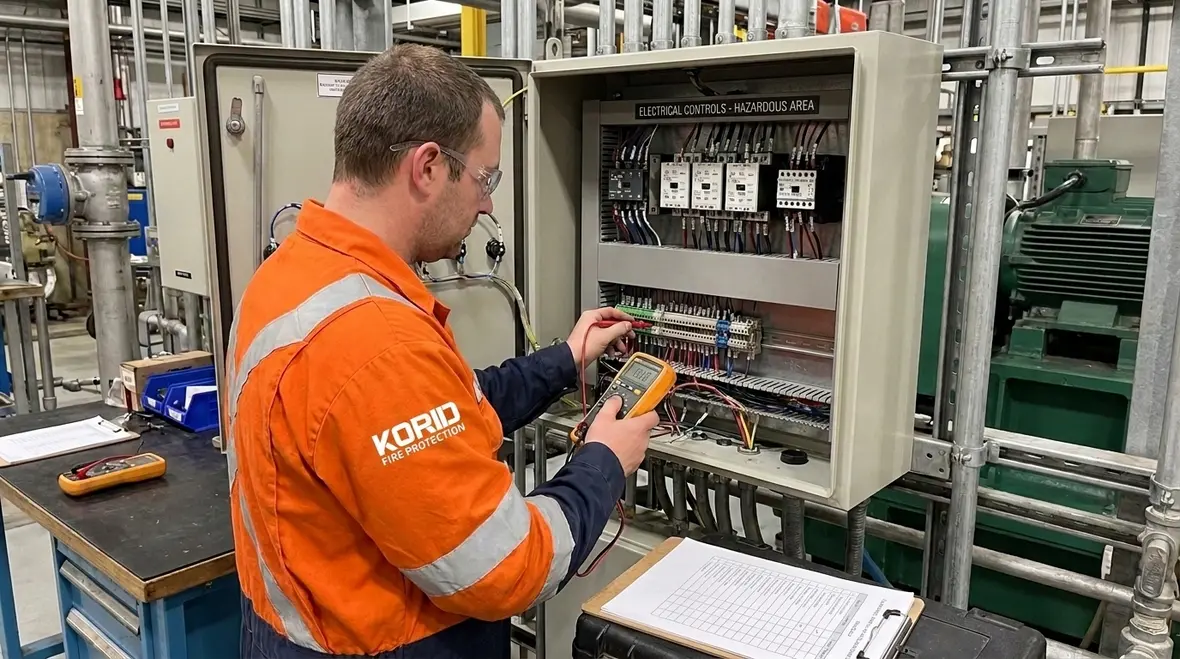
NFPA 35 Section 9.4: Repair of Electrical Equipment (What Commercial Facilities Must Get Right)
Quick Answer: NFPA 35 Section 9.4 sets enforceable controls for repairing electrical equipment used in processes involving hazardous chemicals. Facility teams must maintain safe operating conditions, limit repair methods that introduce new hazards, and verify performance after work through inspection and testing.
Facilities dealing with complex hazards often benefit from broader system coordination, especially where electrical work intersects with suppression readiness. For a related look at integrated protection support, see commercial fire suppression systems and services.
Why NFPA 35 electrical equipment repair requirements matter in the real world
Facilities that manage flammable, combustible, or reactive materials rely on electrical equipment to power controls, heaters, pumps, ventilation components, and instrumentation. NFPA 35 electrical equipment repair requirements exist to prevent repair work from unintentionally increasing ignition risk, degrading protective features, or leaving equipment in a nonconforming condition. In commercial and industrial settings, the most common compliance failures arise during “like for like” assumptions, incomplete documentation, and insufficient post repair verification.
For maintenance leaders, the standard functions as a practical boundary: repairs must restore equipment to a safe condition, and they must not compromise the design intent that the original installation relied upon.
What Section 9.4 covers: electrical repairs that keep the hazard controls intact
NFPA 35 Section 9.4 addresses the repair of electrical equipment, including electrical components and assemblies associated with hazardous chemical processes. The core expectation is that repair activities preserve the electrical and mechanical characteristics that reduce the likelihood of ignition.
In practice, Section 9.4 is often enforced alongside other electrical safety provisions and facility procedures. When facilities combine NFPA 35 requirements with internal inspection programs, the intent becomes operational: repairs must restore integrity of insulation, enclosures, seals, wiring integrity, component ratings, and protective features. Any repair that alters those characteristics must be evaluated for safe operation in the specific environment the equipment serves.
How repair work should be performed: procedures, documentation, and controlled acceptance
To meet NFPA 35 electrical equipment repair requirements, maintenance teams typically need a controlled repair workflow. The goal is to ensure repairs do not create new failure modes such as overheated connections, compromised enclosures, insulation breakdown, or incorrect component substitution.
1) Start with equipment identification and repair scope
Before any part is removed, the repair team should document the equipment nameplate data, operating environment, protection method, and the failure mode. Scope definition prevents “field substitutions” that can change voltage ratings, temperature ratings, or mechanical fit. For example, replacing a thermal component or connector without matching ratings can undermine the intended safety margin.
2) Use repair methods that preserve the original hazard mitigation
Repairs should maintain the protective intent of the equipment. That includes preserving enclosure integrity, cable management, bonding and grounding pathways, sealing practices, and electrical clearances. When repairs involve internal components, the installation must match the manufacturer’s design and applicable safety requirements.
3) Control wiring terminations and insulation integrity
Many repair failures come from termination variability: loose connections, improper torque, damaged conductors, or insulation damage during rework. Facilities should require wiring checks that confirm conductor condition, correct terminal selection, secure fastening, and routing that avoids abrasion and strain.
4) Require post repair testing and inspection
Section 9.4 expectations typically translate into a verification step after repair. The facility should confirm the equipment performs as intended and remains safe for the hazardous chemical environment. Common verification actions include continuity checks, insulation checks where appropriate, functional checks, and enclosure integrity verification. Acceptance criteria should be defined in maintenance procedures, not left to informal judgment.
Operationally, Kord Fire Protection supports this process by helping facilities align electrical repair verification with broader fire and life safety compliance practices, so maintenance work does not outpace inspection and testing readiness. For more related guidance, see fire protection services for commercial facilities.
Common compliance pitfalls during electrical repairs in chemical process areas
Even when the repair feels routine, small deviations can trigger noncompliance. The following pitfalls show up repeatedly in audits and incident investigations.
Unapproved component substitutions
Using components with different ratings or forms can compromise safe operation. “Equivalent” parts must truly match electrical and environmental requirements, including temperature rating and enclosure or sealing compatibility.
Incomplete restoration of enclosure and sealing features
Repair work that leaves gaps, missing gaskets, damaged seals, or poorly reseated covers can undermine the protective design. Sealing practices matter because the environment can expose equipment to ignition capable conditions.
Damaged wiring during disassembly and reassembly
Rework operations often create conductor insulation damage or stress points. Facilities should emphasize conductor inspection before termination and verify strain relief and routing after assembly.
Missing records and inability to demonstrate “safe return to service”
When documentation is weak, a facility cannot show that repairs restored safe operating conditions. Even if the equipment works, the facility still needs evidence that the repair followed controlled methods and that inspection or testing occurred.
Testing performed without defined acceptance criteria
Post repair checks must connect to requirements. Without documented acceptance criteria, teams may conduct superficial verification that does not confirm safe operation in the specific environment.
Inspection and maintenance integration: making Section 9.4 auditable
NFPA 35 repairs cannot function as a standalone activity. Facilities should integrate Section 9.4 with their maintenance management system so the repair is traceable, verifiable, and repeatable across different contractors.
-
Work order structure: link each repair to equipment identification, failure mode, and hazard area classification or process context where applicable.
-
Procedure alignment: ensure internal SOPs address pre job checks, part verification, installation method controls, and post repair acceptance testing.
-
Competency controls: confirm technicians understand electrical repair practices that preserve enclosure and protective features.
-
Verification evidence: capture test results and inspection findings in a way that can be reviewed quickly during compliance assessments.
-
Coordination with fire and life safety programs: ensure electrical repair activities support broader fire protection objectives, not compete with them.
Kord Fire Protection can help commercial facility teams coordinate maintenance verification with compliance outcomes, supporting sustained readiness across inspections, preventive maintenance, and corrective action planning. This helps reduce the risk of “repair gaps” that appear later during audits.
Implementation checklist: NFPA 35 electrical equipment repair requirements in one place
Use this practical checklist to standardize repairs and reduce compliance drift across shifts and contractors.
-
Confirm equipment identity: nameplate data, ratings, and operating environment.
-
Define repair scope: identify what failed and what must be restored.
-
Use approved parts and methods: match manufacturer intent and safety characteristics.
-
Preserve protective features: enclosures, seals, clearances, bonding, and grounding paths.
-
Inspect wiring and terminations: check conductor condition, torque, and routing integrity.
-
Perform post repair testing: verify safe operation and confirm acceptance criteria are met.
-
Document and retain records: capture repairs, test results, and inspection findings.
-
Return to service only after verification: ensure the equipment remains safe for the chemical process area.
Frequently Asked Questions
Conclusion and call to action
Electrical repairs in chemical process areas demand more than “it works again.” To support NFPA 35 electrical equipment repair requirements, commercial facilities should standardize repair controls, protect enclosure and wiring integrity, and document verification testing for return to service. Kord Fire Protection can help your organization strengthen compliance readiness through coordinated inspection, testing, and maintenance support. Contact Kord Fire Protection today to align repair workflows with ongoing fire and life safety objectives.

Join Our Newsletter!
Get the latest fire safety tips delivered straight to your inbox From our Newsletter.



