
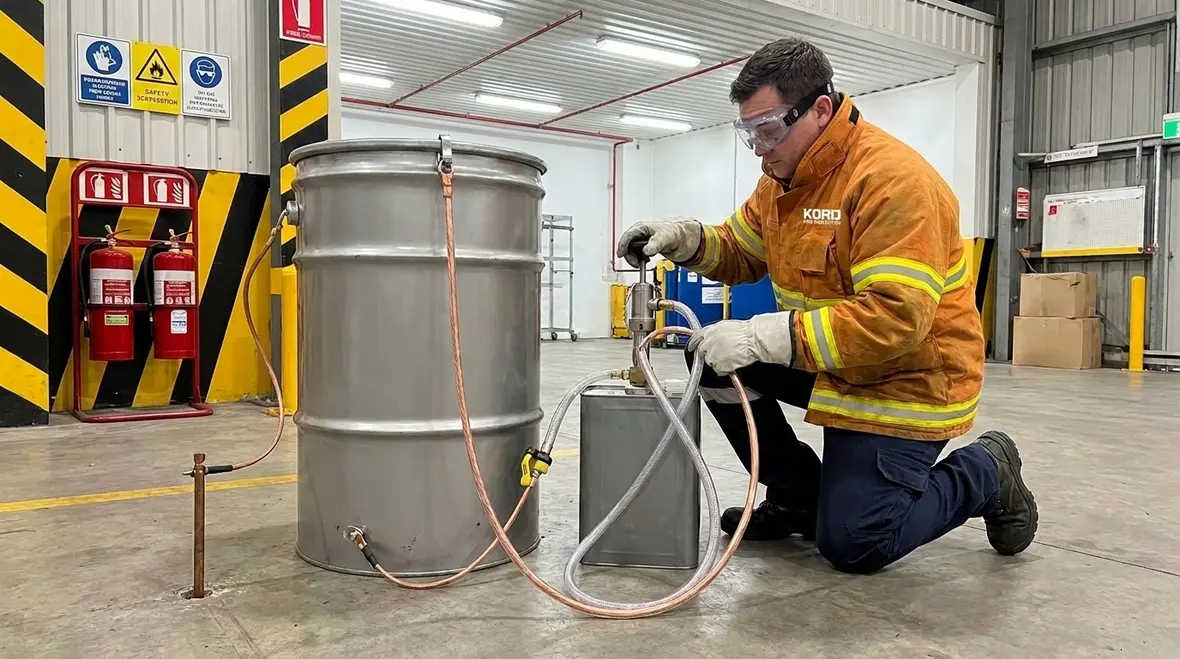
NFPA 35 Section 6.1: Transfer of Flammable and Combustible Liquids
Quick Answer: NFPA 35 Section 6.1 establishes practical safeguards for safely transferring flammable and combustible liquids, focusing on bonding and grounding, approved transfer equipment, ventilation where required, control of ignition sources, and operational procedures that reduce vapor release and static hazards during routine and non routine transfers.
For closely related guidance, review NFPA 30 Section 28.3: General Requirements for Bulk Transfer. It fits naturally alongside Section 6.1 because both center on safe liquid movement, static control, equipment condition, and practical transfer discipline. ([kordfire.com](https://kordfire.com/nfpa-30-section-28-3-general-requirements-for-bulk-transfer/?utm_source=openai))
Why NFPA 35 flammable liquid transfer requirements matter in real facilities
Commercial, industrial, and retail operations often treat transfers as routine tasks. NFPA 35 Section 6.1 is written to challenge that assumption. The rule targets conditions that reliably drive severe incidents: vapor accumulation, electrostatic ignition, equipment failure or misuse, improper hose handling, and transfers conducted outside of a controlled procedure. For compliance teams, the most common gap is not the lack of a written policy. It is the difference between the written procedure and what occurs during everyday transfers, maintenance, and after-hours operations.
NFPA 35 flammable liquid transfer requirements also connect directly to facility inspection readiness. Inspectors commonly evaluate transfer controls as a system, including equipment condition, labeling and approval status, jobsite setup, and the competency of personnel performing the task.
What Section 6.1 focuses on during transfer activities
Section 6.1 addresses the entire transfer lifecycle rather than isolated devices. The intent is to keep flammable vapors from reaching ignition sources and to prevent hazardous static energy buildup during liquid movement. In practice, the core compliance themes include:
- Control of ignition sources: Transfers require ignition control consistent with the flammable liquid hazards and the area classification.
- Static electricity management: Bonding and grounding practices must prevent dangerous potential differences between equipment, containers, and the receiving vessel.
- Approved transfer methods and equipment: Hoses, pumps, fittings, and connections must match the liquid and the transfer conditions, and must be used as intended.
- Vapor control and spill prevention: Setup, positioning, and handling reduce splashing, leaks, and unnecessary vapor release.
- Operational discipline: Written procedures and on the floor execution must align.
When facilities ignore any one of these, the remaining controls often prove insufficient. A properly bonded system still cannot compensate for a cracked hose, mismatched fittings, or a transfer performed with a damaged coupling that leaks vapors.
Bonding, grounding, and static control: the frequent compliance failure point
Static electricity is a primary hazard during the transfer of flammable liquids, particularly when flow rates, hose lengths, or filtration introduce additional charge generation. Section 6.1 operational emphasis typically drives three questions during inspections: Are the correct bonding jumpers used? Is continuity maintained throughout the transfer? And does the connection practice prevent bypass or floating?
Common operational problems
- Missing or disconnected bond cables: Personnel may remove bond cables for convenience and forget to reattach before flow begins.
- Inconsistent attachment points: Bonding must maintain electrical continuity across the intended conductive path. Attaching to painted surfaces, clamps on nonconductive adapters, or temporary fixtures can undermine continuity.
- Hose and coupling handling: Twisting hoses, allowing couplings to hang off contact points, or using worn couplers can create intermittent continuity.
- Improper sequence of operations: Bonding must be established before flow and maintained during the transfer process where applicable.
Commercial facilities can reduce risk by standardizing the bonding workflow. That includes pre transfer checks, clear attachment points on each tank and transfer station, and a verification step that confirms continuity before the start of pumping. Kord Fire Protection commonly supports facilities through transfer hazard audits, grounding and bonding verification practices, and documentation that helps demonstrate consistent control during inspections.
Equipment and transfer setup: what inspectors typically look for
NFPA 35 Section 6.1 requires that transfer equipment and connections support the intended hazard controls. In the field, inspectors frequently focus on equipment condition and the realism of what employees actually do during transfers.
Transfer equipment condition and compatibility
- Hoses and couplings: Check for cracking, abrasion, blistering, damage, and degradation from chemical exposure and aging.
- Valves and fittings: Confirm correct placement, secure connections, and functional operation to prevent drips and leaks.
- Pumps and metering components: Ensure pump seals and fittings do not leak during operation and that shutoff controls work reliably.
- Signs of tampering or substitution: Non compliant adapters or improvised connections create pathways for leaks and lost static control.
Jobsite setup and vapor management
Setup decisions often determine whether vapors accumulate. Practical controls include positioning transfer points to limit splash, using spill containment where required by facility risk assessment, and controlling airflow where ventilation is part of the overall safety plan. Facilities should also ensure transfer areas do not introduce ignition sources such as unapproved hot work, inadequate control of smoking, or equipment that can generate sparks.
If your facility also manages fire protection systems that must remain operational during transfer periods, coordinated inspection and maintenance is critical. For related guidance, facility teams can review NFPA 30 Section 27.9: Bonding and Grounding Liquid Piping. ([kordfire.com](https://kordfire.com/nfpa-30-section-27-9-bonding-and-grounding-liquid-piping/?utm_source=openai))
Operational procedures, training, and maintenance discipline
NFPA 35 Section 6.1 is not achieved by equipment alone. It is achieved by repeatable operational behavior. The most effective programs translate NFPA concepts into jobsite steps that employees can follow under time pressure and during shift changes.
Procedure elements to standardize
- Pre transfer checks: Verify equipment condition, correct hose length and compatibility, and correct bonding attachment.
- Transfer initiation steps: Confirm valves are positioned to prevent uncontrolled discharge and that transfer begins only after the hazard controls are in place.
- Monitoring during transfer: Watch for drips, leaks, abnormal flow behavior, and signs of coupling stress.
- Shutdown and post transfer handling: Address residual liquid, relieve pressure where applicable, and ensure the area is cleared of drips and stray ignition sources.
Maintenance and inspection alignment
Maintenance often reveals hidden failure modes. Examples include bond cable wear at connection points, corroded tank lugs, degraded hose jackets, and valves that seep under low pressure. Facilities should treat transfer hazard controls as maintenance items with scheduled inspection criteria, not as ad hoc checks.
Kord Fire Protection supports facilities by helping establish consistent compliance workflows, maintenance expectations, and documentation practices. That helps commercial and industrial sites maintain operational readiness and reduce the likelihood of deficiencies tied to transfer activities during inspections.
Frequently asked compliance scenarios for NFPA 35 flammable liquid transfers
Facilities frequently encounter situations that stress transfer controls. Below are examples that commonly require additional attention to align with NFPA 35 flammable liquid transfer requirements.
Transfers involving portable containers and hoses
Portable setups increase the chance of improvised connections, mismatched fittings, and temporary bonding shortcuts. A standardized portable transfer kit, with clearly identified bond cables and couplings, reduces variability.
Transfers occurring during shift changes or after hours
After hours increases the risk of reduced supervision and incomplete pre transfer checks. A strong signoff process and clear equipment staging helps maintain control during low staffing periods.
Equipment aging and hose replacement intervals
Hose material degradation can be subtle until it fails under real-world chemical exposure. Facilities should implement replacement intervals based on documented condition and service history, supported by inspection findings.
For additional fire protection program support tied to inspections and service readiness, Kord Fire Protection can assist with compliance strategy and maintenance planning through resources like NFPA 30 Section 28.11: Operating Bulk Loading and Unloading Safely. ([kordfire.com](https://kordfire.com/nfpa-30-section-28-11-operating-bulk-loading-and-unloading-safely/?utm_source=openai))
Frequently Asked Questions
Next step: get a transfer compliance check tailored to your site
Ensure your transfer procedures, equipment condition, and static control practices align with NFPA 35 Section 6.1. Kord Fire Protection can help your team assess transfer risk, confirm bonding and grounding discipline, and strengthen maintenance and documentation so you stay inspection ready. Contact Kord Fire Protection to schedule a focused review of your flammable and combustible liquid transfer operations.

Join Our Newsletter!
Get the latest fire safety tips delivered straight to your inbox From our Newsletter.



