
NFPA 31 Section 13.3: Following Oil-Gas Appliance Instructions
Quick Answer: NFPA 31 Section 13.3 requires facilities to follow the appliance manufacturer’s installation, servicing, and maintenance instructions for oil-gas equipment. Compliance means aligning burner setup, controls, combustion testing, and service intervals with the documented requirements to prevent unsafe operation and noncompliance.
For facilities managing broader compliance demands, it helps to connect appliance servicing with a larger fire protection services program so inspections, maintenance, and documentation stay coordinated across systems.
What does NFPA 31 Section 13.3 require in practice?
NFPA 31 Section 13.3 focuses on a simple but high impact compliance principle: when an oil-gas appliance is installed or serviced, personnel must follow the instructions provided by the appliance manufacturer. In commercial, industrial, and retail environments, this requirement functions as a control layer over day to day servicing decisions that can easily drift from the documented design intent.
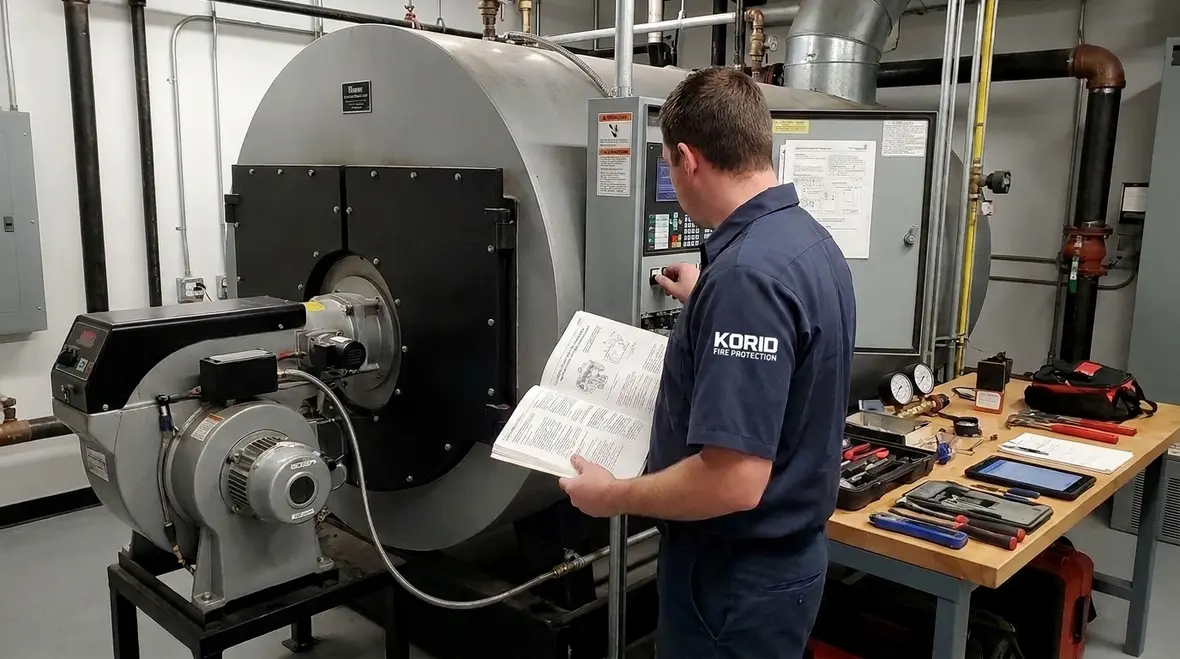
In practice, NFPA 31 oil gas appliance installation servicing instructions should be treated as operational documentation, not marketing material. When contractors service equipment, they confirm the correct burner configuration, verify control operation, apply specified replacement parts, and complete the combustion and safety checks the manufacturer directs. This alignment reduces risk of improper firing, unsafe combustion byproducts, and operating faults that can progress from nuisance lockouts to hazardous conditions.
Where Section 13.3 applies across commercial facility operations
Section 13.3 applies during both installation and service activities, including routine maintenance, corrective service after faults, and modifications that affect the appliance firing system. Commercial sites often have multiple appliance rooms or scattered assets across buildings, with tenant turnover and outsourced service schedules. Those realities increase the chance that equipment is serviced with partial information, wrong parts, or generic settings.
Common commercial scenarios that trigger Section 13.3 scrutiny
- Preventive maintenance performed on a schedule that does not match the manufacturer’s specified service intervals or test sequence.
- Burner component replacement using equivalent parts that the manufacturer does not approve for the specific model.
- Combustion adjustment performed without completing the manufacturer required verification checks, including test instrument usage and measurement targets.
- Control changes or software updates completed without confirming the appliance documentation for start up, ignition, and safety shutdown behavior.
- Vent and combustion air verification performed using generic checklists that do not reflect the manufacturer’s stated configuration and limits.
For facilities under frequent inspection, the documentation trail matters as much as the work itself. NFPA 31 Section 13.3 compliance should be defensible through service records that demonstrate the technician used the appliance’s instructions as the governing standard for the specific unit.
How technicians should follow NFPA 31 oil gas appliance installation servicing instructions
Following manufacturer instructions means working through the appliance documentation as a sequence of requirements tied to safety systems, combustion performance, and control behavior. Technicians should not infer steps. They should verify the instructions for the exact appliance model, firing rate, fuel type, and control configuration.
Step by step: service execution aligned to manufacturer instructions
- Confirm the correct documentation for the unit in service, including model and serial number references, piping configurations, and control trim details.
- Inspect the appliance condition before adjustments. Identify soot buildup, abnormal flame characteristics, corrosion, leakage, or damaged refractory or seals.
- Check burner and fuel train components in the order specified, including strainer condition, filter cleanliness, pump operation (where applicable), gas valve integrity, and ignition and flame sensing components.
- Verify safety and control operation according to the manufacturer. This includes proving ignition safety timing, flame signal behavior, and correct response to abnormal conditions.
- Complete combustion testing using the instruments and procedures the manufacturer specifies. Adjust burner parameters only within the documented limits and targets.
- Reassemble and document settings, parts used, and test results. Service records should connect actions taken to the instructions followed.
This approach supports consistent outcomes across multiple service cycles and reduces reliance on memory or generalized tuning assumptions.
Common failure points when instructions are not followed
In the field, noncompliance with Section 13.3 usually shows up as one or more of these patterns. They are not always dramatic at first. They can appear as recurring faults, inconsistent combustion readings, or repeated call backs.
Typical technical breakdowns
- Incorrect burner adjustment after service because the technician did not match the unit to the manufacturer’s specified adjustment method.
- Improper flame detection setup after replacing igniters or sensors, resulting in weak flame signal and intermittent lockouts.
- Fuel pressure or manifold verification skipped or done to incorrect reference points, causing unstable combustion and off target emissions.
- Vent and combustion air settings treated as universal rather than model specific, affecting draft, combustion stability, and safety.
- Replacement parts mismatch that changes timing, valve flow characteristics, or ignition performance.
For commercial buildings, these failure points create operational disruption. They also increase inspection risk because combustion and safety checks may not reflect the manufacturer’s required verification steps.
Compliance documentation and inspection readiness
Facilities should treat Section 13.3 compliance as a documentation management system. NFPA 31 compliance is easier to demonstrate when the service team can show that the NFPA 31 oil gas appliance installation servicing instructions were actively used during the service event.
What “good” service records usually include
- Appliance identification (manufacturer, model, serial number) and date of service.
- Reference to the correct installation and service instructions version or publication as applicable.
- Documented inspection findings prior to adjustments.
- Combustion test results and adjustment verification against the manufacturer’s targets or limits.
- Safety control observations, including ignition and flame signal checks as applicable.
- Parts replaced and whether they matched the manufacturer’s specified components.
If the facility operates multiple buildings or has a rotating contractor base, it helps to standardize how documentation is stored and retrieved. Kord Fire Protection supports commercial clients with structured maintenance and compliance workflows, helping facilities keep service history consistent and inspection ready.
Related guidance for oil burning equipment installation
For teams needing broader installation background that complements Section 13.3 practice, Kord Fire Protection recommends reviewing the practical approach in this resource: NFPA 31 a practical guide to oil burning equipment installation. It supports decision making around correct setup, verification, and ongoing service discipline that aligns with the intent of NFPA 31.
Frequently Asked Questions
Call to action
Ensure every service event follows the manufacturer’s NFPA 31 oil gas appliance installation servicing instructions, not generic shortcuts. Kord Fire Protection can help commercial and industrial facilities standardize maintenance procedures, document combustion and safety verification, and stay audit ready. Contact Kord Fire Protection to schedule a compliance focused inspection and service plan review for your oil and gas appliances.

Join Our Newsletter!
Get the latest fire safety tips delivered straight to your inbox From our Newsletter.



