
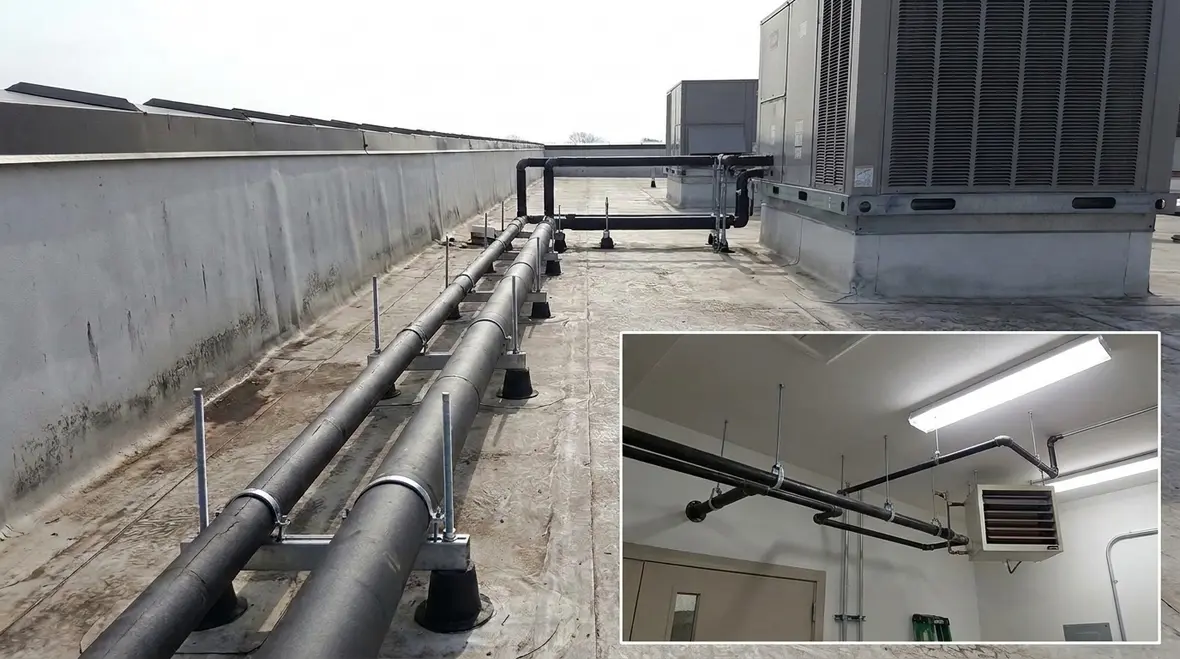
NFPA 31 Section 9.3: Oil Distribution for Roof-Mounted and Ceiling-Suspended Units
Quick Answer
NFPA 31 Section 9.3 governs how oil piping supplies roof mounted and ceiling suspended burners with safe, reliable distribution. It focuses on routing, supports, protection, valves, and impairment control to prevent leaks, fire spread, and loss of delivery. Compliance also depends on routine inspection and maintenance.
If you are reviewing the bigger installation picture, it helps to pair this section with this practical NFPA 31 guide to oil burning equipment installation, which gives broader context for appliances, fuel piping, venting, and system level compliance.
What NFPA 31 Section 9.3 is trying to prevent
NFPA 31 Section 9.3 addresses a practical fire and operational risk: oil distribution piping that runs where it can be struck, heat damaged, or physically stressed over time. In commercial roof and ceiling suspended installations, gravity, thermal cycling, building movement, and maintenance access can all create conditions for leaking joints, loose fittings, and compromised protective features.
For facilities planning NFPA 31 roof mounted oil distribution piping runs, the compliance goal stays consistent: maintain confinement and controlled flow under normal operation, abnormal service, and inspection conditions. Where distribution piping fails, the consequences can include oil accumulation, delayed detection, ignition of spilled fuel, and unsafe burner shutdown behavior.
Where Section 9.3 applies in real facilities
Section 9.3 targets oil distribution arrangements that feed oil fired appliances located on roofs or suspended from ceilings. Typical project scenarios include packaged heating units on roof curbs, boiler rooms with remote burners, and suspended make up air or process heating units in retail and light industrial occupancies.
Commercial properties commonly encounter Section 9.3 during initial build outs, replacement projects, and major retrofits. It also reappears during lifecycle maintenance because ceiling suspended piping is often affected by ceiling rework, duct modifications, and patch repairs that alter clearances or support conditions.
Design and installation requirements that drive compliance
Section 9.3 requirements interact with mechanical installation details. Compliance typically succeeds or fails based on how the piping system is supported, protected, and kept from becoming unreliable.
Routing, accessibility, and protection from damage
Oil distribution piping must be routed to reduce exposure to impact damage and to limit the chance that maintenance activities will disturb it. Roof mounted runs face additional risk from foot traffic, ladders, housekeeping equipment, and weather exposure. Ceiling suspended runs face risk from ductwork installation, sprinkler adjustments, and insulated ceiling panel work.
The practical compliance standard is straightforward: piping should remain inspectable and serviceable. Where piping passes through or near openings, penetrations and interfaces must preserve the intended integrity of the system.
Supports and hangers that manage movement
Supports and hangers control vibration, thermal expansion, and movement of the building structure. If supports are undersized, improperly spaced, or placed without considering expansion, fittings and joints carry extra stress. Those stresses often show up later as weeping at threaded joints, seal failure at connections, or mechanical strain around shutoff valves.
A common commercial failure point involves the region near vibration sources, such as burner skids or equipment base plates. Another common issue involves ceiling suspended piping sections that become lightly constrained after ceiling renovations, leaving no room for expansion and creating pressure on fittings.
Valves, shutoff control, and oil flow stability
Section 9.3 arrangements support safe control of oil supply. Valves must be installed where they can be used properly without creating hidden hazards. The system must maintain stable flow conditions for reliable burner operation and safe shutdown behavior.
In the field, technicians also verify that valve locations support inspection and functional testing. Improper access causes valves to be left untouched for long periods, which increases the likelihood of sticking, actuator failure, or seat degradation.
Common failure points during inspections and service
Facilities often meet NFPA 31 Section 9.3 expectations on paper, yet still fail inspection due to installation drift over time. Inspectors and safety teams usually focus on evidence of leakage, impaired confinement, and compromised mechanical integrity.
Leak pathways at joints and fittings
Oil leaks most often appear at threaded fittings, unions, flexible connectors, and areas where repairs were made without matching the original materials and sealing practices. Even small weeps can create ignition sources when they reach hot surfaces, burner areas, electrical components, or exhaust pathways.
Heat exposure and weathering on roof systems
Roof mounted runs experience high temperature swings, UV exposure, and mechanical wear. Protective considerations must address the piping and the route. Condensation and corrosive agents can also accelerate deterioration of components and clamps.
A practical compliance challenge involves rooftop housekeeping. If piping routing or protective shielding does not prevent accumulation of debris and pooling liquids, oil system inspection becomes harder and leaks can persist longer before detection.
Ceiling suspended constraints after renovation
Ceiling suspended oil distribution piping is vulnerable to becoming misaligned after duct upgrades, cable tray installs, or insulation changes. When piping is rerouted during renovation without restoring the original support geometry and clearance, it can become partially restrained. That restraint increases strain on connections and can lead to early seepage.
Impaired inspection and maintenance workflow
Section 9.3 compliance includes maintaining the system in a condition that can be properly inspected. If access panels are missing, covers are painted shut, or routing forces technicians to work around energized equipment, the facility effectively reduces the quality of ongoing compliance.
Inspection, testing, and ongoing maintenance that satisfy the intent
Compliance cannot rely only on the original installation. Commercial facilities should plan a repeatable inspection and maintenance cadence tied to burner run time, seasonal demands, and known risk points on both roofs and ceilings.
Documented visual checks
- Verify piping condition, including supports, clamps, and evidence of movement or misalignment.
- Inspect around valves and fittings for staining, wetness, and oily residue.
- Check protective routing features for damage from impacts or ongoing service activity.
Functional checks for safe control and shutdown
The oil distribution system must support safe oil supply control. Operational checks typically confirm that shutoff functions respond as intended and that the burner system behavior remains stable. Any indication of unstable flow, abnormal burner cycling, or repeated lockouts can reflect distribution system issues such as restrictions, air entry, or leaking conditions.
Corrective action discipline
When issues appear, corrective actions should restore the piping system to its intended configuration. Repairs should match materials, sealing methods, and mechanical support layouts. Facilities that apply temporary patching or non matching fittings commonly reintroduce failure points.
For a broader installation and equipment context, Kord Fire Protection provides a practical resource here: NFPA 31 practical guide to oil burning equipment installation. Use it to align distribution piping decisions with burner, tank, and safety control concepts across the full system.
How Kord Fire Protection supports Section 9.3 compliance
Kord Fire Protection helps commercial, industrial, and retail facilities manage the ongoing compliance reality of oil fired systems. The service focus includes inspection support, documentation readiness, maintenance planning, and correction verification for piping routes, valves, and accessible components.
Roof and ceiling suspended oil systems require more than a one time check. Kord Fire Protection coordinates practical follow up that reduces the chance of recurrence by targeting known risk zones such as joint stress points, protective routing boundaries, and areas affected by tenant improvements or building modifications.
For related inspection perspective, you can also review common fire suppression deficiencies found during inspections, especially if your facility team is tightening up documentation, access, and maintenance workflows across multiple life safety systems.
Frequently Asked Questions
Conclusion and next step
NFPA 31 Section 9.3 requires oil distribution piping systems on roofs and in ceiling spaces to remain secure, protected, and maintainable. If your facility has roof mounted or ceiling suspended oil runs, schedule a focused inspection that targets supports, joints, valves, and access conditions. Kord Fire Protection can help you verify compliance readiness, document corrective actions, and build an ongoing maintenance plan to prevent recurring piping defects.

Join Our Newsletter!
Get the latest fire safety tips delivered straight to your inbox From our Newsletter.



