
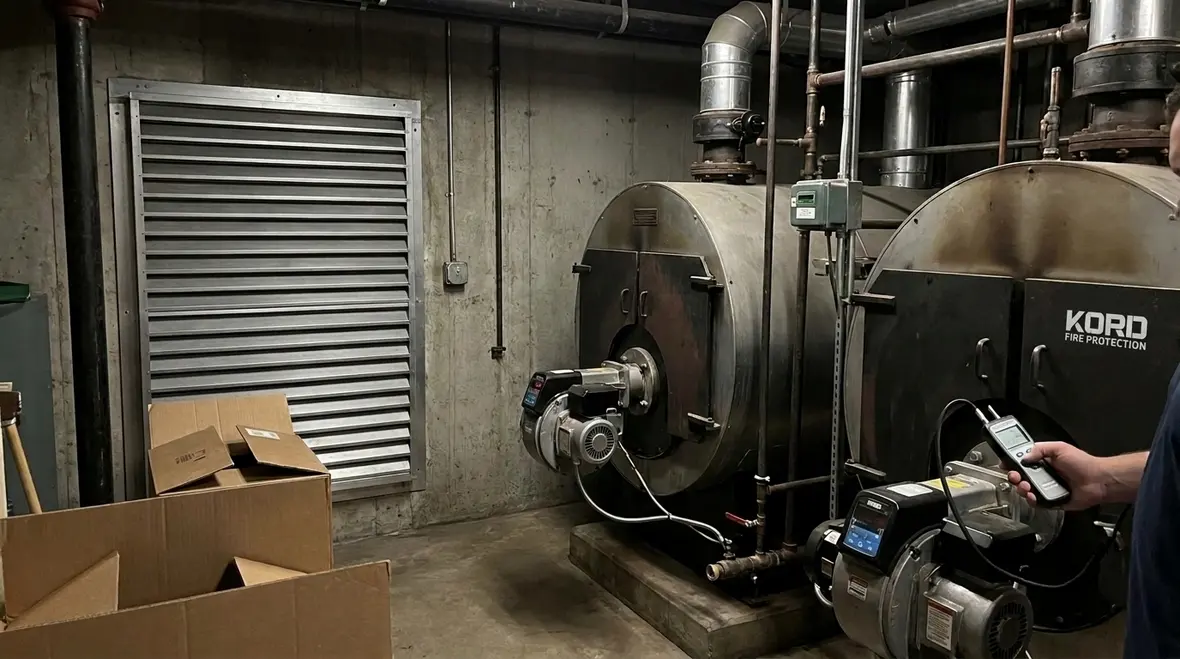
NFPA 31 Section 5.3: Combustion Air for Appliances in Unconfined Spaces
Quick Answer
NFPA 31 Section 5.3 requires sufficient combustion air for oil burning appliances located in unconfined spaces. Facilities must verify air supply pathways, prevent negative pressure, and confirm the engineered air requirements match the actual installation and operating conditions. Ongoing inspection and maintenance reduce drift from compliance.
NFPA 31 unconfined space combustion air requirements protect safe combustion by ensuring appliances receive enough oxygen to burn fuel completely. This is not a paperwork exercise. In commercial, industrial, and retail environments, air supply failures often come from operational changes, envelope upgrades, and HVAC pressure imbalances that quietly reduce the available air to the burner room.
For a broader look at compliance minded protection support across commercial facilities, explore commercial fire suppression systems and services. It fits naturally here because combustion safety does not live in a vacuum, and neither do mechanical rooms.
What NFPA 31 Means by “Unconfined Space”
Under NFPA 31, an unconfined space is a room or area where combustion air is not restricted by tight construction and where adequate air is expected to be provided through defined openings or other approved means. The intent is straightforward: the appliance must not starve for oxygen, regardless of the fuel burn rate, stack draft, and ventilation conditions created by the building.
In practice, many “unconfined” spaces become functionally confined when commercial buildings undergo renovations. Common examples include upgraded doors, new gasketing, sealed service penetrations, upgraded mechanical exhaust, and tighter air handling schedules. Even when the room volume has not changed, the effective air exchange can drop enough to affect combustion.
NFPA 31 Unconfined Space Combustion Air: The Core Compliance Checks
Facilities typically meet NFPA 31 unconfined space combustion air compliance by demonstrating that the combustion air pathways provide the required amount of air under normal operating conditions. Section 5.3 centers on two operational risks: insufficient oxygen supply and adverse pressure conditions that limit air inflow.
1) Verify air openings and air pathway geometry
Compliance depends on the available free area of openings used for combustion air, not simply the nominal opening size. Installations should confirm that louvers, screens, and grilles do not reduce effective area beyond what the design assumed. The air pathways must also remain unobstructed, including during routine housekeeping and seasonal maintenance.
2) Prevent negative pressure in the appliance space
Negative pressure is a frequent hidden failure point. Exhaust fans, restroom ventilation, kitchen hoods, warehouse make up air imbalance, and dock equipment can pull air out of the appliance room. When this happens, the appliance may attempt to draw combustion air through unintended routes, including from interior spaces, which can cause poor combustion, soot formation, and unstable draft.
3) Match the combustion air strategy to the burner demand
Air requirements scale with firing rate and appliance design. A room that passed earlier inspections can fail after burner changes, nozzle changes, or boiler upgrades that increase input. Facilities should treat combustion air verification as an installation attribute, not a one-time event.
How Appliances Actually Get Their Combustion Air
Oil burning appliances rely on a combination of draft and burner airflow to pull combustion air through the intake pathways. In an unconfined space, the air typically enters via openings communicating with the outdoors or spaces that communicate with the outdoors, or by approved methods that provide adequate air movement.
Where failures originate
-
Blocked openings: dumpsters, stored materials, temporary barriers, or accumulated dust can reduce free area.
-
Damper drift: automatic dampers or intake louvers can stick due to corrosion, misalignment, or lack of maintenance.
-
Seasonal HVAC effects: pressure relationships shift with heating versus cooling mode, exhaust staging, and make up air cycling.
-
Exhaust appliance sequencing: intermittent exhaust systems may create transient negative pressure during burner operation.
-
Envelope sealing: new weather stripping and sealed penetrations reduce uncontrolled infiltration that previously supported combustion air supply.
What inspectors look for operationally
Rather than only measuring at rest, field verification often includes confirming that the combustion air provisions remain adequate when the building operates as normal. Many compliance issues only appear when exhaust systems run concurrently with burner operation.
Common Commercial Installation Scenarios and Real-World Compliance Challenges
In commercial facilities, combustion air compliance must withstand changes across tenants, schedules, and building systems. The following scenarios regularly create gaps between design assumptions and field reality.
Retail and strip centers
Retail units commonly introduce intermittent exhaust for cooking, restrooms, and seasonal cleaning. Even when combustion air openings exist, airflow changes caused by loading docks and vestibule door traffic can alter room pressure profiles. Any change to store ventilation or make up air should trigger a combustion air reassessment.
Industrial maintenance bays and warehouses
Dock door usage, forklift traffic, and large exhaust systems can create substantial pressure fluctuations. A burner room may experience momentary negative pressure during dock operations, causing combustion instability, odor complaints, and elevated particulate on heat exchanger surfaces.
Hospitals, education campuses, and multi tenant buildings
Pressure zoning, pressure relief strategies, and long term mechanical balancing can drift after renovation or after equipment replacement. These spaces also often have strict maintenance regimes, which can inadvertently cause combustion air openings to be covered or temporarily modified during work.
Inspection, Testing, and Maintenance Practices That Keep Compliance Stable
NFPA 31 compliance for combustion air is best maintained through routine operational checks, not annual paperwork. Commercial systems require a repeatable approach that ties mechanical performance to air supply conditions.
Recommended field verification steps
-
Document existing combustion air provisions: record opening sizes, louver types, and the condition of intake pathways.
-
Confirm unobstructed access: verify that no stored goods, temporary barriers, or insulation repairs have reduced free area.
-
Check pressure behavior during operation: confirm that the room does not become excessively negative when connected exhaust equipment runs.
-
Review burner performance indicators: verify combustion results through readings that reflect oxygen availability and stable draft behavior.
-
Coordinate with HVAC and maintenance schedules: align combustion air checks with the building’s actual operating sequence.
Maintenance items that often get missed
-
Cleaning of intake paths: soot and dust accumulation can reduce airflow and indirectly impair draft.
-
Verification of louvers and grilles: damaged or misaligned louvers can reduce effective free area.
-
Seal checks after repairs: new penetrations around pipework and electrical conduits can change pressure behavior.
-
Exhaust fan set point reviews: small changes to fan control can create large pressure impacts at the appliance room.
For a practical installation perspective that supports safer commissioning and ongoing compliance, see NFPA 31: A Practical Guide to Oil Burning Equipment Installation. It complements Section 5.3 considerations by focusing on real-world commissioning and equipment placement.
Kord Fire Protection supports commercial facilities with compliance focused inspections and maintenance planning, helping ensure combustion air provisions remain effective through ongoing building operations and upgrades. This reduces the likelihood of combustion problems that can otherwise appear months after initial install.
Frequently Asked Questions
Conclusion and Call to Action
Combustion air compliance under NFPA 31 Section 5.3 depends on real operating conditions, not assumptions. Commercial pressure changes, sealed renovations, and exhaust system sequencing commonly create failures after installation. For reliable verification and steady performance, engage Kord Fire Protection to inspect combustion air pathways, assess room pressure behavior during normal schedules, and maintain burner performance over time. Contact Kord Fire Protection to schedule a compliance focused review.

Join Our Newsletter!
Get the latest fire safety tips delivered straight to your inbox From our Newsletter.



