
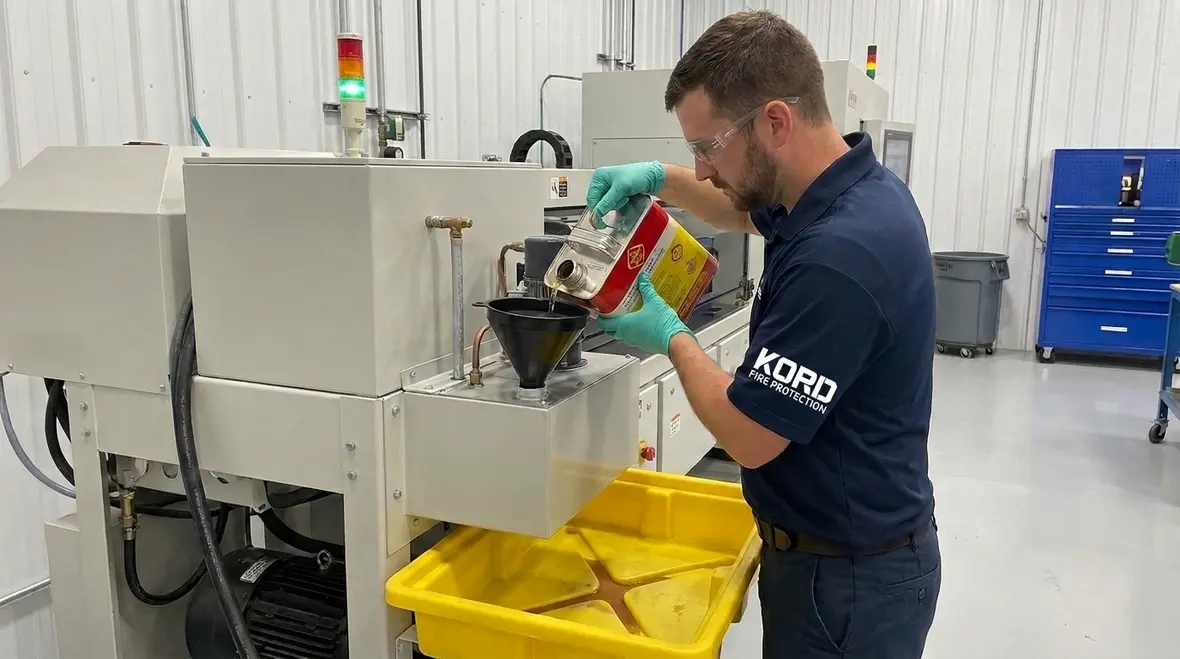
NFPA 30 Section 18.6: Incidental Operations — What Qualifies?
Quick Answer
NFPA 30 Section 18.6 incidental operations liquids applies to liquid-related activities that are minor, infrequent, and not part of the primary process handling. Qualifying operations depend on quantity control, containment practices, transfer methods, and documented safeguards that limit spill, ignition, and release scenarios.
Why facilities get this wrong in the real world
Commercial, industrial, and retail facilities often treat “incidental” as a blanket label. Inspectors and insurers rarely accept that approach. NFPA 30 Section 18.6 expects incidental operations liquids to remain truly secondary to the main process, with controls that prevent incidental usage from becoming an unbounded storage or transfer activity.
In practice, the compliance gap usually shows up during daily work and maintenance. Drip trays left incomplete, unattended containers, deteriorated hoses, poor waste segregation, and missing shutdown plans all turn an incidental task into a predictable hazard. The result is elevated expected incident frequency and a higher likelihood that releases exceed the assumptions used to justify “incidental” classification.
Facilities dealing with broader system reliability issues often pair this review with fire protection services in Southern California so liquid handling controls, inspections, and corrective actions stop living in separate little compliance universes.
What NFPA 30 Section 18.6 intends to cover
NFPA 30 Section 18.6 focuses on liquid hazards associated with operations that occur as part of handling, service, cleanup, or support activities, rather than the main processing system. The rule intent is to prevent normalizing small, uncontrolled liquid use into a de facto storage or transfer regime.
To qualify, the operation must meet an incidental profile across four technical dimensions:
- Secondary nature: The task supports the main operation but does not function as a production scale liquid use.
- Quantity discipline: Work uses limited amounts that remain controlled and do not accumulate.
- Containment and ignition control: Equipment and practices reduce spill spread and ignition exposure.
- Operational control: The facility can demonstrate procedures, inspection routines, and corrective actions.
When these dimensions fail, the activity often shifts from “incidental” to “process handling” or “flammable liquid operations” requiring higher levels of controls and design verification.
So what actually qualifies as incidental operations liquids?
Facilities typically qualify incidental operations liquids when the operation is bounded by procedure, time, and quantity, and when the liquid pathway does not create a new credible release scenario beyond the facility’s hazard assumptions.
Common examples that may qualify
- Small scale dispensing for sampling, routine maintenance top ups, or quick changeouts where containers remain attended and limited in size.
- Cleaning and wipe use where contaminated wipes and residues follow a documented waste stream and are not allowed to accumulate in open areas.
- Minor transfer between approved containers using equipment designed for flammable liquid service, such as closed transfer or properly bonded and grounded transfer setups.
- Short duration lubrication or tooling fluids used during maintenance cycles, where total quantities remain within controlled limits and spills trigger immediate response.
Common “it seemed incidental” failure points
- Uncontrolled accumulation: Multiple partially filled containers staged “temporarily” that become long term storage.
- Open containers left on benches, in corridors, or near traffic with no secondary containment.
- Inconsistent housekeeping around pumps, hoses, and drum stands, resulting in frequent puddling and residue buildup.
- Improvised transfer using non-rated nozzles or missing bonding and grounding for flammable liquids.
- Waste handling drift: Oily rags and cleaning residues placed into general waste bins rather than controlled containers.
Any of these failure points can push the activity out of the incidental category because they increase both the amount of liquid present at one time and the likelihood that a release transitions from minor to major.
Quantity, time, and containment: the real decision criteria
NFPA 30 incidental operations are not only about the task label. They require defensible control of how much liquid exists, how long it exists, and what physical barriers contain it.
Quantity control methods auditors expect
- Authorized container sizes and maximum allowable volumes per work area.
- Single active container rule during dispensing, supported by inventory and procedure logs.
- Segregated waste stream limits with frequent removal schedules tied to observed volumes.
- Clear staging boundaries for totes, drums, and pails, with no overflow and no “parked” containers.
Containment and spill control mechanisms
Commercial facilities often meet the intent on paper but fail at the containment level. Auditors look for these mechanisms:
- Secondary containment where incidental liquids are handled near equipment, drains, or traffic paths.
- Drip management for hoses, pumps, and valves, including drip trays that remain functional and properly sized.
- Absorbent readiness with the right material and placement near the point of use.
- Waste container design that is compatible with the liquid, covered when not actively adding waste, and maintained in good condition.
Operational controls that prove incidentality
To sustain “incidental” status under day to day operations, facilities need operating controls that reduce variability. Examples include:
- Written work instructions that define steps, limits, and shut down triggers.
- Competency expectations for personnel performing the task.
- Checklists that confirm containers are closed, labeled, and removed promptly.
- Documented corrective actions when spills, leaks, or overages occur.
Inspection, maintenance, and documentation: how compliance gets sustained
NFPA 30 compliance for incidental operations liquids depends on ongoing verification, not one time audits. Kord Fire Protection supports commercial facilities by aligning inspection routines with facility workflows so incidental tasks remain controlled between formal reviews.
Where liquid handling risk overlaps with water-based protection reliability, Kord Fire Protection’s fire pump service fits naturally into a stronger inspection and maintenance plan.
What should be inspected routinely
- Transfer equipment condition: hoses, couplings, nozzles, gaskets, and quick disconnects for compatible material integrity.
- Bonding and grounding readiness where applicable, including verification that the system is not bypassed by temporary practices.
- Container integrity: lids, seals, and closures that prevent vapor release and reduce spill spread.
- Waste container practices: coverage, compatibility, labeling, and removal frequency.
- Spill response readiness: absorbent replenishment and accessibility.
Common documentation gaps
Inspectors often ask for evidence that incidentality is not hypothetical. Common gaps include:
- No quantity limits defined per location.
- Missing work instructions for cleaning, sampling, or maintenance dispensing.
- No logs showing waste removal timing or waste stream segregation.
- Photos or inspection records that show recurring issues without corrective closure.
For additional context on how NFPA 30 regulates flammable liquids beyond incidental operations, refer to this guide on how NFPA 30 regulates flammable liquids. It helps facilities connect incidental controls to broader requirements for classification, storage, and handling.
Quick compliance checklist for incidentality reviewers
Use the following checklist during walkdowns to verify that incidental operations liquids remain within the intended scope.
- Task classification: The operation supports the main process and does not function as production liquid handling.
- Quantity boundary: Maximum container sizes and limits are defined for the work area.
- No staging drift: No open containers, no long term accumulation, and no repeated temporary storage.
- Containment present: Drip trays, secondary containment, and absorbent controls are maintained and used.
- Ignition risk management: Tools and equipment practices reduce ignition sources near the point of use.
- Waste segregation: Used wipes and residues go to the correct controlled containers on a defined schedule.
- Records available: Work instructions, inspection checklists, and corrective action history are accessible.
Where these points cannot be demonstrated, the facility typically benefits from a technical review to reclassify the operation and upgrade controls accordingly. Kord Fire Protection can help develop an evidence based compliance posture that stands up to inspections and internal management reviews.
Frequently Asked Questions
Conclusion and call to action
NFPA 30 Section 18.6 incidental operations liquids requires more than a label. It requires quantity control, containment discipline, reliable equipment practices, and documented operational oversight that holds up under walkdown scrutiny. Kord Fire Protection helps commercial facilities validate incidentality, close documentation gaps, and maintain inspection and maintenance routines that reduce recurring failure points. Arrange a compliance review to confirm your incidental operations classification and strengthen ongoing readiness.

Join Our Newsletter!
Get the latest fire safety tips delivered straight to your inbox From our Newsletter.



