
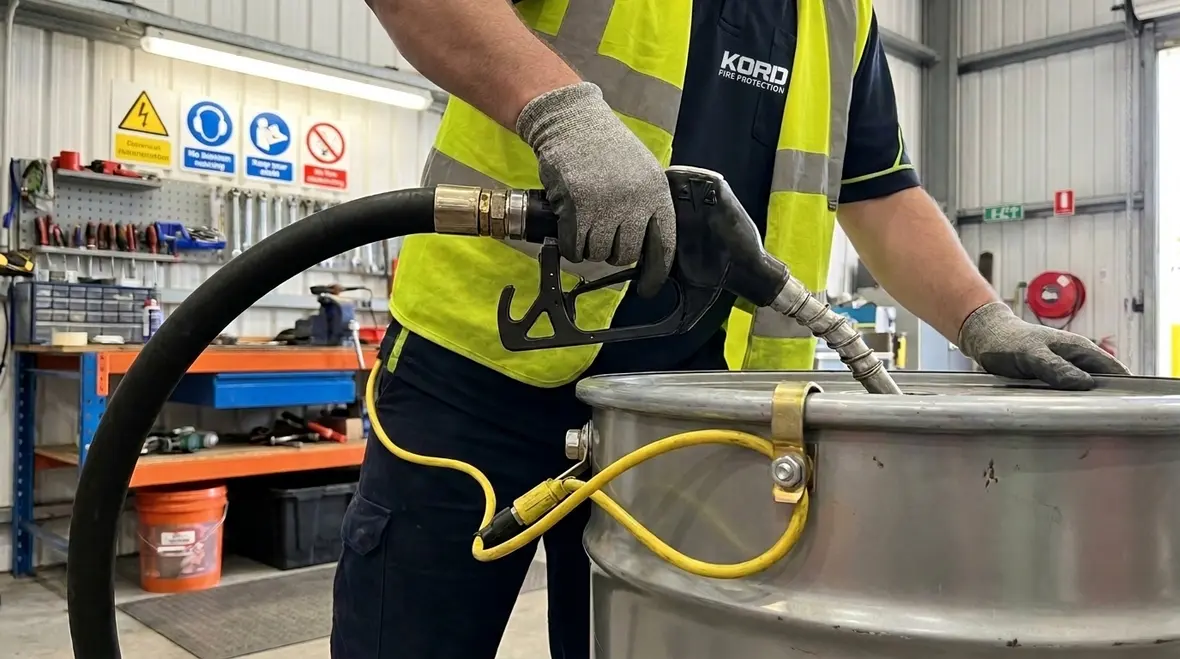
NFPA 30 Section 18.4: General Requirements for Liquid Dispensing
Quick Answer
NFPA 30 Section 18.4 general dispensing requirements define how flammable and combustible liquids must be transferred and dispensed in commercial settings to control ignition sources, manage containers and hoses, and maintain safe operating conditions. Compliance depends on equipment integrity, proper location and bonding, and documented inspection and maintenance.
What NFPA 30 Section 18.4 general dispensing requirements cover (in plain terms)
NFPA 30 Section 18.4 general dispensing requirements set the baseline safety rules for liquid dispensing operations. These rules aim to prevent releases, reduce ignition risk, and ensure dispensing equipment remains fit for purpose. For facilities such as retail fuel and lubricant bays, industrial maintenance shops, chemical storage and transfer areas, and bulk dispensing rooms, the section establishes practical controls around how liquids move from containers to use points.
If your facility also handles broader flammable liquid processes, review NFPA 30 Section 17.4 general requirements for processing facilities for related compliance context. To understand how the broader standard regulates flammable liquids in context, review: how NFPA 30 regulates flammable liquids. That background helps teams connect Section 18.4 dispensing controls to storage, handling, and ignition management requirements across the lifecycle of a liquid product.
1) Dispensing equipment must be suitable, arranged, and kept in safe condition
NFPA 30 Section 18.4 general dispensing requirements are not only about “what you do,” but also about “what you use” and “how it is maintained.” Facilities commonly struggle when dispensing systems age, are modified, or experience routine wear without replacement. A compliant dispensing program typically treats equipment status as a core safety control.
Common operational targets
- Equipment compatibility: Pumps, hoses, nozzles, meters, valves, and fittings must be appropriate for the liquid’s characteristics, including volatility and conductivity requirements where applicable.
- Safe placement: Dispensing points require protection from mechanical damage, vehicle impact, weather exposure where relevant, and interference with emergency egress and access.
- Guarding and impact resistance: Dispensing components should not be vulnerable to impact from forklifts, trolleys, or routine cleaning and maintenance.
Maintenance and inspection realities
In commercial environments, the most frequent non compliance drivers include degraded hoses, worn couplers, loose fittings, damaged meters, blocked vents on components designed for pressure management, and improper replacement parts. A safety focused maintenance plan should include documented inspection intervals aligned to how frequently the system is used, the products dispensed, and the conditions of service.
Kord Fire Protection supports ongoing compliance through inspection and maintenance planning that aligns operational practice to the expectations auditors typically test for during walk downs and documentation reviews.
2) Control ignition sources at the dispense point
Dispensing operations create localized risk. Liquids move through flexible lines and fittings, nozzles are handled frequently, and static or mechanical ignition hazards can increase when procedures or equipment degrade. NFPA 30 Section 18.4 general dispensing requirements therefore emphasize ignition control measures that apply specifically to dispensing operations.
High risk failure points teams should watch
- Improper bonding or grounding: Disconnected bonds or damaged bonding leads can undermine static control during transfer.
- Damaged hose ends or couplers: Poor connections increase release risk and can create friction and vapor concentration issues at the nozzle area.
- Non rated components: Substituting incorrect pumps, switches, or accessories can introduce ignition sources not intended for the classified environment.
- Uncontrolled ignition sources nearby: Hot work, smoking, or unsuitable portable equipment in the immediate dispensing area can violate site ignition control expectations.
Because dispensing often occurs in active commercial buildings, ignition control must also include practical site rules: signage, access control, hot work permits, and coordination with housekeeping and maintenance schedules. Kord Fire Protection helps facilities translate these requirements into operational procedures and evidence that supports audit readiness.
3) Prevent leaks, spills, and vapor accumulation during transfer
Even small releases can change the hazard profile of a dispensing area. NFPA 30 Section 18.4 general dispensing requirements support spill and leak prevention by focusing on containment, secure connections, and safe operation practices. Operational teams must apply the controls while handling equipment at speed and under real site constraints, such as customer flow, production schedules, and cleaning routines.
Operational controls that prevent releases
- Secure connection verification: Couplings should be fully seated and verified before transfer begins, especially after hose changes.
- Nozzle handling practices: Staff should avoid improper aiming, overfilling beyond intended limits, and leaving nozzles unattended during flow.
- Spill response readiness: Spill kits, absorbents, and disposal processes must match the liquids used and be kept accessible without blocking egress or equipment access.
Many facilities treat spill kits as a “checklist item.” The stronger approach links spill kit contents to the products being dispensed, the surfaces involved, and staff training. Kord Fire Protection can help align your inspection and maintenance approach with the practical conditions that determine whether spill controls work when they are needed.
4) Manage hoses, fittings, and discharge points like safety critical assets
Hoses and fittings are the most frequently handled components in dispensing systems. When they wear out, are mishandled, or are replaced incorrectly, they become major contributors to leakage and ignition risk. NFPA 30 Section 18.4 general dispensing requirements therefore expect facilities to manage these components proactively through safe handling, correct replacement, and inspection.
What “good” looks like during audits
- Condition visibility: Hose condition checks are easy to perform and documented, focusing on cracking, blistering, abrasion, kinks, and end wear.
- Correct routing and protection: Hoses are routed to avoid traffic hazards and avoid repeated flexing at sharp angles.
- Replacement discipline: Spare parts match the original specifications, and replacements follow approved procedures to avoid creating incompatible system behavior.
Facilities often discover compliance gaps after incidents or near misses. A preventive program should include clear criteria for when equipment is removed from service, plus a process for capturing trends in recurring failures by product type and usage pattern.
5) Documentation, training, and inspection evidence that stands up
Compliance programs fail when they rely on informal checks or inconsistent staff practice. NFPA 30 Section 18.4 general dispensing requirements support ongoing operational safety, and that typically requires documentation that shows controlled equipment use and effective ongoing maintenance.
Core documentation elements
- Inspection records: Evidence that hoses, fittings, pumps, and related dispensing components receive routine inspection.
- Maintenance logs: Records of repairs, part replacements, calibration checks where relevant, and corrective actions.
- Operational procedures: Standard work for start up, dispensing, shutdown, and spill response.
- Training records: Proof that relevant staff understand dispensing hazards, correct handling techniques, and escalation paths.
From commercial retail bays to industrial transfer rooms, a strong documentation set reduces the gap between “policy” and “practice.” Kord Fire Protection positions itself as a continuing compliance partner by helping facilities maintain consistent, testable evidence that supports inspections and audit outcomes.
Frequently Asked Questions
Conclusion and call to action
NFPA 30 Section 18.4 general dispensing requirements protect people and property by controlling ignition risk, preventing leaks, and keeping dispensing equipment reliable over time. Facilities should verify equipment suitability, enforce disciplined hose and nozzle handling, and maintain inspection and maintenance documentation that matches real operating conditions. Engage Kord Fire Protection to assess your dispensing setup, strengthen your compliance evidence, and establish a practical inspection and maintenance program that holds up during audits and day to day operations.

Join Our Newsletter!
Get the latest fire safety tips delivered straight to your inbox From our Newsletter.



