
NFPA 30 Section 9.4: General Rules for Storing Flammable Liquids
Quick Answer
NFPA 30 Section 9.4 sets enforceable expectations for general container storage of flammable liquids, focusing on container integrity, proper placement, spill control, and hazard communication. Facilities reduce ignition and release risks by meeting container compatibility rules, maintaining clearances, and implementing inspection and maintenance routines.
Why NFPA 30 Section 9.4 matters to commercial operations
Commercial and industrial facilities often assume that “container storage” is a low risk activity until an inspection or incident forces a deeper review. NFPA 30 Section 9.4 general container storage requirements address the day to day realities: mixed product inventories, aging containers, poor segregation practices, and inadequate housekeeping that can turn a minor leak into a fire or vapor release.
Compliance becomes more challenging when facilities store flammable liquids in multiple areas such as maintenance bays, loading docks, retail back rooms, and specialty storage cabinets. In those environments, the most common failure points include degraded container seals, incorrect container types for the liquid, blocked access for emergency response, and insufficient secondary containment strategies.
For facilities reviewing broader inspection readiness, it also helps to align container storage practices with a practical fire sprinkler inspection strategy for commercial sites so storage conditions, access, and documentation stay consistent during audits.
To understand how the standard fits into the broader regulatory framework, refer to Kord Fire Protection’s guidance: how NFPA 30 regulates flammable liquids.
What Section 9.4 focuses on: container integrity and safe placement
NFPA 30 Section 9.4 general container storage requirements typically emphasize three fundamentals that inspectors verify on site: the containers must remain serviceable, the storage location must minimize exposure to ignition sources, and stored product must be managed to prevent uncontrolled releases.
1) Container condition and compatibility
Containers used for flammable liquids must remain compatible with the product and maintain their intended performance. Practical considerations include:
- Leak prevention: Inspect caps, plugs, valves, gaskets, and weld seams for seepage, corrosion, or deformation.
- Material compatibility: Confirm containers do not react with the liquid, which can compromise strength or sealing performance over time.
- Closure integrity: Ensure caps and lids stay fully seated and that seals remain intact during routine handling.
- Container identification: Maintain legible labels so the product hazard can be understood immediately by operators and emergency responders.
Operationally, facilities frequently experience container failures after frequent movement, impacts during palletization, or improper storage temperatures. A reliable inspection program reduces both container deterioration and the likelihood of unrecognized product release.
2) Storage location controls
Section 9.4 expectations connect container placement to ignition control and safe access. While facilities use different layouts, inspectors typically look for:
- Clearance and access: Storage does not block egress routes, doorways, electrical panels, sprinkler components, or firefighting equipment.
- Avoiding ignition hazards: Containers are not stored near sources of heat, open flames, or equipment likely to generate ignition.
- Segregation: Flammable liquids are not commingled with incompatible materials in a way that increases escalation potential.
How facilities apply general container storage requirements day to day
Meeting NFPA 30 Section 9.4 often depends less on paperwork and more on standard operating procedures that withstand operational stress. The goal is consistency: every shift, every storage location, and every product line.
Receiving, staging, and movement procedures
A common compliance gap occurs before containers ever reach “storage.” Best practice procedures include:
- Designated staging areas with controlled ignition exposure.
- Temporary containment for small leaks during transfer.
- Handling steps that prevent impacts and valve damage during loading and unloading.
- Verification of label integrity and container type before containers enter the storage area.
Facilities should also define who conducts the initial container check and how defects are quarantined. Without a clear quarantine pathway, defective containers may remain in storage and create a slow buildup of risk.
Spill and release preparedness
For flammable liquids, a minor spill can create flammable vapor that spreads quickly in many commercial environments. Even when large spills are unlikely, NFPA 30 Section 9.4 general container storage requirements support the concept that containers and storage areas must limit uncontrolled release consequences.
Practical control measures include:
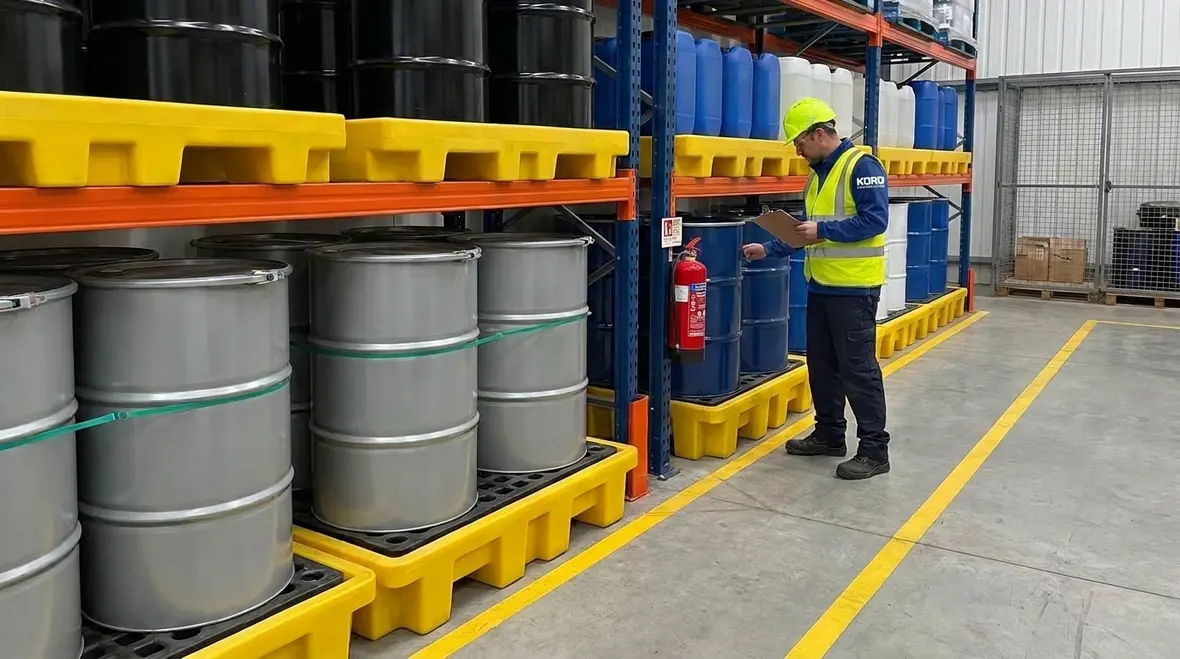
- Secondary containment strategy: Use containment capable of capturing leaks from individual containers or groups.
- Spill response readiness: Maintain appropriate absorbents, compatible containment materials, and trained response procedures.
- Routine housekeeping: Remove residues that can increase slip and contamination risk during cleanup.
Commercial facilities that rely on ad hoc spill response often fail inspections due to missing or incompatible cleanup materials, expired absorbents, or response plans that do not match the actual products stored.
Ventilation, environmental conditions, and storage area housekeeping
Although storage cabinets and enclosures vary, facilities should manage storage environment factors that influence vapor accumulation and container performance. Inspectors typically scrutinize:
- Ventilation pathways: Storage areas do not trap vapors due to blocked vents or sealed conditions not designed for that purpose.
- Temperature extremes: Containers are not exposed to heat that can accelerate pressure rise or degrade seals.
- Housekeeping discipline: Dirt, debris, and damaged secondary containment reduce spill effectiveness and increase cleanup time.
Common noncompliance patterns and why they happen
Even competent teams often encounter the same inspection findings. These patterns typically stem from operational pressures, not ignorance.
Pattern 1: “Container storage” without a true inspection rhythm
Containers age even when they are not visibly leaking. Without scheduled checks for seals, corrosion, and label legibility, facilities can accumulate risk that becomes evident only after a failure.
Implement documented inspections that include date tracking, defect categorization, and corrective actions. Kord Fire Protection supports ongoing compliance management by aligning inspection documentation with real storage configurations and commercial maintenance cycles.
Pattern 2: Blocked access and unmanaged stacking
Storage may appear orderly until an additional pallet is added, an aisle is narrowed, or emergency equipment becomes difficult to reach. NFPA 30 Section 9.4 general container storage requirements support the principle that accessibility and egress must remain protected.
Control stacking practices with clear maximum heights, stable racking, and defined aisle widths. Train operators to treat access lanes as non negotiable safety infrastructure.
Pattern 3: Incompatible containers or deteriorated components
Replacement containers and maintenance refills can drift away from the original compliant setup. Over time, incompatible closures, seals, or unofficial containers increase the chance of leakage.
Facilities should standardize container approval criteria and maintain a locked or controlled process for substitutions. When product lines change, re verify compatibility and storage suitability.
Equipment and maintenance: what inspectors expect to see
Compliance success depends on how storage systems perform under real conditions. The inspection focus commonly includes the physical storage hardware and its maintenance.
Storage cabinets, racks, and secondary containment
Where cabinets, flammable storage lockers, or racks exist, inspectors typically expect:
- Condition: No rust-through damage, warped doors, missing latches, or compromised containment systems.
- Function: Doors close properly and remain effective at limiting release spread.
- Compatibility: Materials and trays remain appropriate for the liquids stored.
Documentation and training that match the actual site
Written policies help, but inspectors validate that training matches storage reality. Facilities should keep records that align with:
- Inspection schedules and results.
- Corrective actions for container damage or leakage.
- Spill response readiness checks.
- Operator awareness of hazard communication and product segregation practices.
For facilities that need practical support beyond initial assessments, Kord Fire Protection can help maintain a defensible compliance position through inspection coordination, corrective action verification, and ongoing fire safety management services.
Integrating Section 9.4 compliance into your safety management system
NFPA 30 Section 9.4 general container storage requirements work best when they operate as part of a broader safety management cycle.
- Plan: Map flammable liquids inventory to storage locations, container types, and segregation needs.
- Implement: Use standardized receiving, staging, and inspection procedures.
- Verify: Conduct periodic inspections of containers and storage systems, not just documentation.
- Act: Remove defective containers quickly and track repeat issues by location or process step.
- Improve: Update training after process changes, contractor work, or layout modifications.
This approach reduces downtime during audits and protects daily operations by catching degradation early, before leaks and ignition sources align.
Frequently Asked Questions
Call to action
Commercial sites storing flammable liquids should treat NFPA 30 Section 9.4 general container storage requirements as an ongoing operating standard, not a one time checklist. Kord Fire Protection can help your team validate container integrity practices, storage access controls, and spill preparedness with site aligned inspections and maintenance support. Contact Kord Fire Protection Australia to schedule a compliance review and build a defensible, repeatable inspection rhythm across every storage area.

Join Our Newsletter!
Get the latest fire safety tips delivered straight to your inbox From our Newsletter.



