
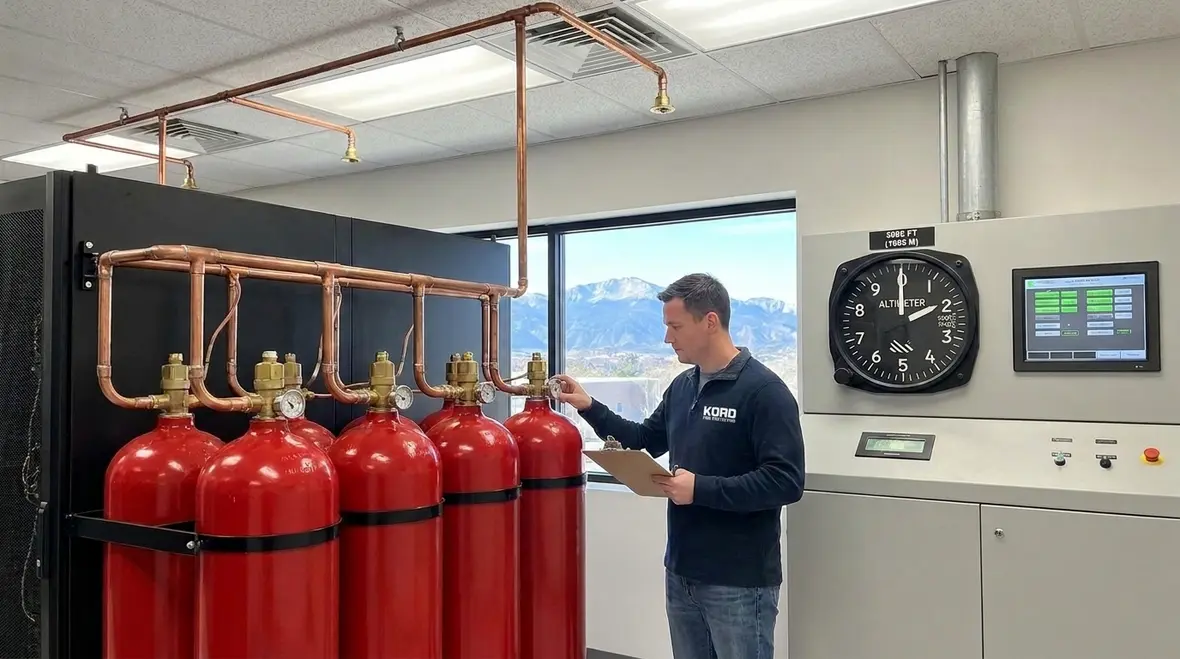
NFPA 12A Section 5.6: Altitude Adjustments to Halon 1301 Design Concentration
Quick Answer
NFPA 12A Section 5.6 requires adjusting Halon 1301 design concentration based on altitude to maintain the required extinguishing performance. As altitude increases, air density changes and the system must be engineered and verified so the protected hazard receives the intended concentration.
Facilities that need broader fire suppression system services often discover altitude assumptions only after plan review, inspection, or system updates bring the original engineering basis back under the microscope.
Why altitude changes Halon 1301 performance in real facilities
Commercial, industrial, and retail facilities often treat gaseous system design like a one time calculation. NFPA 12A Section 5.6 corrects that assumption by recognizing that atmospheric conditions change with elevation. The Halon 1301 altitude adjustment to design concentration ensures the system discharge produces an effective extinguishing concentration at the actual site conditions, not just at a nominal reference.
In practice, this matters most when a building is located far above sea level, when sites share equipment specifications across regions, or when a project change order alters the designed location or discharge parameters. Without the altitude adjustment, a system may discharge exactly what the nameplate and design documents claim, while the protected atmosphere receives a concentration that is too low to achieve the expected performance.
NFPA 12A Section 5.6: what the requirement targets
NFPA 12A Section 5.6 addresses the need to adjust the design concentration for altitude. The intent is straightforward: keep extinguishing performance consistent despite differences in air density and the resulting gas behavior at higher elevations. This is not a cosmetic documentation change. It directly influences the engineering concentration used to calculate nozzle sizing, discharge duration, and total net quantity of agent.
For compliance, the critical point is the alignment between:
- The design concentration stated in the approved hazard analysis and engineering calculations
- The actual discharge performance during commissioning and any periodic inspections
- The documented altitude and site elevation basis used to calculate the system
When teams reuse prior calculations from a different address or assume the same elevation across a portfolio, they commonly miss the altitude adjustment and create a gap that becomes obvious during functional testing, maintenance reviews, or third party plan checks.
How the Halon 1301 altitude adjustment affects engineering and discharge calculations
The Halon 1301 altitude adjustment to design concentration modifies the amount of agent and the discharge characteristics needed to reach the target extinguishing concentration in the protected space. While exact numeric factors come from the NFPA 12A methodology, the operational effect remains consistent across designs: the system must be engineered so the atmosphere reaches the required concentration at the site altitude.
Key areas impacted by altitude based concentration changes
- Total net agent quantity increases or decreases based on the altitude adjustment logic, affecting tank quantity, manifold configuration, and packing of spare cylinders.
- Discharge rate and duration influence whether the concentration reaches the target and holds long enough for the design scenario.
- Enclosure and leakage assumptions become more critical in high altitude conditions. Slight leakage can move the achieved concentration further from the design target.
- Distribution effectiveness may shift due to pressure changes that alter flow characteristics through piping, valves, and discharge nozzles.
Commercial facilities should treat altitude as a design input that must appear in the engineering package. For ongoing compliance, that same altitude basis should also surface in the inspection records reviewed by the authority having jurisdiction, the facility safety officer, and any insurance risk assessor.
Common compliance and maintenance pitfalls (and how to prevent them)
Altitude requirements create predictable failure modes, especially during renovations, relocation, or documentation updates. The following pitfalls repeatedly surface in field reviews.
1) Reusing design concentration without verifying elevation
Systems get upgraded, reissued, or relettered when a facility changes management or undergoes tenant improvements. If the altitude adjustment to design concentration is not revalidated for the actual site elevation, the discharge design may no longer match NFPA 12A intent.
2) Incomplete records that omit the altitude basis
Inspection teams frequently check whether cylinder weights and device statuses look correct, but they do not always verify the engineering concentration basis against site conditions. A compliance gap can exist even when the system appears physically sound.
3) Enclosure changes after tenant fit out
Openings, door hardware, ceiling modifications, or changes to HVAC pressurization can affect how quickly the agent mixes and how long the concentration remains within the intended range. At higher altitudes, the margin for error shrinks when enclosure integrity and leakage rates are not controlled.
4) Maintenance performed without updating calculations
Valve rebuilds, nozzle changes, piping repairs, and replacement of control components sometimes trigger a reassessment obligation. Even if the original system passed acceptance, a maintenance-driven revision should recheck whether the engineered concentration and discharge parameters still align with NFPA 12A, including altitude assumptions.
For a broader NFPA 12A context and how these compliance elements fit into system design and service planning, see this overview: NFPA 12A overview.
Operational verification: how facilities should validate the right outcome
Altitude adjustments are validated through a combination of engineering documentation review and field performance verification. The most effective approach for commercial sites combines paperwork control with functional testing discipline.
Documentation checks that prevent expensive rework
- Confirm the design altitude or site elevation value used to apply the Halon 1301 altitude adjustment to design concentration.
- Verify that the approved hazard analysis and calculations reference NFPA 12A Section 5.6 methodology.
- Check that any post installation changes include a design review, especially enclosure modifications and actuator or nozzle changes.
Maintenance and inspection behaviors that reduce risk
- Track agent cylinder condition and replacement schedules to preserve the designed discharge capability.
- Verify clean and unobstructed discharge paths. Even minor obstructions can reduce effective flow and mixture quality.
- Perform periodic functional checks of controls and release equipment, ensuring release timing matches the design assumptions.
- Confirm seals, door closures, and protected area boundaries remain consistent with the enclosure model used in design.
Kord Fire Protection supports commercial owners by connecting NFPA 12A design assumptions to day to day compliance. That means reviewing the engineering basis, verifying the system’s configuration after maintenance, and maintaining inspection records that stand up to audits and authority reviews.
Frequently Asked Questions
Conclusion and next step
Altitude adjustments under NFPA 12A Section 5.6 directly affect engineering concentration and discharge effectiveness. To protect compliance and operational reliability, confirm the site elevation used for the Halon 1301 altitude adjustment to design concentration, then maintain enclosure integrity and inspection discipline. Contact Kord Fire Protection to review your system design basis, document completeness, and maintenance status so your gaseous fire suppression performance remains verifiable year after year.

Join Our Newsletter!
Get the latest fire safety tips delivered straight to your inbox From our Newsletter.



