
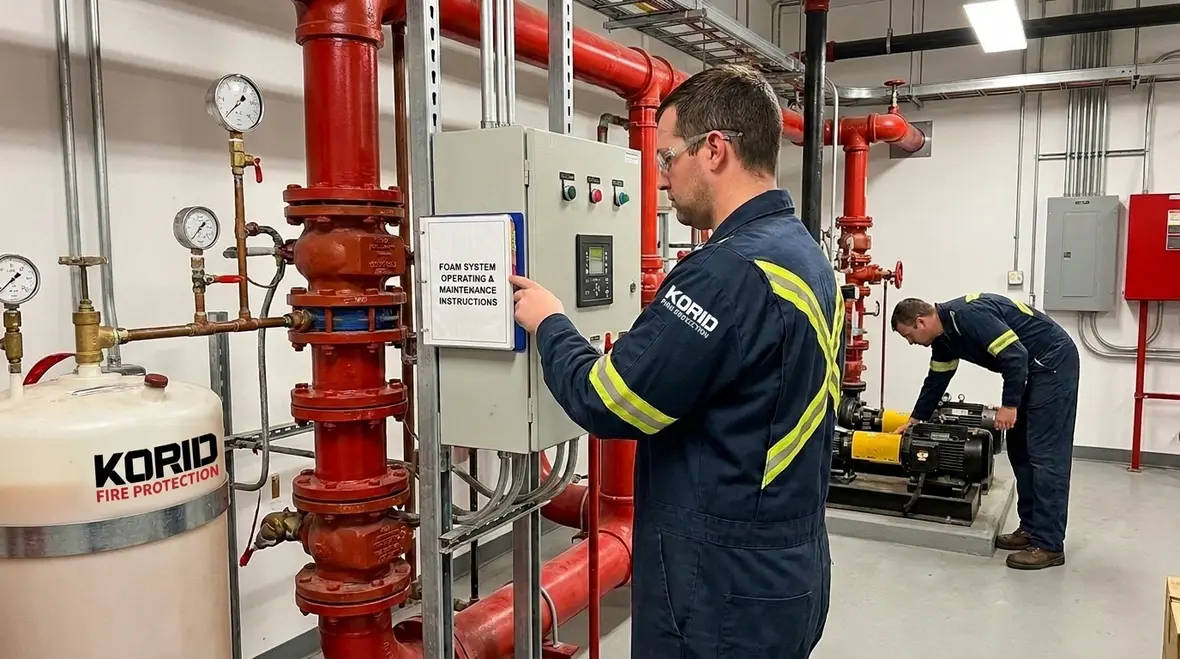
NFPA 16 Section 8.5: Operator and Maintenance Instructions for Foam Systems
Quick Answer: NFPA 16 Section 8.5 requires that foam-water system operator and maintenance instructions be clear, readily available, and aligned with the system’s components and hazards. The goal is to ensure trained operators can initiate foam application and verify readiness through routine inspection and maintenance.
Facilities that need a broader service view on foam system upkeep can also explore foam fire suppression system maintenance and testing for practical context around inspection, testing, and documentation.
Why Section 8.5 matters in real facilities
In commercial, industrial, and retail occupancies, foam-water systems often sit behind permits, inspections, and annual testing cycles. When systems do not perform as expected, the root cause frequently involves operational drift. Operators may not recognize a configuration change, maintenance staff may use the wrong procedure for a specific proportioning method, or documentation may not reflect the installed hardware.
This is where the intent of foam-water system operator instructions becomes critical. NFPA 16 Section 8.5 focuses on practical usability: instructions must guide people who actually operate and maintain the system, not merely satisfy a binder checklist.
What NFPA 16 Section 8.5 requires: instructions people can use
Section 8.5 centers on documenting and providing operator and maintenance instructions that match the installed foam system. In practice, compliance typically includes three outcomes:
- Specificity: Instructions reference the actual system type, foam concentrate, proportioning device, tank or supply arrangement, and foam-water application method.
- Usability: The language supports fast decision-making during incidents and routine verification during inspections.
- Consistency: The instructions remain correct after service events, component replacements, and configuration changes.
To support effective compliance, operators and maintainers should receive instructions that reflect how the system works from alarm or manual initiation through foam generation and discharge. When the documentation is generic, technicians often discover the mismatch during testing, when the “paper procedure” conflicts with the “as installed” hardware.
Operator instructions: what should be covered step by step
Operational guidance under Section 8.5 should enable responders to initiate foam application correctly and safely. For many facilities, the fastest way to reduce operational errors is to build operator instructions around the system’s functional sequence.
1) System recognition and readiness cues
Operator instructions should describe how to confirm system status before initiation where practicable. Common readiness checkpoints include foam concentrate level or pressure, proportioner status indicators, valve positions, and any system-specific supervisory signals.
2) Initiation and flow path confirmation
Instructions should explain how the system starts, including what actions trigger proportioning and foam discharge. Operator guidance must align with the actual control scheme, such as:
- Manual start procedures
- Pump start sequencing and permissives
- Remote station actuation and control panel expectations
- Supervisory alarms and what they mean operationally
3) Foam application basics during incidents
Operator instructions must address the intent of foam use for the hazard. They should clarify limits and expectations, such as discharge duration considerations, correct application location, and what to do if a fault indicates the system cannot reach expected foam generation performance.
4) Safe interruption and re-commissioning
Facilities often need guidance on what constitutes a safe shutdown or pause during incident operations and how the system is restored afterward. Operator instructions should align with maintenance realities, including when the system must be serviced before the next operational event.
Maintenance instructions: protecting reliability between tests
Maintenance is where foam-water systems either stay dependable or quietly drift out of spec. NFPA 16 Section 8.5 expects maintenance instructions to be detailed enough to keep the system aligned with the foam concentrate, proportioning method, and discharge requirements.
Maintenance documentation should include these core elements
- Equipment identification: Document exact brands, model numbers, and configuration details for tanks, proportioners, pumps, strainers, valves, and controls.
- Routine inspection checks: Define what operators or maintainers must verify on a scheduled basis, including indicators of contamination, leaks, and abnormal pressure trends.
- Service intervals: Tie tasks to facility schedules and manufacturer guidance, not ad hoc habits. Foam systems require disciplined timing to prevent concentration drift and clogging.
- Testing preparation and acceptance criteria: Provide what to record, how to interpret results, and when to escalate repairs before declaring the system “ready.”
Common failure points maintenance instructions should address
Good foam-water system operator instructions and maintenance instructions reduce predictable failures. Typical problem areas include:
- Strainer and line contamination: Partial blockages can disrupt foam generation and concentrate delivery.
- Incorrect proportioner setup: A mismatch in settings, tubing, or calibration can alter foam quality.
- Concentrate age and storage conditions: Foam concentrate performance degrades outside specified conditions and time windows.
- Valve position drift: Tampering, maintenance shortcuts, or vibration can move valves and bypass the intended flow path.
- Control and permissive logic issues: Supervisory signals and interlocks can prevent correct operation if not maintained and verified.
Commercial facilities frequently discover that their instruction sheets do not match renovation work. When systems are modified for new piping layouts, new control cabinets, or different proportioner hardware, the documentation must be updated and version controlled to avoid repeating the same failure at every cycle.
For a broader compliance framework, facilities can review the NFPA 16 standard overview here: NFPA 16 standard guidance.
Where documentation must live and who must have it
Instructions fail when they are not accessible to the people who need them. Section 8.5 expectation translates into practical facility controls.
- Placement: Store the current operator and maintenance instructions at the system control location and where practical for maintenance teams.
- Training alignment: Ensure that training references the same document version used during inspections.
- Version control: Every service change should trigger an instruction update, including drawings, setpoints, and configuration notes.
- Incident usability: Operators should not need to interpret a maintenance procedure during an emergency. The emergency page should be short, direct, and consistent with the control panel.
Kord Fire Protection supports commercial compliance by aligning documentation with as-installed equipment, service history, and inspection findings. This reduces “documentation drift,” which is a frequent operational challenge during audits and alarm events.
Compliance challenges during audits and annual maintenance cycles
Even when foam-water systems test satisfactorily, audits often focus on whether the documentation supports safe and effective operation. The most common audit gaps include incomplete procedures, missing equipment-specific details, and instructions that do not reflect changes after renovations or component replacements.
Audit gap patterns seen in the field
- Generic instructions: Sheets that do not identify the exact foam concentrate and proportioning equipment installed.
- Missing verification steps: Instructions that do not specify what to inspect, measure, and record.
- Unclear fault response: No guidance for what to do when supervisory signals indicate a fault that could prevent proper foam generation.
- Outdated valve lineups: Diagrams that do not match the current piping or actuator assignments.
To keep foam systems audit-ready, documentation must be treated like a living system component. Kord Fire Protection helps facilities maintain alignment between procedures, drawings, and real-world hardware by pairing service, testing, and maintenance with documentation updates.
Frequently Asked Questions
Conclusion and call to action
NFPA 16 Section 8.5 requires foam-water system operator instructions that are current, equipment-specific, and usable during both emergencies and maintenance cycles. If your facility has undergone renovations, concentrate changes, control upgrades, or repeated service calls, document alignment is often the fastest compliance improvement with the highest operational payoff. Contact Kord Fire Protection to review your installed foam system, validate instruction content against real hardware, and support ongoing inspection, testing, and maintenance compliance.

Join Our Newsletter!
Get the latest fire safety tips delivered straight to your inbox From our Newsletter.



