
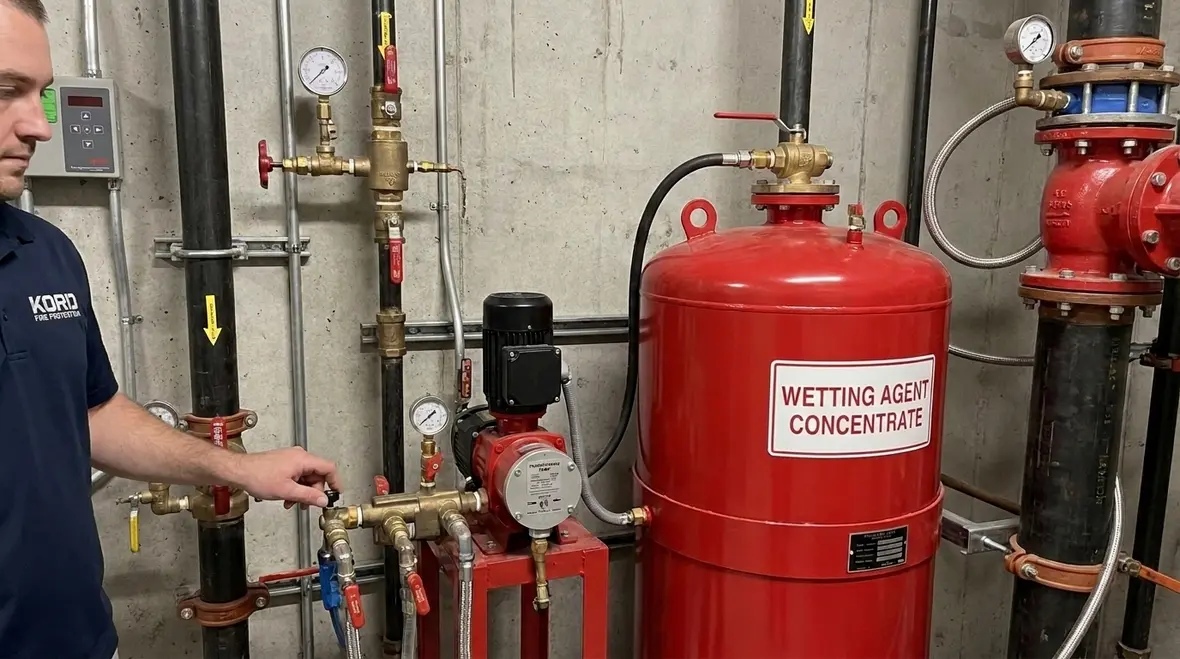
NFPA 18 Section 8.1: Wetting Agent System Requirements
Quick Answer
NFPA 18 section 8.1 wetting agent system requirements define how wetting agents are stored, proportioned, connected, and maintained so they deliver reliable foam firefighting performance. Compliance depends on correct concentrations, functioning components, tested delivery, and disciplined inspection and maintenance practices.
Facilities reviewing broader sprinkler reliability often pair wetting agent compliance with fire sprinkler system service so inspection, maintenance, and deficiency correction stay aligned across the full water based protection setup.
What NFPA 18 section 8.1 covers in wetting agent systems
NFPA 18 focuses on sprinkler systems and other water based systems used for foam and enhanced fire control. Section 8.1 addresses wetting agent systems that improve water penetration and foam solution performance by reducing surface tension. In practical terms, facilities use these systems where ordinary water application does not achieve the required distribution, burnback control, or suppression effectiveness.
For many commercial, industrial, and retail occupancies, the biggest compliance risk is not the initial installation. It is operational drift over time, including incorrect dosing, contamination, clogged proportioning components, degraded hoses or valves, and missed inspections. Facility teams that treat wetting agent systems like a one time capital purchase often encounter performance failures during drills, audits, or after extended periods without testing.
For an overview of wetting agent concepts and where they fit within NFPA 18 driven design decisions, see: NFPA 18 overview wetting agents.
How wetting agent systems must be designed to deliver correct concentration
NFPA 18 section 8.1 wetting agent system requirements center on delivering the wetting agent at the proper concentration to the firefighting water stream. That means the system must proportion accurately under real operating conditions, not just under ideal laboratory or commissioning conditions.
Proportioning and injection points
Wetting agent is typically injected into the water supply using calibrated proportioning equipment such as venturi style injectors, metering pumps, or other approved dosing devices. The injection point must ensure mixing and stability so the agent reaches the target hazard with consistent concentration.
- Correct hydraulic placement: injection locations must account for flow turbulence and pressure losses so the dosage does not change across operating ranges.
- Backflow prevention: protective devices are needed so firefighting or contaminated water conditions do not migrate into the agent side.
- Temperature and chemical compatibility: wetting agent formulation must be compatible with system materials and expected ambient temperatures.
Concentration verification is the compliance reality
Many facilities struggle because wetting agent systems can appear operational while still delivering the wrong concentration. Dilution changes can occur after maintenance, after component replacement, or due to unnoticed leaks in valves and injection piping. As part of compliance readiness, concentration should be verifiable using an inspection procedure aligned with the system design and applicable standards.
What equipment components must remain functional during inspections
NFPA 18 section 8.1 wetting agent system requirements translate into a practical expectation: every component that controls supply, concentration, and delivery must remain in working order.
Storage, piping, valves, and integrity checks
Commercial facilities often store wetting agent in tanks or containers connected to the proportioning unit. Over time, storage related problems can affect performance even when the dosing device works.
- Container condition: degradation, damaged labels, or incomplete inventory records can create uncertainty about agent type and concentration.
- Piping and hose wear: hoses can fatigue, and fittings can loosen. Even small leaks can shift the delivered concentration.
- Valve reliability: valves used for isolation, drain, or changeover must operate smoothly and seal effectively. Sticking valves can delay injection.
Filters, strainers, and clogging failure points
Clogging is a common failure mode in wetting agent systems because the agent and system can introduce particulates. Filters and strainers protect injection components, but they also require maintenance. A partially blocked strainer can reduce flow through the injector, which can in turn alter the dose delivered to the hazard.
Mixing, flow paths, and operational changes
Wetting agent performance depends on correct flow paths. Facility modifications, including pump changes, valve replacements, or rebalancing of water supplies, can unintentionally change the injection and mixing conditions. NFPA 18 section 8.1 wetting agent system requirements implicitly require operational consistency, so facilities should manage change control carefully.
Testing and inspection practices that prevent noncompliance
In real world audits, wetting agent systems fail because inspection schedules focus only on the fire suppression side and overlook the dosing side. Compliance programs for commercial facilities should treat wetting agent systems as a dedicated, testable subsystem.
Operational checks during maintenance cycles
A robust program typically includes:
- Verification of supply: confirm agent inventory levels and ensure the correct product is installed.
- Functional activation: inspect that injection devices can operate when required and that isolation valves are correctly configured.
- Leak checks: verify seals and connections, especially after component replacement or line work.
- Visual and tactile inspection: look for corrosion, discoloration, residue buildup, and abnormal vibration at pumps and proportioning equipment.
Commissioning level controls after any intervention
After any maintenance, refurbishment, or component replacement, the system should be returned to a verified baseline. This is where many facilities fall short because technicians replace parts but do not confirm concentration delivery. Kord Fire Protection supports commercial compliance through ongoing inspection, testing, and maintenance workflows designed to keep wetting agent delivery within specification.
When wetting agent is integrated with sprinkler and water supply performance, pump systems also become a critical dependency. For supplementary guidance on pump system fundamentals used in fire water delivery reliability, see: firepumps.org.
Common compliance challenges in commercial, industrial, and retail facilities
Facilities use wetting agents to address specific suppression challenges, but operational complexity increases compliance exposure. The most frequent issues include documentation gaps, dosing drift, and maintenance shortfalls.
1) Incomplete records and product traceability
Many commercial asset registers do not capture wetting agent product identification, lot information, or replacement dates. Without traceability, it becomes hard to demonstrate what is actually installed and whether it matches the original design assumptions.
2) Concentration changes from routine work
After service events, dosing components can be reassembled incorrectly, calibrated settings can be lost, or isolation valves can remain mispositioned. These errors may not be obvious during visual inspections but can lead to concentration failures during functional tests.
3) Deferred maintenance of strainer and injection components
Filters and injection components need attention on a planned schedule. If they are ignored, performance degrades gradually. Facilities then discover the problem only after a test reveals insufficient delivery or inconsistent performance.
4) Staffing and training gaps
Some sites rely on multiple contractors, and handovers can miss wetting agent specific tasks. A consistent maintenance protocol and accountable service provider help prevent omissions. Kord Fire Protection delivers specialty sprinkler and fire protection service coordination suitable for ongoing compliance obligations.
For related sprinkler services context, see: Australian fire sprinkler services.
Why ongoing maintenance matters as much as initial compliance
NFPA 18 section 8.1 wetting agent system requirements aim to ensure dependable delivery, not just initial acceptance. Over months and years, wetting agent systems can drift due to chemical aging, contamination, valve wear, and changes to water supply conditions. A disciplined maintenance strategy keeps concentration delivery consistent and improves readiness for inspections, annual testing cycles, and emergency response scenarios.
Kord Fire Protection positions wetting agent system compliance as an ongoing service program for commercial facilities, combining inspection readiness with practical field maintenance that reduces performance risk.
Frequently Asked Questions
Get wetting agent compliance stable across your facility
Wetting agent systems require more than periodic sprinkler checks. They need concentration confidence, injection reliability, and maintenance discipline to stay aligned with NFPA 18 section 8.1 wetting agent system requirements. Kord Fire Protection can support your program with specialized inspections, functional checks, and ongoing maintenance planning so your commercial, industrial, and retail assets remain audit ready and operationally reliable. Contact Kord Fire Protection to schedule a compliance review.

Join Our Newsletter!
Get the latest fire safety tips delivered straight to your inbox From our Newsletter.



