
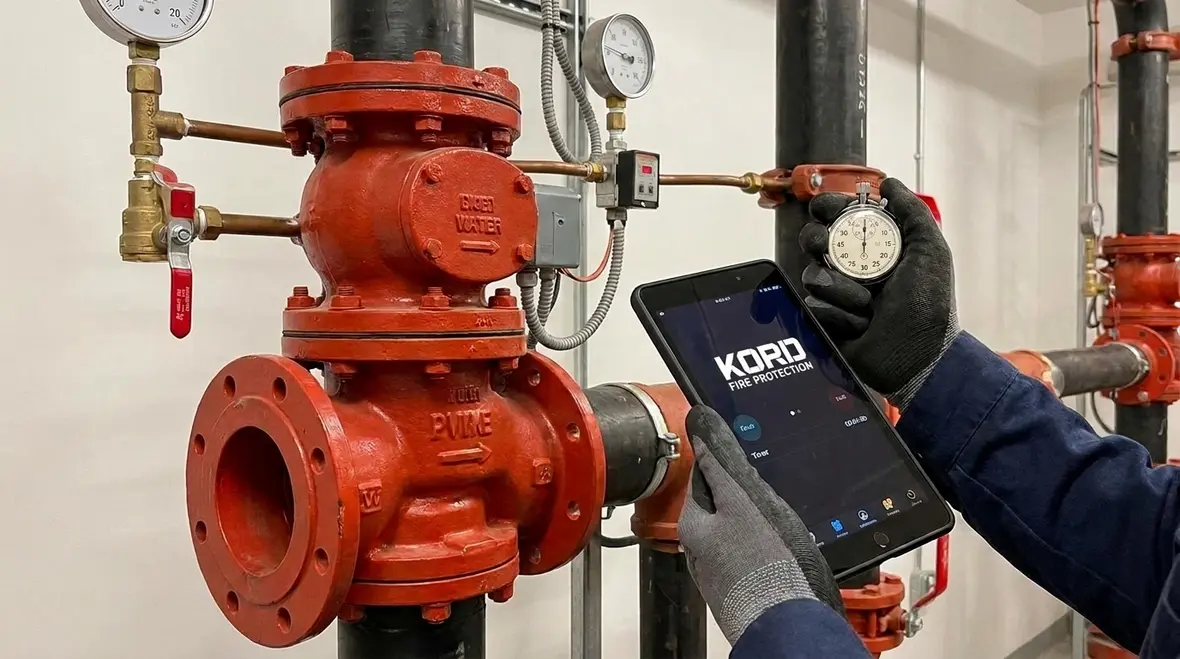
NFPA 15 Section 5.7 Valves: 5-Second Closure and Actuation Limits Explained
Quick Answer: NFPA 15 Section 5.7 sets performance expectations for certain water spray system valves, including actuation that achieves a rapid response within specified timing limits. Facility owners must verify both timing and operating force requirements through commissioning and scheduled inspections.
Commercial water spray fixed extinguishing systems depend on valves that open and close predictably when heat or other initiating devices demand operation. NFPA 15 Section 5.7 addresses that performance with requirements tied to closure time and the actuation behavior of valves used in these systems.
If your team is also reviewing overall water supply reliability, it helps to pair valve timing discussions with fire pump service and inspection support, since pump performance and available pressure can influence how smoothly a system responds under test and during an actual event.
What NFPA 15 5.7 valves indicate when timing matters
In practical terms, NFPA 15 5.7 valves indicate actuation performance that matters to water distribution, system reliability, and the ability of sprinkler or spray components to deliver water when needed. When timing and force requirements are not met, the system may delay water delivery or underperform during demand.
For facilities managing compliance, understanding how the standard treats rapid actuation helps align design, installation, testing, and ongoing maintenance with the expectations used by AHJs, insurers, and service technicians. That includes validating the behavior behind NFPA 15 5.7 valves indicating actuation 5 second 40 lbf 14 inch during acceptance testing and periodic inspections.
NFPA 15 Section 5.7 performance intent in real-world systems
NFPA 15 focuses on water spray system reliability. Section 5.7 addresses valve performance characteristics that directly influence how fast water begins flowing to the hazard once the system is called to act.
From a trade perspective, the key compliance goal is repeatable system response. That means the valve does not just “work,” it works quickly enough and with sufficient mechanical performance to position the valve into the proper flow state. For commercial, industrial, and retail buildings, this matters because operational demands often include limited downtime windows, aging piping systems, and recurring maintenance that can subtly change valve performance.
So what exactly are the 5 second closure and actuation limits?
NFPA 15 Section 5.7 includes performance criteria commonly expressed in terms of closure time and actuation behavior. The standard language is tied to how quickly a valve must reach a required position after actuation initiates and how operating conditions, such as required opening forces, relate to that response.
In facility compliance work, the phrase NFPA 15 5.7 valves indicating actuation 5 second 40 lbf 14 inch serves as a practical shorthand for understanding a common test scenario: a valve must respond within an indicated actuation window, and the required operating effort to move the valve to its functional position corresponds to a measurable force over a defined travel or dimensional relationship.
How those requirements show up during testing
- Timing validation: Technicians capture actuation time from the start of the control signal through valve movement to the target position.
- Force and travel verification: Service teams confirm that the valve mechanism provides sufficient mechanical movement under the system’s operating conditions.
- Controlled repeatability: The valve must achieve the same performance multiple times to satisfy acceptance and recurring inspection expectations.
Common compliance challenges that slow valve actuation
Even when the system design meets the letter of the specification, valve performance can drift over time. For commercial facilities, the most frequent issues fall into a few categories.
1) Mechanical friction, binding, and wear
Valve internals can develop friction due to corrosion, sediment, worn seals, or misalignment during installation. Any added resistance can increase the time required to reach full or functional opening. When friction rises, the system may still operate eventually, but it can fall short of the rapid actuation window expected under NFPA 15 Section 5.7.
2) Inadequate actuator power or pressure conditions
Valves operated by mechanical, pneumatic, hydraulic, or electrical actuation must receive the expected operating energy. Low pressure, reduced flow to a pilot control, or actuator degradation can prevent consistent movement. That inconsistency often appears in trend testing and repeat cycle tests during commissioning or inspection.
3) Control delays and improper system interface
Control wiring, solenoid behavior, relay timing, and interface logic can add delays. Technicians must confirm that the valve actuation time measured in the field corresponds to the standard’s expectation, not just the time the control panel indicates.
4) Flow path obstruction and water quality issues
Even when the actuator works, obstructions in the valve seat area or upstream piping can delay effective water delivery. Sediment, scale, or debris can change flow characteristics and prolong the time until the valve behaves as required for water distribution.
How commercial service teams should inspect and maintain NFPA 15 5.7 valves
Compliance depends on documented performance, not assumptions. Effective programs treat valve actuation performance as a maintenance-critical parameter and schedule verification around operational realities.
Acceptance and commissioning (baseline evidence)
- Actuation timing records: Measure and record the time to reach required valve position under representative conditions.
- Operating force and travel checks: Confirm the mechanism achieves the required travel and functional state with the expected operating energy.
- System-wide coordination: Confirm that associated pumps, controls, and supply conditions do not add delays that cause the valve to miss its performance window.
Periodic inspections (trend detection)
For ongoing compliance, service teams should look for early warning indicators that actuation time is trending longer. That includes monitoring temperature exposure, identifying recurring water quality concerns, and verifying that actuators maintain consistent operating output.
Maintenance actions that protect 5 second performance
- Cleaning and internal inspection: Remove debris, verify seating surfaces, and address corrosion or buildup.
- Seal and gasket condition: Replace worn components to restore intended friction and movement behavior.
- Actuator servicing: Maintain springs, diaphragms, solenoids, linkages, and pilot components according to manufacturer requirements and system performance history.
- Re testing after any intervention: After replacing parts, technicians must revalidate timing and functional travel to confirm the standard’s performance remains met.
For guidance on keeping water spray fixed systems aligned with NFPA-aligned maintenance practices, Kord Fire Protection also publishes practical compliance insights here: NFPA 15 enhancing fire safety with water spray fixed systems.
How to align valve performance with system design and national guidance
Valve actuation limits do not exist in isolation. They interact with the system’s design intent, hazard classification, hydraulic supply arrangements, and the way spray patterns distribute water. That interaction is why technicians also review relevant references and system documentation during testing.
Facilities can improve readiness by benchmarking against industry training materials and standards summaries. For additional educational context on fire pump operation and water supply behavior that can indirectly affect valve actuation conditions, teams often reference resources such as firepumps.org.
Kord Fire Protection supports commercial owners by providing structured inspection, testing, and maintenance programs that focus on measurable valve performance. This approach helps facilities maintain compliance, reduce the likelihood of failed inspections, and keep systems ready for emergency demand.
Frequently Asked Questions
Stay inspection ready with documented valve performance
NFPA 15 5.7 valve performance depends on repeatable timing and operating behavior, not assumptions. Kord Fire Protection helps commercial facilities establish baseline test evidence, monitor performance trends, and maintain valve mechanisms so actuation stays within required limits. Schedule a valve inspection and actuation verification today to reduce operational risk and keep your water spray system compliant.

Join Our Newsletter!
Get the latest fire safety tips delivered straight to your inbox From our Newsletter.



