
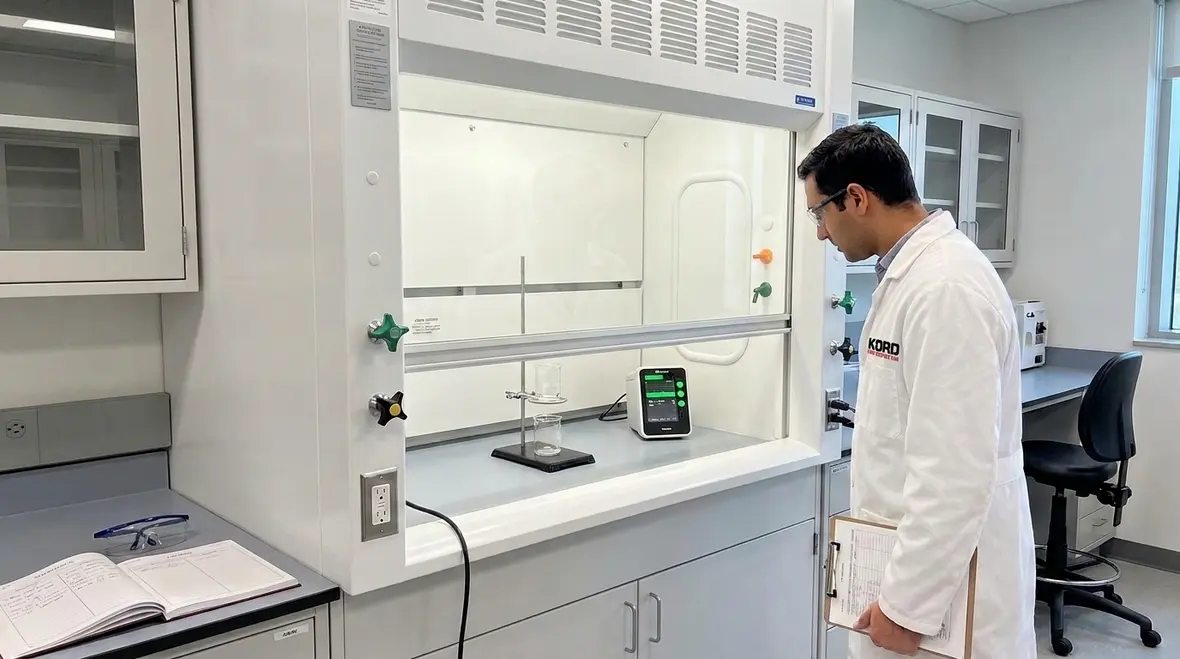
NFPA 45 Section 7.8: Chemical Fume Hood Design Requirements
Quick Answer
NFPA 45 Section 7.8 sets design requirements for chemical fume hoods to control hazardous vapors and maintain safe capture performance. It addresses ventilation effectiveness, placement, airflow considerations, and construction details that support reliable operation and inspection readiness.
Facilities that want a broader view of inspection, testing, and maintenance can also review Kord’s fire protection services guide for context on how compliance programs are documented and maintained.
What NFPA 45 chemical fume hood requirements actually control
NFPA 45 chemical fume hood requirements focus on the engineering intent behind the hood: minimizing employee exposure and preventing the release of hazardous chemical vapors to the room. Section 7.8 does not treat fume hoods as “set and forget” equipment. It ties design to performance so that capture and exhaust conditions remain predictable during normal operations, maintenance activities, and inspection intervals.
For commercial, industrial, and retail facilities with laboratory, preparation, or specialty chemical handling spaces, these expectations directly affect how owners select hood types, coordinate ductwork, and document operating conditions for ongoing compliance.
Design foundation under Section 7.8: containment and ventilation effectiveness
Section 7.8 centers on ensuring that a fume hood behaves like a containment system, not merely a cabinet with a fan. The design must support stable airflow patterns at the hood opening so that contaminants are captured and transported to an appropriate exhaust path.
1) Airflow control and capture performance
Proper design supports stable inward flow at the sash opening across expected usage conditions. This typically requires that hood exhaust volume and duct resistance are selected to maintain target face velocities under realistic operating states. Facilities commonly run into noncompliance when duct balancing assumptions do not match installed conditions, when filter or exhaust components add unexpected resistance, or when hoods are modified after commissioning without rebalancing.
2) Hood configuration must match the process
Fume hoods may be installed for a wide range of chemical handling tasks, but hood design and operation must align with the specific hazards. For example, the hood should support the containment goals for procedures that generate vapors, aerosols, or other airborne contaminants. When facilities install hoods primarily for general storage or low generation activities, they still need to meet the ventilation effectiveness and design requirements that Section 7.8 expects for the hood classification and intended use.
Where Section 7.8 design requirements show up in real inspections
On commercial sites, inspectors and internal safety teams typically evaluate whether the hood installation and its control strategy can demonstrate performance. NFPA 45 chemical fume hood requirements often surface during walkdowns, maintenance audits, and commissioning verification, especially when failures are subtle.
Common compliance challenges
Incorrect or drifting airflow: Fans, dampers, and controls can drift after maintenance, filter changes, or seasonal building pressure variations.
Improper duct routing or installation damage: Kinks, poor support, or leaks can change airflow distribution and reduce capture.
Uncontrolled room air effects: Supply air jets, doors that open frequently, or HVAC imbalances can disrupt the hood’s inward flow.
Inadequate signage and operating discipline: Sash positions, cluttered work surfaces, or blocked baffles can reduce containment performance.
Because these failures often develop gradually, facilities benefit from a documented inspection and performance verification cycle aligned with internal risk and external expectations.
Construction and installation considerations that reduce failure points
Fume hood design requirements under Section 7.8 depend on how the hood is built, installed, and integrated with exhaust systems. The goal is to preserve intended airflow and containment under real working conditions.
Key installation elements that matter
Sash and baffle integrity: Worn hardware, misalignment, or obstructions can alter airflow at the opening and at internal flow paths.
Duct and exhaust interfaces: Transitions, fittings, and component selection influence total pressure and distribution to the hood.
Exhaust discharge and system compatibility: Exhaust paths must be compatible with the hood exhaust rate and the facility’s exhaust strategy.
Labeling and safe use orientation: Operational clarity reduces the risk of improper use that undermines capture performance.
Commercial facility teams often underestimate how much after installation changes can affect performance. Examples include adding equipment that obstructs airflow, changing room HVAC supply patterns, and relocating workstations without verifying the hood response.
Inspection, testing, and maintenance: the compliance loop after design
Section 7.8 expectations are sustained through ongoing maintenance and verification. Even a well designed hood can fail if balancing, exhaust components, or control logic does not remain within expected parameters.
What effective compliance programs do
Document commissioning results: Capture the baseline airflow conditions and control settings so performance drift can be detected.
Schedule performance checks: Confirm hood performance at routine intervals and after any change in ductwork, filters, fan motors, or control components.
Maintain critical components: Dampers, fans, belts or drives, and sash operation hardware require proactive service to prevent gradual loss of performance.
Train operators: User behavior affects containment. Staff should understand how sash position, clutter, and process placement influence capture.
To support ongoing compliance, Kord Fire Protection provides commercial inspection, testing, maintenance, and repair services that help owners manage life safety systems and documentation across working environments.
For facilities already coordinating broader system upkeep, Kord’s fire sprinkler service program is a useful related resource near the top of an overall compliance plan, especially when inspection scheduling and documentation need to stay organized across multiple fire protection systems.
How to plan for upgrades and retrofits without triggering performance gaps
Many facilities retrofit or reconfigure spaces for new processes, and those changes can undermine NFPA 45 chemical fume hood requirements if the ventilation system is not evaluated as a system.
Retrofit planning checklist
Assess duct resistance and balancing: Verify that installed ductwork and components match design assumptions.
Check HVAC interaction: Confirm that supply and return air patterns do not disrupt hood inward flow.
Re test after modifications: Any change to exhaust, controls, or hood hardware requires performance verification.
Update operating procedures: Ensure the written program reflects actual sash practices, equipment placement, and chemical handling controls.
When commercial teams treat fume hoods as part of a broader ventilation and process safety package, they reduce the likelihood of late discovery during inspections. Kord Fire Protection can support the testing and maintenance pathway that keeps retrofit projects aligned with sustained compliance outcomes.
Frequently Asked Questions
Next steps
Facilities should verify that each chemical fume hood installation meets NFPA 45 Section 7.8 design intent and that performance is documented through repeatable testing. Partnering with Kord Fire Protection helps commercial and industrial sites maintain traceable inspection records, address performance drift, and keep hoods operating safely through maintenance cycles. Start with a gap review of hood condition, ductwork integration, and testing history, then build a corrective action and verification plan.

Join Our Newsletter!
Get the latest fire safety tips delivered straight to your inbox From our Newsletter.



