
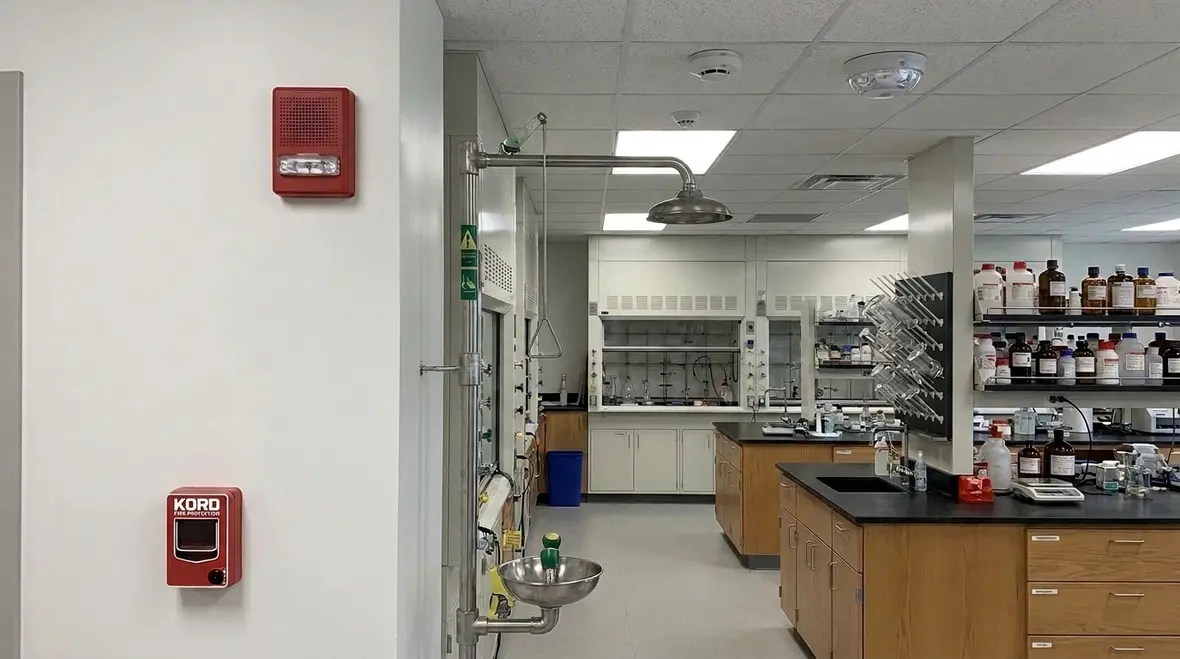
NFPA 45 Section 6.4: Fire Alarm System Requirements for Labs
Quick Answer: NFPA 45 Section 6.4 sets the minimum expectations for fire alarm systems protecting laboratory occupancies, including required functions, audibility and notification, manual and automatic initiation behavior, and testing and maintenance practices. Proper documentation and inspection readiness are essential for compliance and safety.
Facilities managing laboratory fire alarm compliance often benefit from pairing code review with broader commercial fire alarm services so inspections, testing, maintenance, and documentation stay aligned from the beginning instead of becoming a last-minute scramble.
What NFPA 45 Section 6.4 expects from a laboratory fire alarm system
Laboratory spaces create unique fire and life safety risks due to specialized equipment, hazardous materials, and frequent process changes. NFPA 45 laboratory fire alarm system requirements address how alarm systems detect, annunciate, and notify occupants so that response actions remain consistent even as lab operations evolve. For many commercial and industrial owners, the compliance challenge is not only whether the system sounds alarms, but whether it performs as intended for lab-specific hazards, including correct device placement, reliable notification behavior, and verifiable ongoing maintenance.
In practice, facilities must ensure that the alarm system is designed, installed, inspected, and maintained so that it meets both the letter of the code and the functional needs of laboratory operations. A robust program typically aligns fire alarm programming, labeling, and acceptance testing with the lab’s workflow and occupancy patterns.
Which functions the alarm system must provide in labs
Section 6.4 focuses on the fire alarm system’s ability to initiate and communicate a fire condition effectively. While the exact configuration depends on the lab layout, occupancy classification, and hazards, the core expectation is that the system supports timely detection and clear notification to occupants and responsible staff.
1) Alarm initiation and signaling logic
- Multiple initiation paths: Labs typically require both manual alarm activation and automatic detection where the hazard profile warrants it.
- System zoning and annunciation: The system should identify the general location of an alarm so response teams can act efficiently.
- Fail safe behavior: Programming must avoid ambiguous or delayed signaling. Alarms should transmit and annunciate as designed without reliance on manual interpretation.
2) Alarm notification and intelligibility
NFPA 45 laboratory fire alarm system requirements place emphasis on occupant notification that is perceivable under real-world conditions in laboratory environments. Commercial facilities often fail this requirement through overlooked factors such as background noise, lab door arrangements, or audibility dead spots during final commissioning.
- Audibility and visual notification: Notification appliances must be installed and verified so they meet the required audibility and visibility criteria for the specific areas.
- Message consistency: The alarm message or alarm pattern should be consistent with facility training so occupants do not hesitate or confuse fire signals with other alerts.
How to plan the lab fire alarm coverage so it actually works during inspections
Meeting NFPA 45 laboratory fire alarm system requirements requires more than device count. It requires defensible coverage logic that survives plan review, acceptance testing, and periodic inspection.
Device placement challenges in laboratories
- Obstructions and ducting: Shelving, lab benches, fume hoods, and equipment can block airflow patterns or create stratification that impacts detection performance.
- Process changes: Chemical usage, hot work practices, and storage arrangements change over time, and those changes can affect smoke, heat, and ignition behavior.
- Ventilation influence: HVAC and localized exhaust can dilute smoke or delay detection, requiring careful coordination of detection type and spacing.
Documentation and labeling that inspectors expect
Many compliance delays come from weak documentation, not weak hardware. Facilities should maintain clear labeling, panel zone maps, device address lists, and as-built information. Kord Fire Protection routinely validates that drawings match the installed system and that the labeling supports operational response.
Commissioning and acceptance testing readiness
Commercial facilities should expect a performance-focused test approach during commissioning. The goal is to prove that the system will initiate and notify as required, including the correct behavior of initiating devices, notification appliances, trouble signals, and alarm routing.
Common failure points in lab alarm systems and how to prevent them
Even well-designed systems can fail in labs due to operating realities. Understanding the typical failure modes helps owners reduce risk, reduce downtime during inspections, and keep the system dependable.
1) Wrong detection type for the hazard behavior
Using the wrong sensor technology for a lab’s expected smoke or heat profile can lead to nuisance alarms or, worse, delayed detection. Correct selection requires hazard review and operational input, not only a general layout approach.
2) Notification appliance audibility and strobe visibility gaps
Audibility failures often occur when doors are closed, when occupants work behind partitions, or when notification appliances were not tuned during acceptance testing. Strobe placement and field-of-view issues can also prevent effective visual notification.
3) Programming changes after construction
Programming drift happens when contractors add circuits, modify zoning, or repurpose lab rooms. Without disciplined change control, alarm mapping, annunciation, and response expectations can diverge from what NFPA 45 laboratory fire alarm system requirements intend.
4) Maintenance gaps and unverified performance
When preventive maintenance is inconsistent, dirty detectors, faulty end-of-line supervision, and damaged wiring connections can go unnoticed. These issues can degrade performance and create surprise nonconformities during inspections.
For continuous compliance, many commercial owners partner with Kord Fire Protection to manage system inspections, functional testing, device maintenance, and corrective actions with documentation suitable for audit and authority review.
Inspection, testing, and maintenance: the compliance backbone
NFPA 45 laboratory fire alarm system requirements depend on ongoing verification. A lab may look code compliant on installation day, but it must remain compliant through routine testing and documented maintenance.
Operational testing approach
- Functional testing: Test initiation devices, alarm signaling circuits, and system annunciation to confirm the system reaches the intended state.
- Trouble signal verification: Confirm supervisory and trouble behavior so technicians and monitoring can act promptly.
- Alarm audibility verification: Validate that notification performance remains effective after tenant improvements, equipment layout changes, or room renovations.
Maintenance mechanics that matter in labs
- Detector cleaning and condition assessment: Labs can produce residues and airborne contaminants that affect optical sensors and sensitivity.
- End-of-line device and wiring checks: Supervision failures can mask degraded system health.
- Battery and power system verification: Reliability depends on stable power and correct standby capacity.
If your facility supports multiple tenants, Kord Fire Protection can help standardize test schedules, coordinate access into active lab spaces, and keep records organized for compliance readiness.
Teams that want a practical example of inspection-focused documentation can also review this Kord Fire article on fire alarm testing for commercial properties, which highlights how blocked devices, sensitivity problems, and missing records turn into inspection headaches.
How labs and facility standards influence the final configuration
Laboratory fire alarm designs often integrate life safety requirements with facility standards used by commercial, industrial, and retail operators. While Section 6.4 drives lab-specific expectations, owners typically must harmonize the alarm system with building-wide practices, including emergency procedures and tenant responsibilities.
Tenant improvements and change management
Commercial lab environments frequently undergo remodeling. A disciplined approach helps prevent unwanted rework. Owners should require that alarms affected by lab improvements follow an established change control process, including updating maps, labels, and programming records.
Training and operational readiness
Even the most compliant alarm system can underperform if staff responses do not match the annunciation and location strategy. Facilities should align test outcomes with training so occupants understand what alarm states mean and who responds first.
Frequently Asked Questions
Conclusion and call to action
NFPA 45 laboratory fire alarm system requirements focus on dependable detection and clear notification in environments that change. To maintain compliance, facilities should treat alarm systems as operational life safety equipment, not static infrastructure. Kord Fire Protection helps commercial owners plan testing, validate performance, manage maintenance, and keep documentation audit-ready. Schedule an assessment today to confirm your lab alarm system functions as intended and stays that way through ongoing inspections.

Join Our Newsletter!
Get the latest fire safety tips delivered straight to your inbox From our Newsletter.



