
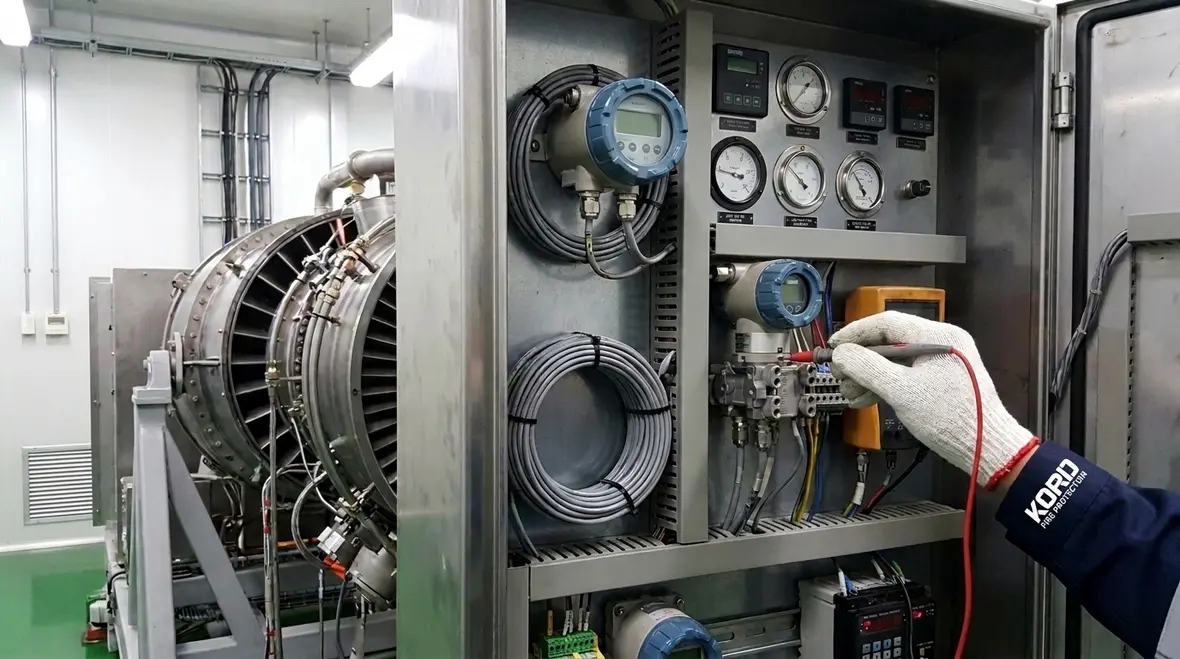
NFPA 37 Section 9.3: Controls and Instrumentation for Combustion Gas Turbines
Quick Answer
NFPA 37 Section 9.3 sets the performance expectations for combustion gas turbine controls and instrumentation. It focuses on safe startup, operation, shutdown, and protective shutdown functions, supported by reliable detection and signaling. Facilities must verify functions through inspection, testing, and documented maintenance.
For facilities that want a broader compliance support framework beyond turbine-related risk points, full fire protection services across Southern California can help connect inspection, testing, maintenance, repairs, and documentation into one practical program.
Why NFPA 37 gas turbine control instrumentation requirements matter in real facilities
Commercial sites that rely on gas turbines for power, process heat, or backup generation often treat controls as “set and forget.” NFPA 37 Section 9.3 challenges that assumption by requiring controls and instrumentation that remain dependable during normal operation and abnormal conditions. This is one reason NFPA 37 gas turbine control instrumentation requirements are a frequent audit focus, especially in industrial, data center, and retail campuses with remote operations and contractor-led maintenance.
From a risk perspective, instrumentation failures can prevent protective actions, delay shutdown, or create unsafe operating states. From a compliance perspective, incomplete testing records, unmanaged calibration intervals, and undocumented setpoint changes commonly lead to findings. Effective programs align turbine control hardware, detectors, wiring, control logic, and protection sequences into a verifiable system.
What Section 9.3 covers: controls, instrumentation, and protective behavior
NFPA 37 Section 9.3 addresses the controls and instrumentation used to manage combustion gas turbine operation and safeguard against hazardous conditions. While turbine OEMs design specific control architectures, Section 9.3 expectations translate into practical requirements that facilities must maintain throughout the lifecycle.
Key compliance outcomes
-
Safe operating sequence integrity: Controls must drive the turbine through start, acceleration, and run conditions without skipping required steps.
-
Protective shutdown capability: Instrumentation and control logic must reliably detect unsafe conditions and initiate the appropriate protective response.
-
Reliable signaling and indication: Field devices must provide correct signals to the turbine control system, and operators must receive accurate status information.
-
Maintainability: Control and measurement components must be capable of being inspected, tested, and maintained according to a documented program.
How controls and instrumentation should work during startup, operation, and shutdown
In practice, Section 9.3 compliance hinges on whether the turbine behaves correctly during the transitions when abnormal conditions are most likely: ignition, acceleration, flame establishment, and load changes.
Startup and ignition phase checks
During startup, controls depend on instrumentation feedback to confirm safe conditions before permitting continued operation. A common commercial challenge occurs when facilities replace sensors or modify wiring during maintenance but fail to update or validate calibration and acceptance criteria. If the turbine control system receives out of range values, it may either nuisance trip or, worse, permit operation without adequate verification.
Running phase protection and monitoring
During operation, instrumentation signals feed the control system to maintain combustion stability and protect against conditions that can lead to overheating, abnormal exhaust gas behavior, or loss of safe combustion. Typical failure patterns include drift in measurement devices, loose termination points, degraded wiring insulation, or control module fault states that do not lead to timely protective action.
Shutdown behavior and fail safe responses
Shutdown sequences must respond properly to normal shutdown commands and protective shutdown scenarios. Facilities must ensure the turbine control system and its associated input devices generate the expected shutdown behavior under alarm and fault conditions. A frequent compliance gap involves incomplete end to end validation, where technicians verify an alarm display but do not confirm the downstream shutdown initiation function.
Common compliance challenges under NFPA 37 Section 9.3
Even when turbines are installed to OEM specifications, NFPA 37 Section 9.3 expectations can be undermined by operational drift over time. The following issues frequently surface during commercial and industrial inspections.
1) Instrument calibration and sensor drift
-
Drift in temperature, pressure, and flame related measurements can move readings into ranges that trigger nuisance trips or mask hazardous conditions.
-
Calibration documentation gaps occur when calibrations are done by subcontractors without traceable records aligned to facility acceptance criteria.
2) Wiring, terminations, and signal integrity
-
Loose terminations and corrosion at terminal blocks can create intermittent faults.
-
Signal mismatch can happen after control room upgrades or retrofits, particularly when scaling factors or input types are changed without full functional testing.
3) Setpoint and logic changes without revalidation
-
Unauthorized tuning can alter protective thresholds and delay protective shutdown actions.
-
Inadequate revalidation occurs when setpoints change but engineers do not perform the full alarm to shutdown function verification.
4) Test scope that stops short of safety function confirmation
Facilities often test “controls are alive” rather than confirming the complete chain: detector reading, signal processing, annunciation, and final protective shutdown behavior. NFPA 37 Section 9.3 expectations emphasize that instrumentation must support protective functions, not merely provide alarms.
Inspection, testing, and maintenance practices that hold up to scrutiny
NFPA 37 gas turbine control instrumentation requirements are not satisfied by equipment presence alone. Effective compliance programs verify that controls and instrumentation perform as designed and remain reliable between service intervals.
Recommended program elements
-
Documented functional testing: Verify detector signals, control responses, annunciation, and shutdown actions as a connected system.
-
Calibration management: Establish traceable calibration intervals aligned to OEM guidance and facility risk tolerance.
-
Configuration control: Manage setpoint changes, software updates, and hardware swaps through controlled approvals and post change validation.
-
Wiring and termination inspections: Include visual checks, continuity verification where appropriate, and corrosion mitigation practices.
-
Maintenance records: Maintain test results, acceptance criteria, and corrective actions with clear traceability.
Where fire protection professionals add value
Fire safety oversight for turbine facilities often intersects with combustion safety, protective shutdown initiation, and alarm system reliability. Kord Fire Protection supports commercial compliance and ongoing verification through systematic testing coordination, documentation discipline, and practical field readiness. Facilities benefit when fire protection and turbine life safety requirements operate as one integrated program rather than separate schedules.
Implementation strategy: reducing risk while meeting NFPA 37 expectations
Facilities typically succeed with an approach that combines compliance planning, operational coordination, and disciplined verification. A strong strategy includes a gap assessment against NFPA 37 Section 9.3 outcomes, followed by targeted testing and maintenance improvements.
Step by step approach
-
Map protection functions: Identify which instrumentation inputs support each protective shutdown sequence.
-
Verify test coverage: Confirm the facility’s test procedures cover detector to shutdown behavior, not only alarm indications.
-
Review calibration and configuration control: Ensure records are traceable and change management is enforced.
-
Address common failure points: Focus on sensors, terminations, control modules, and wiring integrity.
-
Maintain continuous readiness: Schedule recurring verification aligned with risk and manufacturer guidance.
For additional compliance context across detection, testing, and inspection program development, facilities can review resources from Kord Fire Protection here. Teams focused on water-based reliability can also explore proactive maintenance for fire pump system reliability to see how disciplined testing and recordkeeping support broader life safety readiness.
Frequently Asked Questions
Call to action
NFPA 37 Section 9.3 compliance depends on more than having instrumentation installed. Kord Fire Protection helps commercial and industrial facilities build defensible inspection and testing workflows that confirm turbine protection functions, manage records, and reduce operational risk. Request a compliance readiness assessment to identify gaps, align test scope to protective outcomes, and strengthen ongoing maintenance discipline before your next inspection cycle.

Join Our Newsletter!
Get the latest fire safety tips delivered straight to your inbox From our Newsletter.



