
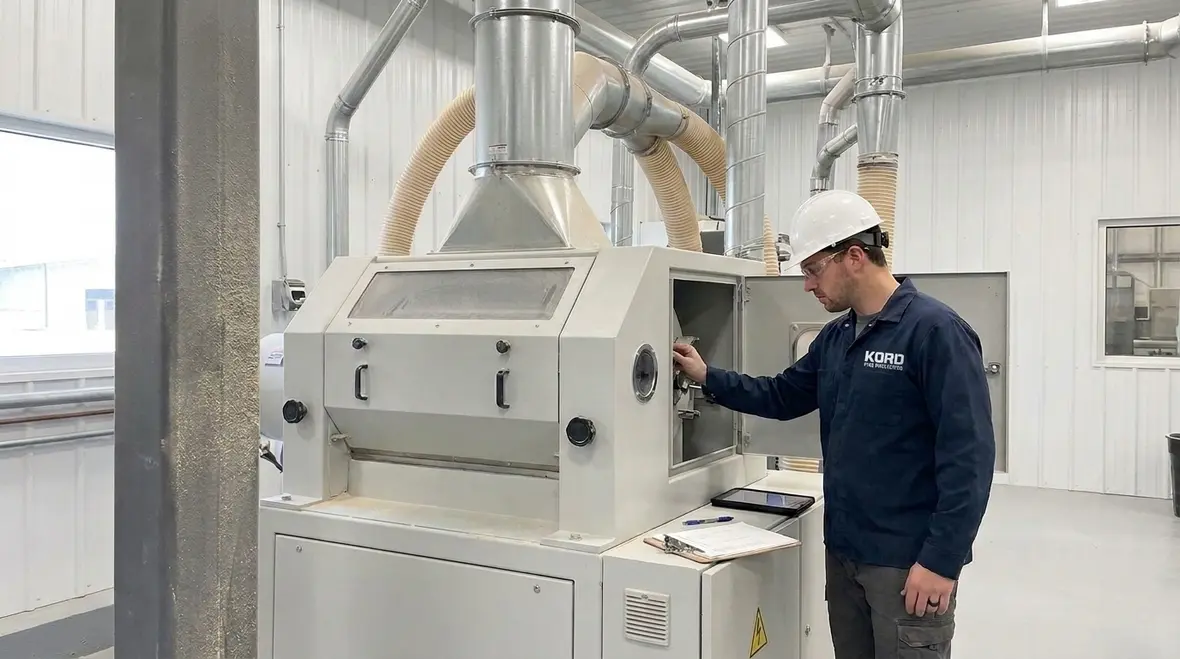
NFPA 36 Section 8.5 Grinder Requirements: Compliance Guidance for Commercial Facilities
Quick Answer
NFPA 36 Section 8.5 establishes safety expectations for grinders used in food processing and similar industrial operations, with emphasis on fire hazard control. Compliance focuses on grinder construction, installation, safe operation, and ongoing inspection and maintenance to prevent ignition sources and combustible accumulation.
Facilities tightening grinder area controls often also need broader support around inspection readiness and corrective work. Kord Fire Protection offers fire protection services in Southern California for teams that want a cleaner path from open deficiencies to documented compliance support.
What NFPA 36 grinder requirements actually target
Facilities subject to NFPA 36 must control ignition risk in areas where grain, feed, or processing materials create combustible dust and residue. NFPA 36 grinder requirements are not limited to the grinder body. They cover the entire operational reality around the equipment, including feeding, dust control behavior, contamination and residue management, and how the grinder is maintained so it does not create a new ignition pathway.
In commercial, industrial, and retail environments, common compliance failures occur when equipment “runs well” but the supporting systems are neglected: worn guards, poor electrical fit, damaged belt drives or couplings, leaking dust collectors, blocked discharge chutes, or combustible buildup in and around the grinder area. Section 8.5 expectations align with these real world failure points.
Where Section 8.5 grinder requirements apply
Section 8.5 focuses on grinders used to reduce particle size as part of production. These units frequently operate in proximity to combustible dust and high air movement from conveyors, dust collection systems, and material handling. The practical takeaway for safety teams is to treat grinders as ignition risk hubs within the processing train.
Compliance planning should include:
- Mapping grinder locations to the facility combustible material inventory and airflow patterns.
- Confirming grinder operating modes, including start up, shut down, jam clearing procedures, and typical misfeeds.
- Verifying that the dust control arrangement matches the grinder duty, not just the manufacturer “nameplate” description.
- Maintaining a clear inspection baseline tied to grinder components and the surrounding surfaces and ducts.
Where operational zones transition from production to maintenance access, safety staff must ensure grinders remain under the same ignition control discipline. Kord Fire Protection supports many facilities with documentation and verification programs that make it easier to demonstrate good faith compliance during internal audits and third party inspections.
For facilities building operating procedures around combustible dust hazards, the article on NFPA 1 Section 40.6 dust explosion operating procedures pairs naturally with grinder compliance planning and helps connect daily work practices to broader fire risk controls.
How grinders are expected to be built and installed
NFPA 36 grinder requirements emphasize reducing ignition sources and preventing conditions that allow fire to grow. While exact language and numbering can vary by edition, the engineering intent stays consistent: a grinder must be installed and configured so normal operation does not create hazardous ignition conditions, and so the risk created by dust and residue remains controlled.
Operational ignition controls
Grinders contain rotating components, drive systems, bearings, and internal clearances that can become failure sources if worn or misaligned. Compliance programs should ensure:
- Drive components operate within design tolerances to prevent friction heating.
- Guards and covers remain installed to limit debris exposure and reduce the chance of mechanical failure spreading.
- Electrical connections and motor enclosures remain intact, sealed where needed, and free of damage that can produce hot spots.
- Housings and chutes prevent accumulation zones that allow dust to build and remain undisturbed.
Installation alignment with dust handling reality
Grinders often sit upstream or downstream of conveyors and dust collectors. If ducting, seals, and collection points do not match the grinder’s discharge characteristics, combustible dust can escape and settle. During routine inspections, safety teams should visually confirm:
- Dust collector placement and capture efficiency around the grinder throat and discharge.
- Seals and gaskets at access panels, cleanout ports, and duct connections.
- Chute geometry that does not promote bridging and overflow of fines.
- Nozzles, vacuum pickup points, and deflector placement align with the grinder’s particle flow.
If the facility uses hot work or temporary bypass operations, the grinder area must be treated as a controlled hot work zone. NFPA 36 grinder requirements do not remove risk during maintenance; they demand disciplined controls while equipment is vulnerable to dust disturbance and ignition sources.
Inspection and maintenance: the compliance line that gets missed
Most grinder failures that matter for fire safety appear long before catastrophic damage. NFPA 36 grinder requirements place weight on keeping the grinder in safe condition through inspection and maintenance that is consistent and traceable.
Daily and periodic checks for high risk indicators
Facilities should implement inspection routines that focus on fire hazard drivers:
- Dust accumulation checks: verify the grinder enclosure exterior, surrounding floors, ledges, duct runs, and access panel seams remain free of settled dust that can fuel a fire.
- Mechanical heating indicators: look for bearing noise changes, abnormal vibration, and recurring motor overload events.
- Wear and alignment: confirm belts, pulleys, couplings, and fasteners meet acceptance limits and that guards are not bypassed.
- Electrical integrity: check for damaged wiring, loose conduit fittings, overheating at motor terminals, and compromised seals.
- Choke and jam behavior: monitor jam history and verify cleared jam procedures reduce dust disturbance and do not create new ignition exposure.
Common failure points during audits
Commercial facilities often struggle with the evidence trail. Examples that frequently create compliance gaps include:
- Work orders exist, but they do not specify grinder critical components and do not capture condition observations.
- Maintenance intervals are based on runtime only, not on dust conditions, production changes, or jam rate increases.
- Cleanout procedures rely on sweeping that redistributes fines rather than controlled removal.
- Dust collector maintenance is treated as separate from grinder safety, despite direct coupling through airflow and discharge.
Kord Fire Protection assists facilities with practical compliance workflows, including inspection planning, documentation support, and technical guidance that connects grinder maintenance with broader combustible dust risk reduction. For organizations looking to strengthen their fire protection program, see Kord Fire Protection services for ongoing support.
Dust control integration: making the grinder area “fire safe by design”
Grinders rarely fail in isolation. The fire hazard environment depends on dust concentration, oxygen availability, and how dust behaves around the unit. NFPA 36 grinder requirements should be interpreted with the facility dust control strategy in mind, including cleaning, collection, and containment.
Engineering and housekeeping alignment
Effective compliance requires that the dust collection system and housekeeping practices work together:
- Collection systems capture at the source and do not rely on later cleanup to compensate for poor capture.
- Housekeeping methods remove dust without creating airborne dust clouds that could settle elsewhere and increase fuel loading.
- Maintenance includes verifying collector performance after filter changes, duct adjustments, and fan service.
- Access openings used during inspection and repair remain sealed after work concludes.
Change management around grinders
When production changes, grinder performance changes. Safety teams should treat modifications and operational changes as triggers for revalidation:
- New product formulations or moisture content that increases fines yield.
- Increased throughput that alters discharge velocity and dust carryover.
- Component replacements such as hammers, liners, blades, belts, or bearings without updated maintenance baselines.
These are the moments when NFPA 36 grinder requirements become most difficult to demonstrate, which is why facilities benefit from structured fire safety technical reviews. Kord Fire Protection supports commercial teams in aligning operational changes with defensible fire risk controls.
How to demonstrate compliance during inspections
NFPA 36 grinder requirements translate into a compliance file that shows consistent safe condition management. Regulators and insurers typically look for evidence that the facility does not rely on luck or “good housekeeping habits” without documentation.
What to keep on hand
- Inventory list of grinders and associated dust control equipment, including location and service area.
- Maintenance logs that identify critical components, corrective actions, and inspection results.
- Dust collector service records, filter change dates, and performance verification notes.
- Cleanout procedures and frequency, including method statements for removing settled dust.
- Electrical and mechanical inspection checklists with pass fail criteria and observed conditions.
Inspection walkdown approach
A strong walkdown ties the standard intent to what inspectors can see. Safety personnel should walk the grinder from feed to discharge and then outward:
- Confirm no bypassed guards or missing fasteners near rotating components.
- Verify duct connections and seals show no leakage patterns or dust staining indicative of escape.
- Check for accumulation along seams, access doors, motor bases, and under chutes.
- Validate that housekeeping and maintenance activities align with the stated procedures.
Frequently Asked Questions
Next step: build a defensible grinder compliance program
Facilities that treat grinder safety as a full system, not a single machine, reduce both risk and inspection friction. Kord Fire Protection can help you assess grinder fire hazard controls, strengthen maintenance documentation, and align dust control and housekeeping practices with NFPA 36 grinder requirements. Contact Kord Fire Protection to schedule a technical review and close the most common compliance gaps before they become findings.

Join Our Newsletter!
Get the latest fire safety tips delivered straight to your inbox From our Newsletter.



