
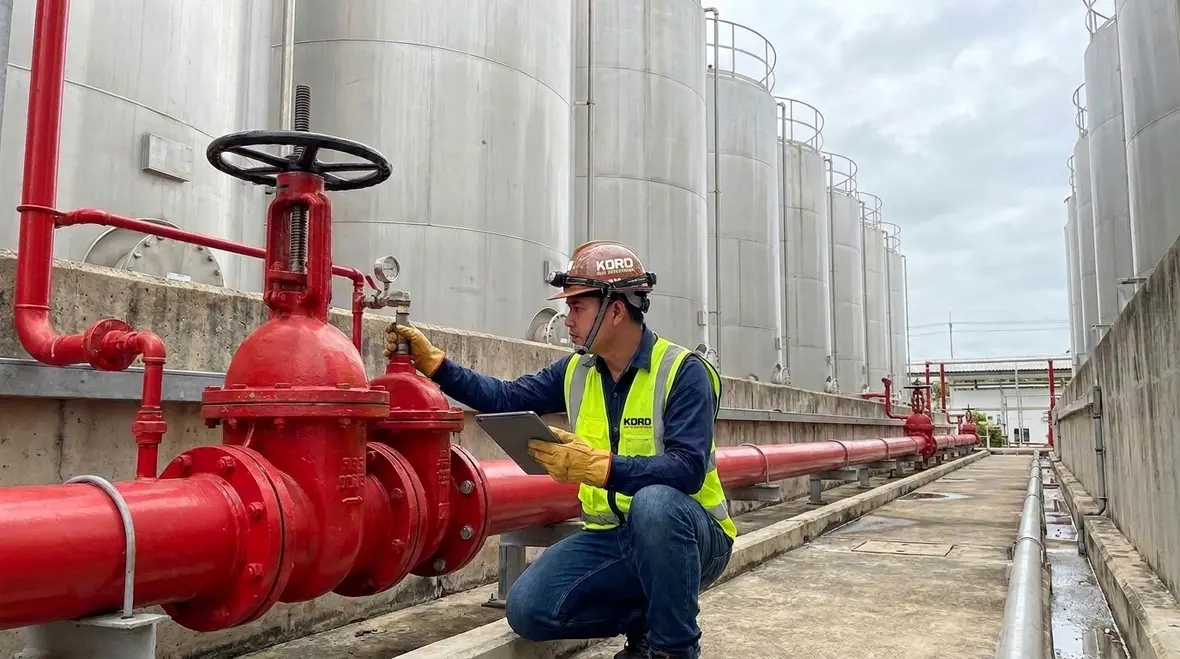
NFPA 36 Section 5.4: Fire Protection Equipment for Bulk Solvent Storage
Quick Answer: NFPA 36 Section 5.4 specifies the fire protection equipment required for bulk solvent storage, including how systems must be arranged, installed, and maintained to control flammable liquid hazards. Facility owners must verify equipment selection, performance readiness, and inspection and testing practices.
For facilities that need coordinated support beyond code interpretation, Kord Fire Protection offers fire protection services that fit naturally into inspection, testing, maintenance, and documentation workflows.
What NFPA 36 Section 5.4 requires for bulk solvent hazards
NFPA 36 Section 5.4 focuses on protecting bulk solvent storage from ignition sources, fire growth, and exposure escalation. It drives facility teams to select NFPA 36 bulk solvent fire protection equipment that matches the hazard profile, provides reliable detection or fire control as appropriate, and remains in service through documented maintenance and periodic testing.
In commercial and industrial settings, the compliance gap typically appears where “installed” is treated as the same as “ready.” Bulk storage systems require ongoing verification that valves, detection components, alarms, and suppression hardware operate correctly and that protective coverage stays consistent as conditions change.
How to interpret Section 5.4 in a real facility
Section 5.4 should be read as an operational requirement, not only an installation standard. Facilities must translate the code language into verifiable performance through procedures, inspection routines, and records that show equipment remains capable of meeting its intended function.
1) Match equipment to the solvent and the storage configuration
Bulk solvent fire protection design depends on the solvent hazard characteristics, storage volume, tank or container arrangements, and potential release scenarios. Practically, the biggest risk during audits is mismatched assumptions, such as selecting equipment based on outdated inventories or changing operations without revisiting the fire protection basis.
2) Treat readiness as a management system
NFPA 36 compliance expectations increase when equipment is not frequently used. Explosion and fire control components, detection circuits, and alarm notification interfaces must be maintained and proven ready. A strong compliance program tracks deficiency trends, not just pass or fail test results.
What “fire protection equipment” typically includes under Section 5.4
While the exact equipment list depends on the facility design basis and configuration, Section 5.4 generally targets systems that can detect, alert, and control or mitigate fire exposure for bulk flammable and combustible liquid storage environments. Facility stakeholders often expect coverage to extend beyond tank surfaces to protect surrounding hazards and allow safe response.
Detection and alarm interfaces
Where required, detection and alarm functions support early decision making. Common failure modes include degraded sensors, misaligned alarm verification workflows, or circuit faults that remain undetected because inspection checklists focus on physical presence rather than functional performance.
Control and mitigation systems
Mitigation equipment must be installed to deliver intended flow, coverage, and response time characteristics. Operational readiness also depends on maintaining actuators, valves, and control panels so the system can operate under expected conditions.
Firefighting access and exposure protection
Even when suppression hardware is present, facilities must ensure access paths, water supply readiness, and protective arrangements do not degrade over time. Obstructions, repurposed staging areas, or temporary barriers can create response delays that undermine the design intent.
Inspection, testing, and maintenance: the compliance-critical parts
Section 5.4 requirements translate into a repeatable maintenance workflow. Commercial facilities in particular must support continuous operations while proving that protective equipment remains functional and that deficiencies are corrected promptly with documentation.
Verification should cover function, not only condition
Inspectors and auditors look for evidence that equipment performs as required. That means functional checks, accuracy of device status indications, and confirmation that control outputs align with alarm and emergency response procedures.
Common failure points seen during commercial reviews
-
Valve and actuator problems: Corrosion, sticking, or actuator impairment can prevent suppression from delivering the intended response.
-
Controller and wiring drift: Changes to adjacent equipment or process modifications can affect interlocks, alarm routing, and fault conditions.
-
Water and agent supply reliability: Supply interruptions, inadequate pressure, or unverified system readiness can render equipment ineffective when needed.
-
Documentation gaps: Missing test reports, unclear deficiency closure timelines, or incomplete device records undermine compliance defensibility.
For ongoing compliance support, Kord Fire Protection helps facilities manage inspection and maintenance cycles with a focus on documentation quality, functional verification, and risk-based follow up. This approach supports audits and reduces the likelihood of hidden impairment.
To learn more about comprehensive fire protection maintenance practices, reference Kord Fire Protection services.
Operational procedures that reduce the compliance risk
Equipment requirements succeed only when procedures keep pace with day to day operations. Bulk solvent storage facilities often experience operational changes that impact fire protection performance, such as different solvent formulations, new storage locations, or updated transfer routines.
Integrate fire protection readiness into transfer and shutdown workflows
Facilities should ensure that transfer activities, loading and unloading procedures, and abnormal condition responses align with the protective equipment’s intended activation logic. A strong program clarifies who verifies system status and who authorizes a return to service after maintenance.
Train for response consistency
Staff competency impacts outcomes during alarm events. Training should cover how alarms translate into actionable steps, what “system fault” indications mean, and which actions do not wait for engineering evaluation. This becomes especially important when equipment is tested on a schedule but not used during normal operations.
Control contractors and change management
Construction, electrical work, and process piping modifications can disrupt fire protection interfaces. Facilities should require contractor coordination and change review for any work that could affect detectors, control panels, valves, or alarm circuits.
Audits and enforcement: how facilities prove compliance
Compliance reviews often evaluate how well documentation matches physical configuration and operational practices. The strongest submittals connect design intent, inspection and testing results, and corrective action history.
Build a defensible compliance file
A practical audit file typically includes device lists, installation evidence, inspection and test reports, deficiency logs with closure dates, and maintenance records that match current system configurations.
Use a cycle that prevents “late discovery” failures
Instead of discovering issues during an audit period, facilities should track component health over time. Trending helps identify recurring valve sticking, recurring fault intervals, or supply reliability weaknesses before failure occurs.
Kord Fire Protection supports commercial clients with structured maintenance planning and documentation that improves audit defensibility while keeping equipment functional for life safety and property protection.
If you want a roadmap for service coordination and documentation readiness, review Kord Fire Protection contact information to discuss your bulk solvent storage protection program.
Frequently Asked Questions
Conclusion and next step
NFPA 36 Section 5.4 compliance depends on selecting the right NFPA 36 bulk solvent fire protection equipment and sustaining performance through functional inspections, testing, maintenance, and strong documentation. Kord Fire Protection can help you manage readiness across alarms, control interfaces, and mitigation components while reducing audit exposure. Contact Kord Fire Protection today to review your bulk solvent storage protection program and establish a maintenance plan built for real-world operating conditions.
If your broader program also touches pump reliability and testing discipline, Kord Fire’s guide to fire pump testing requirements is a useful related read.

Join Our Newsletter!
Get the latest fire safety tips delivered straight to your inbox From our Newsletter.



