
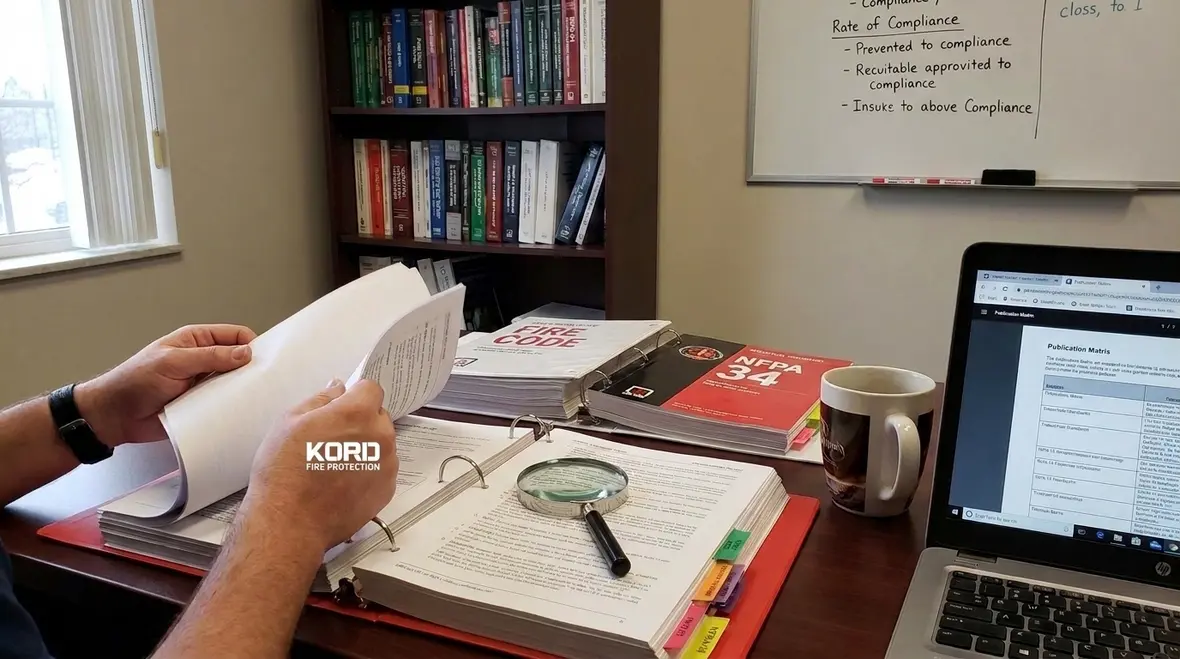
NFPA 34 Section 2.3: Non-NFPA Publications Referenced in the Standard
Quick Answer: NFPA 34 Section 2.3 lists external, non-NFPA documents the standard relies on for specific requirements, definitions, and installation methods. For compliant process safety and fire protection work, facilities must identify the edition referenced, verify applicability, and maintain records for audits.
For facilities building a stronger compliance trail, Kord Fire Protection provides fire protection services in Southern California that support inspections, testing, maintenance, and documentation programs aligned with code-driven requirements.
Why Section 2.3 Matters for Commercial Compliance
NFPA 34 is widely used to manage fire and explosion hazards in processes involving combustible materials, hazardous chemicals, and industrial fire loads. Section 2.3 does not replace the main code requirements. Instead, it anchors parts of the standard to NFPA 34 non-NFPA referenced publications that provide detailed engineering rules, referenced test methods, and recognized installation practices.
In real-world commercial operations, this creates a common compliance gap: contractors and facility teams complete work to “the code” but do not verify the external publication edition, the specific section within that publication, or the practical implications for inspections, testing, and maintenance.
What Section 2.3 Typically Requires: Edition Control and Traceability
Section 2.3 functions as a reference map. When NFPA 34 points to outside material, the facility must treat those documents as enforceable requirements for the portions they govern. This typically includes items such as:
- Referenced test methods and acceptance criteria for systems and components
- Engineering and installation practices that impact system performance
- Operational criteria used during inspections, impairments, and maintenance
For compliance, the facility should maintain a traceable matrix that links each NFPA 34 reference to the exact external document edition and the relevant clause. During audits, inspectors often validate not just that the work was performed, but that the correct reference set was used and that documentation remains available.
How Facilities Apply Non-NFPA References in the Field
Commercial facility teams typically encounter non-NFPA references during three phases: design and installation, acceptance testing, and ongoing maintenance. Each phase needs different controls.
1) Design and installation: confirm “what” and “how”
When NFPA 34 points to non-NFPA documents, those references usually specify installation geometry, component selection, labeling, operating sequence, or performance expectations. A common failure point occurs when drawings and submittals cite NFPA 34 generally, but the construction package does not show how the external publication requirements were satisfied.
Operational best practice is to require submittals that include a compliance checklist referencing:
- The exact external document title and edition
- The specific numbered section or clause
- The installation detail or test procedure tied to that clause
2) Acceptance testing: use the referenced test method, not a substitute
Non-NFPA publications often define the test setup, calibration expectations, sampling approach, and pass fail criteria. Substituting an alternate procedure can create documentation weaknesses even if the system appears to function.
Facility teams should standardize acceptance packages to include:
- Test procedures aligned to the referenced publication
- Instrument calibration records and results
- As found and as left conditions where applicable
3) Maintenance and inspection: ensure the reference stays current in practice
Maintenance teams often focus on functionality and visual inspection. However, non-NFPA referenced publications can impose ongoing requirements, such as frequency of checks, replacement intervals, or condition criteria for components. When those criteria are not captured, systems may remain technically operating while drifting out of compliance.
To reduce drift, facilities should link inspection and maintenance tasks to a controlled document set. That includes update triggers when an external publication edition changes or when NFPA 34 revisions alter reference lists.
Common Commercial Challenges With Non-NFPA Referenced Publications
For retail, industrial, and commercial occupancies that store or process combustible materials, the biggest operational challenges typically include:
- Edition mismatch: drawings or vendor documentation references an older publication edition while the current NFPA 34 reference expects a different one.
- Incomplete documentation: contractors complete installation but leave the facility with no traceable matrix connecting NFPA 34 requirements to external clause numbers.
- Maintenance scope creep: preventive maintenance procedures do not incorporate referenced inspection thresholds, leading to deferred replacements.
- System impairment practices: operations do not align impairment documentation and restoration checks with the referenced criteria used for system performance.
These issues become more visible during regulatory reviews, insurance underwriting, and internal audits. Kord Fire Protection supports facilities by aligning inspections, testing, and maintenance deliverables with NFPA 34 documentation expectations and the referenced external requirements.
How Kord Fire Protection Helps Keep References Audit Ready
Compliance is not only a construction outcome. It is an ongoing evidence trail. Kord Fire Protection helps organizations manage that trail by integrating non-NFPA referenced requirements into practical field workflows.
Key support activities typically include:
- Reference mapping: building a clear matrix that ties NFPA 34 references to exact non-NFPA document editions and clauses.
- Inspection and testing alignment: performing inspections and tests using referenced criteria so results remain defensible.
- Maintenance planning: converting referenced requirements into repeatable schedules, checklists, and service scope definitions.
- Documentation packaging: delivering audit-ready reports with the evidence inspectors look for during reviews.
To see how Kord Fire Protection approaches ongoing fire protection compliance programs, refer to Kord Fire Protection services.
Frequently Asked Questions
Next Step: Make Your References Traceable Now
Facilities should validate their NFPA 34 documentation against the non-NFPA referenced publications used for each scope of work. Start by building a reference matrix, then connect it to inspection, test, and maintenance records. If your program relies on separate vendor reports or incomplete submittals, Kord Fire Protection can help you organize an audit-ready compliance trail. Contact Kord Fire Protection today to review your current reference control and service documentation.

Join Our Newsletter!
Get the latest fire safety tips delivered straight to your inbox From our Newsletter.



