
NFPA 30 Section 27.12: Removing Piping Systems From Service
Quick Answer: NFPA 30 Section 27.12 piping removal from service sets minimum requirements for taking flammable liquid piping out of operation. It focuses on safe isolation, preventing unintended flow, controlling residual vapors and releases, and ensuring the system cannot be returned to service without proper verification.
Why NFPA 30 Section 27.12 matters in real facilities
Commercial, industrial, and retail facilities often need to decommission portions of a flammable liquid system during renovations, equipment swaps, relocations, or corrective actions after damage. NFPA 30 Section 27.12 piping removal from service addresses one of the highest risk phases of compliance: the transition from “operating system” to “not in use.” During this phase, residual product, trapped pressure, and vapor migration can create sudden ignition hazards even when the system is “off.”
From a practical compliance standpoint, the biggest failure points are not the cutting and blanking itself. They are incomplete isolation, inadequate verification of zero flow and zero pressure, and lack of documented control so the piping cannot be mistakenly reintroduced into service by maintenance or contractors.
If your site is coordinating this work as part of broader inspection, testing, or deficiency correction planning, Kord Fire Protection’s fire protection services in Southern California can help align the compliance scope with field execution.
What “removing from service” typically includes
Section 27.12 addresses the actions needed to ensure a piping system that no longer supports normal operations does not continue to present hazards. In day to day commercial work, this usually includes multiple steps that must be coordinated across operations, maintenance, and fire protection stakeholders:
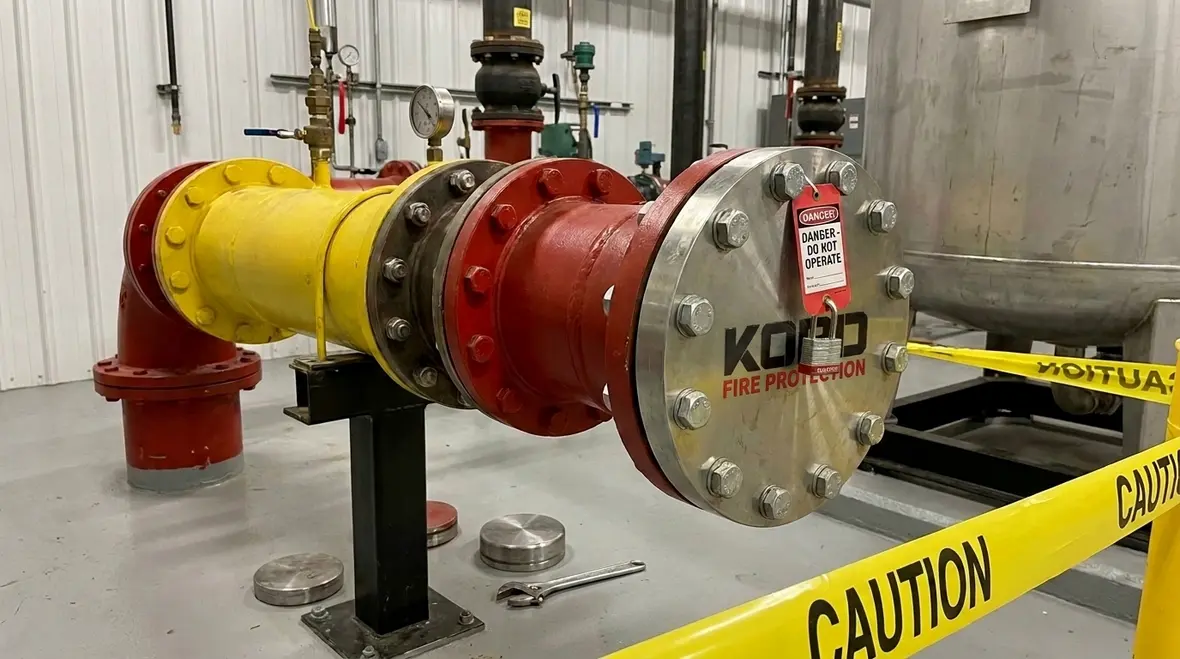
Operational isolation: Valves closed and made effective by additional means where required, such as blinds, plugs, or removal of line sections, depending on the system configuration.
Pressure and residual management: Control of trapped pressure and removal or safe disposal of residual flammable liquids and vapors.
Positive evidence of “not in service”: Verification steps that support compliance, along with labeling, tag control, and restoration controls.
Prevention of unauthorized return to service: Administrative controls that stop the line from being started or reconnected without a controlled re commissioning process.
Facilities that rely on older maintenance practices often discover that “we capped it” is not the same as “it cannot release.” A compliant approach treats the removed piping as still capable of becoming a hazard until verification and documentation are complete.
Key operational risks during piping removal from service
1) Residual product and vapor release
Even after a system is shut down, residual liquid can remain in low points, dead legs, or sections downstream of valves. When piping is disconnected or opened, those residues can flash, generating flammable vapor clouds. Vapor can also migrate through interconnected piping routes in ways operators did not anticipate.
To control this, technicians need a planned sequence that prioritizes containment and safe venting or capture. Any purge or inerting needs to match the facility’s hazardous materials procedures and the system’s design intent, not only a generic “air purge.”
2) Trapped pressure and stored energy
Piping can retain pressure due to pump check valves, closed automation trains, thermal expansion, or manifold configurations. If pressure is not relieved in a controlled manner before disassembly, line components can fail, spraying product or forcing vapors into occupied areas.
Verification must address more than “the pump is off.” It must confirm the absence of hazardous pressure conditions at the correct isolation points, using instrumentation and methods consistent with the hazard classification and system design.
3) Incomplete isolation and accidental re connection
The most common compliance gap is administrative, not mechanical. Contractors and maintenance teams may remove a section, cap it, or label it without a consistent method to confirm it is effectively isolated and cannot be mistaken for an active line. If the system uses shared manifolds or common headers, a “temporary cap” can become a permanent hazard if it is not treated as decommissioned.
Effective controls include controlled lockout or tagout where applicable, physical confirmation of isolation method, and a management process for changes to system configuration.
Inspection, verification, and documentation expectations
NFPA 30 Section 27.12 piping removal from service requirements are commonly evaluated through the lens of whether the facility can demonstrate safe conditions before, during, and after the work. Typical commercial facility compliance expectations include:
Pre work review: Hazard review, line identification, and confirmation of isolation points. The work scope should specify what is being removed, what remains connected, and what verification will be performed.
Field verification: Confirmation that the line cannot pass product or vapor back into the piping network where it is not intended. Verification should be documented with date, method, and results.
System labeling and records: Updated piping isometrics or as built drawings, plus clear markings on what is decommissioned.
Restoration control: Written requirements for re commissioning, including conditions that must be met before reconnection or return to operation.
Facilities often underestimate the value of “as built” accuracy. When inspectors compare drawings to field conditions, the absence of clear decommission records creates an unnecessary compliance gap and prolongs remediation.
For additional context on how NFPA 30 regulates flammable liquid systems and related management practices, refer to: how NFPA 30 regulates flammable liquids.
Facilities reviewing removal from service procedures may also benefit from Kord Fire Protection’s guidance on a layered fire protection system for flammable liquids, especially where piping isolation intersects with suppression, detection, and emergency response planning.
Common failure points in piping removal projects
Blanking or capping that does not match the hazard
Some sites cap lines using methods that are not physically durable for the product, temperature, and pressure characteristics of the system. Even when the cap is installed correctly, vibration, corrosion, and thermal cycling can degrade the isolation over time.
Skipping residual handling and relying on “shutoff valves only”
Multiple closed valves can still allow migration or vapor movement. If the system design includes check valves, trapped pockets, or interconnections, valve closure alone may not provide the “not in service” safety margin required by prudent compliance practices.
No controlled method for disconnect sequencing
Cutting or unbolting without a planned release sequence increases the chance of ignitable vapor generation. A compliant procedure aligns tool access, containment, ventilation or vapor capture steps, and emergency response readiness.
Incomplete update of drawings, tags, and control procedures
When labels remain unchanged or drawings do not reflect decommissioned runs, future maintenance teams may assume the line is active. That is how a “removed” piping system can return to service unintentionally.
How Kord Fire Protection supports compliant decommissioning
Kord Fire Protection helps commercial facilities manage flammable liquid compliance through disciplined planning, verification support, and documentation practices. This includes assisting with risk based work coordination, review of isolation and change management steps, and ensuring that the end state of NFPA 30 Section 27.12 piping removal from service work is defensible during audits.
Instead of treating decommissioning as a standalone trade activity, Kord Fire Protection supports ongoing systems assurance. That means aligning the fire and safety requirements with maintenance realities, preventing “paper compliance” that fails in the field.
Frequently Asked Questions
Next step
If your facility plans to decommission flammable liquid piping, treat NFPA 30 Section 27.12 piping removal from service as a documented compliance process, not a basic cap and disconnect job. Contact Kord Fire Protection to support scope review, verification planning, and audit ready documentation so your project closes safely and stays compliant through renovation and commissioning.

Join Our Newsletter!
Get the latest fire safety tips delivered straight to your inbox From our Newsletter.



