
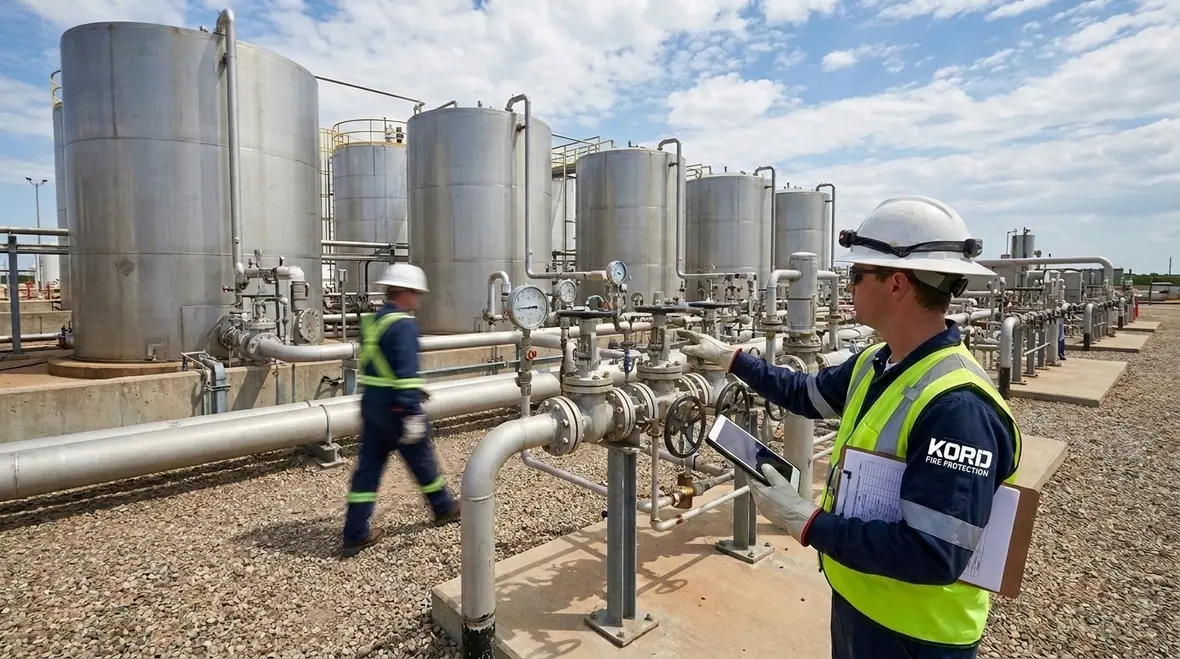
NFPA 30 Section 26.2: Definitions for Petroleum Production Sites
Quick Answer: NFPA 30 Section 26.2 defines the term “petroleum production sites” and related scope boundaries used for applying the standard’s requirements. Correct definitions drive which storage, piping, tank, and maintenance provisions apply, helping facilities avoid compliance gaps and enforcement delays.
Why NFPA 30 Section 26.2 definitions production sites matter in the field
On commercial and industrial sites, the practical risk is not simply misunderstanding wording. The real exposure comes from using the wrong regulatory “box” for a facility area. NFPA 30 Section 26.2 definitions production sites determine how stakeholders classify operational zones, which in turn controls requirements for flammable and combustible liquid systems, integrity practices, inspection frequency, and documentation expectations.
In day to day operations, misclassification commonly shows up during commissioning, change management, or insurance reviews. A facility that expands well pads, adds processing skids, or modifies produced liquid transfer routes may believe existing protection measures still apply. NFPA 30 Section 26.2 definitions production sites can invalidate that assumption if the scope no longer matches the defined classification.
If your team is also reviewing connected fire protection obligations, it helps to pair this scope analysis with broader fire protection services in Southern California so documentation, inspection planning, and system readiness all stay on the same page.
What NFPA 30 Section 26.2 addresses (and what it does not)
NFPA 30 primarily governs flammable and combustible liquids, including storage, handling, and associated engineering controls. Section 26.2 focuses on defining the “petroleum production site” context so the reader applies the correct framework.
In practice, the definitions support consistent interpretation across:
- Operators and contractors responsible for process layouts and transfer piping.
- Fire safety professionals planning inspection routes and testing intervals.
- AHJs and insurers verifying documentation, hazard classifications, and maintenance records.
- Retail and commercial businesses with adjacent liquid handling activities that must remain segregated from production areas.
NFPA 30 Section 26.2 does not replace site hazard analysis. Instead, it provides the baseline definitions that support the standard’s deeper requirements for flammable liquid control measures and system integrity.
How to apply the “petroleum production sites” definitions to real facility layouts
The compliance challenge starts when a site contains multiple activities that can look similar on paper but operate differently in practice. Fire safety teams often need a repeatable method to map defined scope boundaries onto the facility.
1) Start with site purpose and operating boundaries
Facilities must document what the site does and how operations flow. Produced liquids movement, processing steps, and where tanks, separators, and transfer points connect determine whether the area functions as part of a petroleum production site under NFPA 30 Section 26.2 definitions production sites.
Common operational pitfalls include:
- Assuming “remote” storage automatically removes the area from production scope.
- Failing to update drawings after adding temporary tanks, frac or stimulation setups, or skid mounted processing.
- Not accounting for seasonal operational changes that alter where produced liquids are processed and stored.
2) Use piping and transfer evidence, not only process narratives
Definitions are best validated with engineering reality. Fire and safety teams typically confirm:
- Transfer lines carrying produced liquids and condensate from production points to storage or processing equipment.
- Where pumping stations, manifolds, and metering skids are located relative to the defined site boundary.
- Valve arrangements, containment, and isolation strategies tied to flammable liquid handling.
This matters because enforcement and inspections will often focus on physical evidence, including corrosion protection, leak histories, and condition of flammable liquid containment and associated components.
3) Confirm storage classification and containment expectations
Once the defined scope aligns, teams must validate tank and containment arrangements for the applicable flammable and combustible liquid handling requirements. A frequent failure point is treating all liquids the same. Different liquid types, operating temperatures, and vapor behavior can shift control expectations.
To strengthen compliance consistency, teams usually align the NFPA 30 interpretation work with a broader flammable liquid compliance strategy. For background on regulatory coverage and how NFPA 30 concepts are applied, see how NFPA 30 regulates flammable liquids.
Operational compliance impacts: inspections, testing, and maintenance
Correct NFPA 30 Section 26.2 definitions production sites classification influences the rigor of ongoing compliance activities. It affects what equipment must be inspected, what records must exist, and what failure modes receive targeted attention.
Common inspection targets tied to production site scope
- Tank external condition, including corrosion, coating integrity, and leak indicators.
- Secondary containment performance, including drainage behavior and contamination control.
- Piping integrity, including hangers, supports, corrosion points, and vibration related wear.
- Valves, fittings, and flanged joint condition, including gasket aging and torque verification records.
- Overfill and transfer control systems where produced liquids move between process and storage.
Testing and maintenance realities that drive compliance outcomes
In petroleum production environments, maintenance intervals cannot rely on calendar time alone. Condition based factors often govern. Fire safety teams should expect equipment performance influenced by:
- Temperature cycles and pressure fluctuations that accelerate corrosion and seal deterioration.
- Frequent start stop operations that stress pumps and transfer hoses and couplings.
- Spills, misting, and vapor release history that affects inspection priority and documentation.
Kord Fire Protection supports commercial and industrial sites by helping teams maintain a defensible compliance record through practical inspection planning, documentation readiness, and targeted maintenance verification. When scope definitions change due to expansion or process updates, Kord Fire Protection can assist with re validation planning so equipment and procedures remain aligned.
For facilities where water based protection systems are part of the bigger picture, practical maintenance planning often pairs well with proactive maintenance for fire pump system reliability so inspections and records do not drift into chaos with a clipboard.
Commercial and retail adjacent scenarios: where scope confusion often starts
Even when a facility is not a pure production site, commercial and retail properties may handle flammable liquids in ways that appear similar to petroleum production operations. Scope confusion can arise when:
- Retail refueling, washdown areas, or bulk delivery points share access roads or utility corridors with production operations.
- Contractors bring in temporary storage during scheduled maintenance or shutdowns.
- Facilities assume that distance automatically reduces obligations, instead of evaluating how liquids are transferred and contained.
Professional compliance teams reduce risk by mapping liquid flow paths and ensuring segregation of systems that should not be treated as the same operational category. That mapping starts with correct reading of NFPA 30 Section 26.2 definitions production sites and continues through maintenance and inspection discipline.
Frequently Asked Questions
Next step for compliance readiness
If your site has expanded, changed processing, added temporary storage, or updated transfer piping, confirm the NFPA 30 Section 26.2 definitions production sites classification now. Engage Kord Fire Protection to review your current documentation, inspection targets, and maintenance records so your compliance program matches your operating reality and stands up to AHJ and insurance scrutiny.

Join Our Newsletter!
Get the latest fire safety tips delivered straight to your inbox From our Newsletter.



