
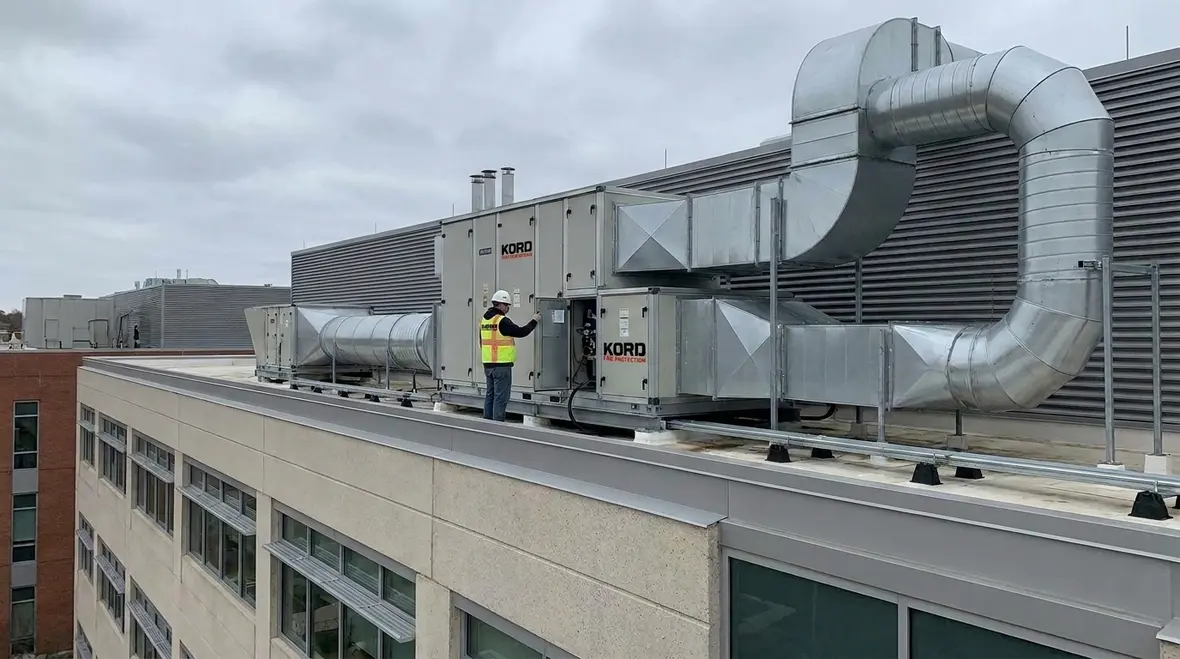
NFPA 45 Section 7.3: Supply Air Systems for Laboratories
Quick Answer: NFPA 45 Section 7.3 establishes requirements for laboratory supply air systems to support safe ventilation performance, control of air distribution, and reliable operation. The standard focuses on maintaining intended airflow, protecting system components, and enabling inspection and maintenance.
Why NFPA 45 Section 7.3 matters for laboratory airflow safety
Laboratory environments depend on stable, predictable ventilation to support hazardous material containment strategies and to prevent unintended exposure routes. NFPA 45 laboratory supply air systems are not simply “comfort ventilation.” They are safety-critical systems that must maintain design intent through startup, normal operation, and off normal conditions.
Section 7.3 addresses how supply air systems support overall laboratory ventilation performance. For commercial and industrial facilities, the compliance challenge often becomes operational rather than theoretical: balancing airflow stability, controlling system failure modes, maintaining dampers and fans, and documenting inspection results that prove the system continues to perform.
To support ongoing compliance, facilities typically need a disciplined maintenance and testing plan. Kord Fire Protection helps commercial operators align inspection routines with real system conditions, including documentation, functional checks, and maintenance-driven improvements.
For facilities reviewing related ventilation compliance topics, general ventilation requirements for hazardous processes offer useful context near the top of the planning process.
Where this shows up in the real world
-
Multi-tenant and shared ductwork: Laboratories often share infrastructure with offices or retail-adjacent spaces, increasing the need for clear isolation and dependable controls.
-
Seasonal drift and coil performance: Changes in humidity load and filter loading can shift airflow, affecting the containment strategy.
-
Commissioning gaps: If initial balancing did not account for long-term component wear, airflow may drift without obvious alarms.
What NFPA 45 Section 7.3 requires of supply air systems
NFPA 45 Section 7.3 centers on supply air system reliability and the ability to verify that airflow delivery continues to meet the safety intent. In practice, this translates into requirements for system design that supports stable air delivery and for operational controls that prevent unsafe conditions during maintenance, abnormal operation, or component failures.
1) System design that supports intended airflow delivery
Supply fans, distribution paths, dampers, and control strategies must be selected and arranged to deliver the correct air volumes and to sustain performance under expected operating conditions. Facilities commonly discover that design intent can be undermined by installed “value engineering” changes such as altered duct sizes, swapped dampers, or substituted control components that do not maintain the same control response.
2) Control and air distribution stability
Laboratory supply systems frequently include variable air volume or pressure control sequences. Section 7.3 expectations typically require that the system’s control logic and components can reliably maintain safe operating states that match the ventilation design. When control sequences allow unstable transitions, containment can be impacted even if the system is still “running.”
3) Operational readiness for inspection and maintenance
A common compliance pain point is the inability to inspect or verify performance without disruption. For commercial operators, this creates a hidden risk: systems may be inspected visually but not functionally verified at the duct and terminal level. Strong programs enable verification without undermining containment operations.
How compliance is verified: inspection points and functional checks
NFPA compliance is strongest when verification ties directly to how the system actually performs. For NFPA 45 laboratory supply air systems, inspections typically focus on performance elements and component integrity that influence airflow delivery and stability.
Key inspection categories
-
Airflow and pressure control verification: Inspect that control sequences produce the expected supply conditions under normal operating modes. Pay attention to setpoint tolerances, reset logic, and how the system responds to building static pressure changes.
-
Dampers and actuators: Verify damper travel, linkage integrity, and correct actuator operation. Slow response or sticking dampers often create transient conditions that can be missed without functional testing.
-
Filters and airflow resistance: Inspect filter loading indicators, pressure drop trends, and replacement practices. Excess resistance can reduce airflow and shift balance.
-
Fans and vibration indicators: Check fan belt tension or direct-drive health, bearings, alignment, and vibration. Degraded fan performance can reduce flow even when power draw appears normal.
-
Documentation readiness: Ensure test reports, balancing records, and maintenance logs show traceability from the current system configuration to the designed ventilation intent.
Common failure points that affect laboratory supply performance
-
Damper drift: Calibration shifts over time cause partial closure, leading to lower-than-intended supply volumes.
-
Control sensor placement issues: Faulty or poorly located sensors can drive improper resets, especially when zones switch or windows open.
-
Undetected duct leakage: Changes from tenant construction or maintenance can introduce leakage that degrades system performance.
-
Bypass paths and temporary modifications: Temporary trades modifications that remain in place can undermine the containment strategy.
Maintenance and testing: keeping NFPA 45 laboratory supply air systems audit-ready
Maintenance determines whether a compliant system remains compliant. For commercial, industrial, and retail-adjacent laboratories, the most effective programs treat supply air performance as a managed lifecycle attribute, not a one-time commissioning event.
Build a maintenance plan around real operating conditions
Facilities typically benefit from a schedule that includes both periodic inspection and condition-based verification. Pressure control sequences, filter change practices, and fan health indicators should be reviewed together because failures cascade.
Operational best practices that reduce risk
-
Document setpoint changes: Log any control modifications, reset logic changes, and zone rebalancing actions.
-
Verify after tenant work: Construction in labs, corridor penetrations, and duct access can introduce leakage or blockage.
-
Track filter performance: Replace filters based on pressure drop and condition, not only time.
-
Confirm “as found” then “as left”: Testing should capture current performance before adjustments, then confirm restoration after maintenance.
Where Kord Fire Protection fits
Kord Fire Protection supports facilities that need consistent documentation, practical test coordination, and ongoing compliance assurance. This partnership approach reduces the gap between what the system is supposed to do and what it actually does across seasons and operating modes.
For related technical guidance, facilities can also review Kord Fire Protection’s broader NFPA codes and guidelines resource center on their site.
Design and commissioning lessons that prevent later noncompliance
Many compliance issues arise after turnover, when operational realities reveal design or commissioning shortcomings. NFPA 45 laboratory supply air systems should be treated as safety equipment in how they are validated and maintained.
Commissioning focus areas that hold up during inspections
-
Functional testing across modes: Verify supply performance not only at peak occupancy but also during reduced load modes and after transitions.
-
Verification of control response time: Ensure control loops do not create unacceptable transient airflow deviations.
-
Air balancing tied to the final configuration: Balance after construction is complete and after all temporary duct modifications are removed.
-
Maintenance accessibility planning: Ensure that dampers, sensors, and fan components can be inspected without compromising containment operations.
Retrofit considerations for existing laboratories
Existing buildings often require retrofits for sensors, dampers, and controls to maintain stable supply delivery. When upgrades are phased, facilities should re-test the affected air paths and update documentation so that audit evidence reflects the current system configuration.
Frequently Asked Questions
Conclusion and next step
NFPA 45 Section 7.3 drives a clear expectation: laboratory supply air systems must maintain intended performance, and facilities must prove it through practical inspection, testing, and maintenance. Kord Fire Protection can help commercial operators stay audit-ready by coordinating verification, documenting “as found” conditions, and supporting corrective maintenance that restores ventilation performance. Contact Kord Fire Protection today to assess your current supply system program and identify the highest value compliance improvements.

Join Our Newsletter!
Get the latest fire safety tips delivered straight to your inbox From our Newsletter.



