
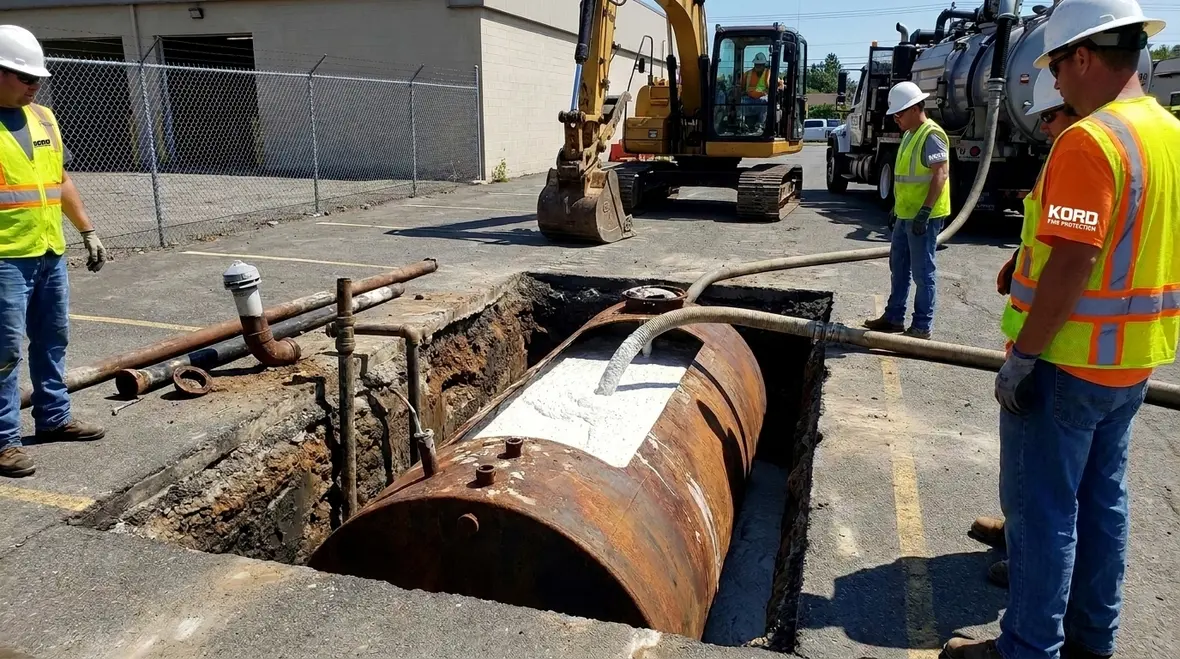
NFPA 31 Section 7.15: Permanent Abandonment of Underground Fuel Tanks
Quick Answer: NFPA 31 Section 7.15 establishes how to permanently abandon underground fuel storage tanks to protect people, property, and the environment. Compliance requires draining, cleaning, removal or isolation, and verified filling methods that prevent future fuel release and unsafe tank conditions. Documentation and inspection close the loop.
What NFPA 31 Section 7.15 requires for permanent abandonment
NFPA 31 underground tank permanent abandonment focuses on one outcome: the tank must no longer function as a fuel reservoir and must not create hazardous conditions over time. Section 7.15 frames the abandonment process as a controlled engineering and fire prevention activity, not a simple “cap and forget” operation. Facilities that store oil for burners, process heat, or emergency power must treat abandonment as a life safety and risk reduction measure that supports ongoing compliance.
Operationally, the work should be planned to maintain safe conditions for occupants and contractors, control residual product and vapors, and leave the tank in a stable state that does not allow fuel migration, structural collapse, or void formation that can later trap contaminants. For commercial facilities, this means abandonment scope, method selection, and verification results must align with your facility’s risk profile, maintenance programs, and permitting requirements.
If you are also tightening up system records after underground tank work, strong fire safety system documentation for compliance helps teams keep drawings, reports, and maintenance history aligned before the next audit shows up uninvited.
For broader installation context across NFPA 31, including how equipment and fuel systems are managed and maintained, refer to this practical resource: NFPA 31 a practical guide to oil burning equipment installation.
Step-by-step: core abandonment workflow
Most failures in abandonment occur when teams follow the physical steps without the required level of verification and closure control. A compliant workflow typically includes the following stages, executed in sequence and documented for audit readiness.
1) Pre-job engineering, controls, and permit readiness
- Confirm the tank identity, capacity, product history, and installation details such as piping layout and venting configuration.
- Establish hot work and confined space controls if tank entry or cutting is required.
- Develop a vapor, spill, and emergency response plan for the site conditions and surrounding exposures.
- Coordinate with facility leadership to control access and maintain fire safety during isolation and cleaning.
2) Drain, purge, and clean to remove fuel and ignition sources
- Remove remaining fuel and manage waste streams per local requirements.
- Purge and clean the tank to reduce combustible residues and flammable vapor risks.
- Verify atmospheric conditions before any intrusive work.
Abandonment work often fails inspection when residual sludge, water bottoming, or untreated piping continues to feed vapors or odor complaints. Effective cleaning protects both safety and long-term integrity.
3) Close and isolate associated piping and appurtenances
- Identify and isolate product lines, pumps, valves, suction piping, and any redundant connections.
- Remove or securely cap components to prevent future re use and unintended fuel migration.
- Address vents and fill lines in a way that prevents creation of pathways for leakage or vapor movement.
For commercial and retail properties, piping routing can be partially concealed in trenches or under slabs. The team must map these routes and confirm complete isolation before final tank closure.
4) Remove the tank or permanently fill it with an approved method
NFPA 31 Section 7.15 focuses on eliminating future hazards by either removing the tank or permanently filling it with material that prevents collapse, voids, and the potential for residual fuel to migrate. The filling method must achieve the intended stabilization across the tank volume and any connected void spaces.
Common operational issues include incomplete fill, channeling that leaves low points untouched, and void formation that can later compromise integrity. Verification steps protect against these failure modes.
5) Final verification and documentation
- Confirm completion of isolation steps and correct sealing of openings.
- Provide tank abandonment documentation for compliance records, including method description, material details, and verification notes.
- Update facility drawings and maintenance records so future trades do not accidentally reopen or disturb abandoned systems.
For facility compliance teams, documentation is often the difference between a closure that passes inspection and one that becomes a recurring compliance finding.
Inspection and enforcement: what inspectors typically look for
When authorities having jurisdiction and internal auditors review abandonment records, they focus on whether the tank was made permanently incapable of storing fuel and whether the method prevents future release. Key inspection themes include completeness, stability, and evidence.
Evidence of permanent closure
- Proof of drain and cleaning completion.
- Confirmation of piping isolation and sealing.
- Verification that vents and openings are handled in accordance with the abandonment method.
Verification of fill or removal effectiveness
- Tank fill completion across the tank profile, not just surface coverage.
- Absence of conditions that could lead to collapse, voids, or future pathways for fuel migration.
- Correct handling of associated subsurface voids and adjacent impacted areas when applicable.
Paper trail quality
- As-built updates showing what changed.
- Abandonment reports describing how the work met NFPA 31 requirements for permanent abandonment.
- Any gas testing, atmospheric verification, and waste handling notes tied to safety outcomes.
Commercial facilities that manage multiple tank locations often face cross-site record gaps. A structured closeout system reduces administrative risk and prevents costly rework.
Common commercial failure points and how to prevent them
NFPA 31 underground tank permanent abandonment projects fail most often due to operational shortcuts, incomplete isolation, and weak verification. The following issues show up repeatedly in real world compliance reviews.
Residual product and sludge left behind
If cleaning steps do not achieve effective removal of fuel residues and sludge, the tank can continue to generate vapors and create odor complaints, while also increasing the risk of future leakage. Teams should match cleaning intensity to actual historical fuel conditions and confirm safe atmospheres before intrusive work.
Inadequate piping closure
Even when the tank is filled or removed, compromised piping sections can remain connected to subsurface pathways. Without complete isolation, future work or pressure changes can expose the facility to leakage risk. Mapping, tracing, and physical confirmation are essential for commercial sites with complex piping routes.
Void formation during filling
Incomplete filling can leave voids that later collapse or allow residual fuel migration. Stabilization depends on correct fill placement and verification that addresses the full tank and any connected void spaces. For maintenance teams, this also impacts future excavation planning.
Outdated drawings and maintenance records
A tank that is abandoned but still shown as active in drawings leads to accidental disturbance during unrelated construction, landscaping, or electrical trenching. Updating documentation is a compliance requirement in practice because it prevents reintroduction of risk.
Why ongoing compliance matters after abandonment
Permanently abandoning an underground tank reduces risk, but it does not eliminate the need for continued fire safety oversight of the oil burning and fuel system components that remain at the facility. Burner rooms, controls, emergency shutoffs, and remaining above ground elements still require inspection and maintenance schedules under NFPA 31 principles.
For commercial, industrial, and retail sites, the abandonment event also triggers a maintenance and compliance handoff. Facilities must confirm that any fuel system dependencies are properly disconnected, controls are set for the new operating conditions, and fire safety documentation reflects the new configuration.
Kord Fire Protection supports commercial sites with structured compliance services that integrate abandonment closeout with ongoing inspection and maintenance planning. This approach helps organizations prevent compliance drift after major underground works, especially at multi-tenant, high turnover, or multi system locations.
For facilities reviewing broader protection programs at the same time, Kord Fire’s commercial fire suppression systems and services can support inspection, testing, installation, repair, and maintenance across active life safety systems.
Frequently Asked Questions
Next step: book a compliance and closeout review
For commercial sites, the safest path is a documented, verified abandonment closeout that integrates with your ongoing NFPA 31 inspection and maintenance requirements. Kord Fire Protection can review your scope, confirm record quality, and support post work compliance planning to reduce rework and inspection findings. Contact Kord Fire Protection to schedule an abandonment closeout and fuel system compliance review.

Join Our Newsletter!
Get the latest fire safety tips delivered straight to your inbox From our Newsletter.



