
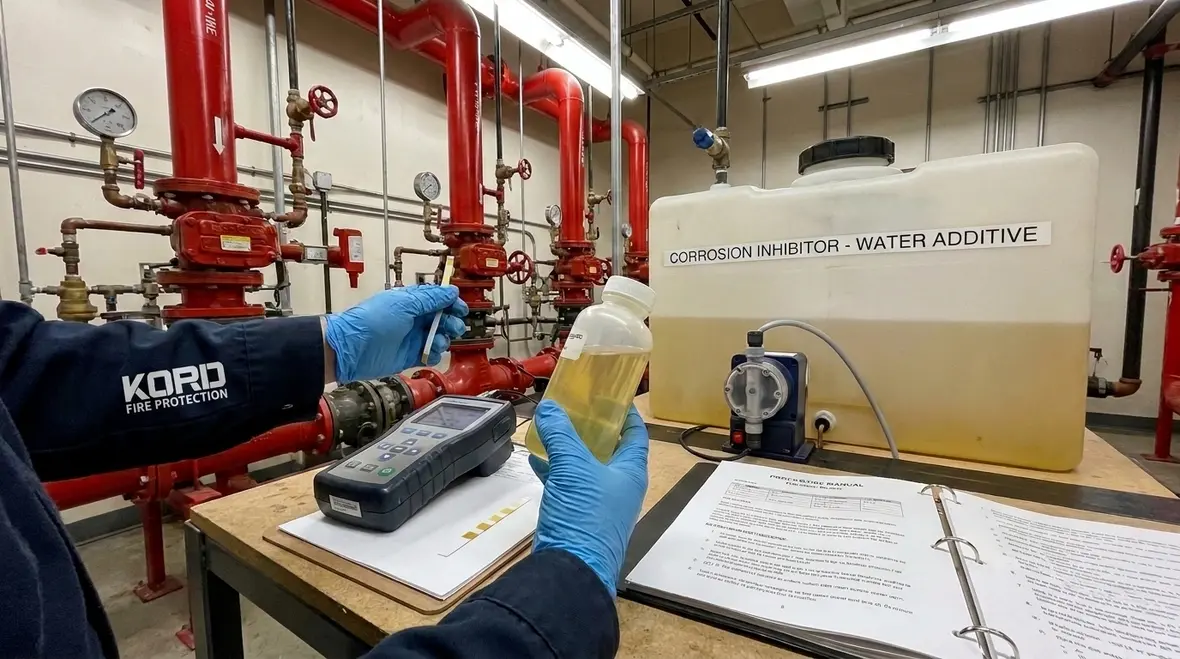
NFPA 18A Section 5.5: Uniform Corrosion Testing of Water Additive Solutions
Quick Answer: NFPA 18A Section 5.5 sets performance expectations for validating how water additive solutions resist corrosion. A properly performed NFPA 18A water additive uniform corrosion test helps facilities confirm product consistency, prevent system degradation, and support documentation for inspection and risk management.
If your facility is refining additive controls, it helps to connect chemistry decisions with a broader fire suppression system service strategy so inspections, maintenance, and documentation all stay pointed in the same direction.
What NFPA 18A Section 5.5 Requires (and Why It Matters)
NFPA 18A Section 5.5 focuses on uniform corrosion testing of water additive solutions. In practical terms, the section exists to ensure that additives used in fire suppression or related water system applications deliver stable corrosion performance across the solution’s operating conditions and concentration range.
Commercial properties face a recurring problem: even when a supplier provides a corrosion inhibitor, facility operations may introduce variability through dilution accuracy, aging, temperature swings, water chemistry differences, and mixing practices. Section 5.5 creates a baseline that supports consistent performance verification, reducing the chance that corrosion protection deteriorates before it becomes visible.
From a maintenance standpoint, corrosion is not a theoretical risk. It drives tuberculation, deposit buildup, loss of valve and nozzle reliability, and accelerated failure of exposed wetted components. Those failures often trigger expensive downtime during impaired-system conditions and can complicate annual inspections and impairment documentation.
For facilities that manage recurring compliance tasks, Kord Fire Protection supports test readiness through structured documentation, process review, and coordinated maintenance planning. For broader code-aligned guidance, see NFPA codes and guidelines solutions for fire protection and life safety.
How the NFPA 18A Water Additive Uniform Corrosion Test Is Typically Conducted
A compliant NFPA 18A water additive uniform corrosion test centers on measuring corrosion under controlled exposure conditions and verifying that the additive solution performs uniformly at the intended concentration. The test concept addresses two key commercial realities: the chemistry must work, and the results must be repeatable and defensible.
1) Concentration control and solution preparation
Uniform corrosion performance depends on getting concentration correct. Facilities commonly apply the additive at a target range (often referenced operationally as 0.5%-1.0% for inhibitor solutions, depending on the formulation and system design). During verification or acceptance testing, the preparation method must replicate real-world mixing practices: order of addition, mixing time, temperature profile, and the makeup water source.
Common failure points include:
- Inaccurate dosing due to meter calibration drift or manual measurement variability
- Insufficient mixing leading to short-term concentration stratification
- Use of water sources with significantly different hardness, alkalinity, or chlorides
2) Exposure conditions that reflect system use
The test environment aims to represent the wetted conditions that the fire suppression or related piping system will experience. This includes controlling temperature and maintaining the chemical stability of the test solution long enough for meaningful corrosion measurement. If the test does not adequately reflect operational conditions, facility teams risk adopting an additive that appears to perform in the lab but fails in service due to mismatch.
3) Measurement criteria that support “uniform” performance
The word “uniform” signals that corrosion effects should not be isolated to a single area or specimen anomaly. Data should support consistent corrosion outcomes across the test setup so that facility owners can defend both the additive selection and continued use.
In real facilities, the same “uniformity” expectation extends beyond the test lab. Kord Fire Protection often sees that uniform inhibitor performance requires consistent dosing controls and disciplined inspection routines, not just a one-time product delivery.
Key Operational Variables That Affect Corrosion Results
Even with a compliant test method, facility conditions can shift corrosion outcomes. Section 5.5 testing and subsequent documentation become most valuable when teams account for the variables that drive corrosion in the field.
Water quality and chemistry swings
Makeup water composition changes by season, utility source, and system maintenance cycles. Chlorides, dissolved oxygen, pH variation, and hardness can all alter how an inhibitor performs. A facility that performs routine bleed and recharge or experiences supply changes should treat the corrosion risk as dynamic.
Dilution and mixing methods
Commercial operations typically rely on injection or metered dilution. Small deviations can matter, especially near the lower end of the 0.5% to 1.0% concentration range commonly targeted for inhibitor solutions. Temperature and mixing time can cause incomplete dispersion, creating localized corrosion risk.
Aging, storage, and solution stability
Additive solutions can degrade due to time, storage temperature, contamination, or improper handling. A solution that remains within specification at the time of testing may drift if it is stored incorrectly or if the facility does not manage tank turnover and cleanliness.
Interaction with system materials and deposits
Corrosion behavior depends on the metal and the existing deposit profile inside the piping. If systems already contain tuberculation or sediment from prior water quality conditions, the inhibitor may not immediately overcome the established corrosion microenvironments.
For commercial facilities, these variables frequently show up during recurring maintenance and inspection cycles. A robust compliance plan needs both test documentation and operational controls that preserve the intended solution chemistry.
Common Compliance and Documentation Challenges in Commercial Facilities
Many facilities can describe the product they use, but struggle to demonstrate that they operate within the tested boundaries. NFPA 18A Section 5.5 emphasizes test-based acceptance, which means facility documentation should tie together product identity, test methodology, and on-site concentration control.
Challenge 1: Concentration confirmation during operations
Facilities may not routinely verify dosing concentration with instruments calibrated to the expected range. This issue becomes critical when the operation is near 0.5% to 1.0%. If the facility cannot show concentration is controlled and consistent, corrosion performance cannot be confidently claimed.
Challenge 2: Evidence gaps after system modifications
When a system undergoes component replacement, valve work, or piping modifications, the facility often updates equipment details but does not update the corrosion control validation record. This creates an evidence gap between installed conditions and the tested additive performance.
Challenge 3: Maintenance practices that introduce contamination
Improper handling, cross contamination from other chemical products, poor tank hygiene, or incorrect cleaning steps can alter inhibitor effectiveness. Kord Fire Protection typically focuses on aligning maintenance procedures with the corrosion control plan so documentation remains consistent with actual system practices.
Best Practices for Maintaining an “NFPA 18A Tested” Corrosion Control Program
To sustain the intent behind NFPA 18A water additive uniform corrosion test results, facilities should implement a corrosion control program that treats inhibitor performance as a controlled maintenance element.
1) Create a traceable additive control record
- Maintain product identification and manufacturer documentation that references test performance
- Record batch or lot numbers when delivered
- Document dilution targets and the operational basis for 0.5%-1.0% concentration range where applicable
2) Use calibrated dosing and verification equipment
Calibration schedules should match the criticality of the dosing system. Concentration verification should reflect the actual injection method used in the facility, including sampling points that avoid stratification.
3) Inspect and clean dosing systems and additive storage areas
Tanks, injection lines, strainers, and transfer hoses accumulate residues. Those residues can reduce dosing accuracy or carry contaminants into the solution. A documented cleaning schedule supports repeatable chemistry.
4) Integrate corrosion control checks into routine maintenance
Corrosion is often discovered late because it presents as a visible condition. Instead, facilities should integrate corrosion control program checks into routine inspection and maintenance workflows, including trending of dosing performance and review of water chemistry variability.
Kord Fire Protection helps commercial teams translate these best practices into operational procedures and documentation workflows that support inspection readiness and reduce risk of service impairments. For teams building a stronger maintenance rhythm, Kord also breaks down inspection, testing, and maintenance for fire protection systems in more detail.
Frequently Asked Questions
Next Steps: Get Your Testing and Maintenance Program Aligned
Facilities that rely on water additives should treat NFPA 18A corrosion testing as part of a continuous compliance workflow, not a one-time acceptance event. Kord Fire Protection can help you verify additive documentation, evaluate concentration control practices, and align maintenance procedures with the tested performance basis. Contact Kord Fire Protection to schedule a corrosion control and inspection-readiness review tailored to your commercial, industrial, or retail facility.

Join Our Newsletter!
Get the latest fire safety tips delivered straight to your inbox From our Newsletter.



