
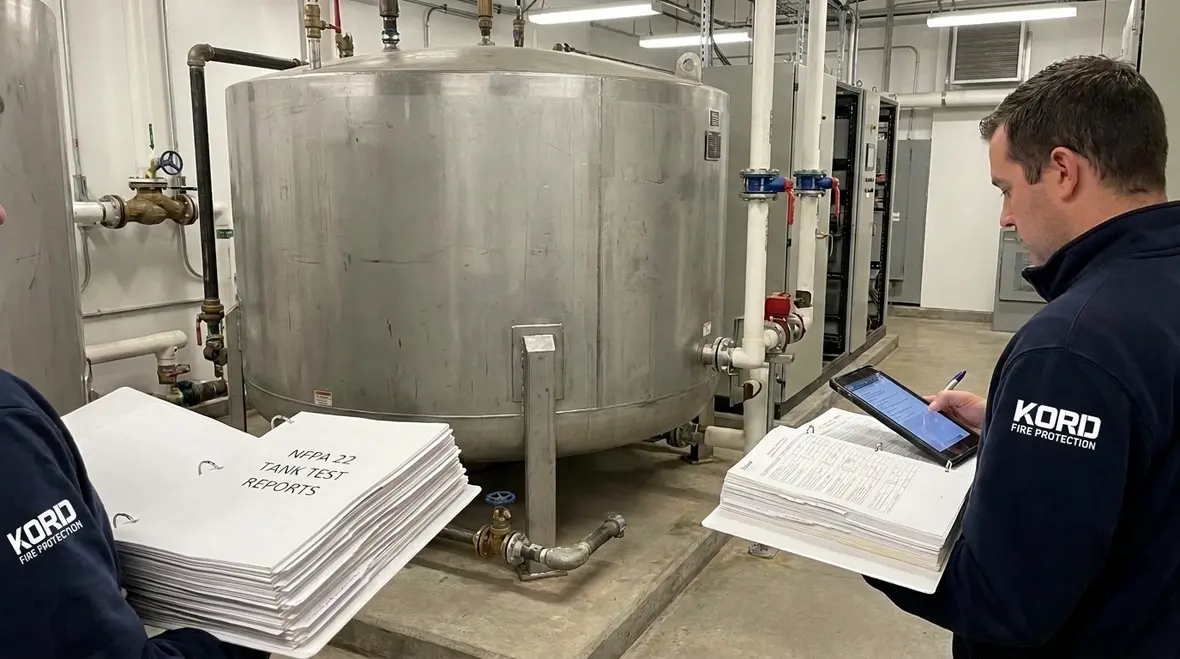
NFPA 22 Section 4.16: Test Reports You Must Document for a Water Tank
Quick Answer
NFPA 22 Section 4.16 requires documented test reports that prove your water tank, its appurtenances, and related components meet acceptance and ongoing performance requirements. Facilities must retain the right evidence for commissioning, periodic inspections, and corrective actions to support compliance during audits and AHJ reviews.
Why NFPA 22 documentation matters for commercial water tanks
For commercial, industrial, and retail fire protection systems, documentation often becomes the deciding factor during Authority Having Jurisdiction (AHJ) reviews, insurer underwriting, and internal compliance audits. The core issue is not only that tests occur, but that results are recorded in a format you can retrieve quickly, trace to the specific tank and system, and defend as complete.
This is where the water tank test report requirements NFPA 22 become operational. NFPA 22 Section 4.16 emphasizes verifiable evidence of test performance and condition. In practice, this means your facility should be able to show which water tank was tested, what was tested, when it was tested, who performed the test, what conditions were observed, and what corrective actions were taken when results failed acceptance criteria.
If your site is trying to connect tank compliance with broader system upkeep before the paperwork starts freelancing, it helps to review fire protection services in Southern California so testing, maintenance, and documentation stay coordinated across the system.
What NFPA 22 Section 4.16 expects you to document
Section 4.16 focuses on test documentation for water tanks used with fire protection systems covered by NFPA 22. The intent is to ensure that test results are not lost between commissioning, routine maintenance, and periodic re evaluation. While the exact scope depends on the system design and tank configuration, the documentation package typically supports:
- Initial acceptance and commissioning evidence for the water tank and its connected components.
- Performance verification that the tank and its associated controls and alarms function as installed.
- Ongoing test records that confirm continued operational readiness.
- Traceability that links tests to dates, locations, tank identifiers, and responsible parties.
Commercial facilities struggle when maintenance is performed without standardized recordkeeping. For example, a technician may correct a valve issue on site but fail to update the test report history. Later, during an inspection, the AHJ may ask for evidence that the corrected condition was re tested and verified.
What “test report” documentation should include in real projects
To meet the spirit of NFPA 22 recordkeeping, each test report should read like a compliance audit trail. Kord Fire Protection commonly sees facilities succeed when reports include consistent field data and clear acceptance status.
Minimum report elements to standardize
- Facility and system identification: building name, address, system tag, tank location, and tank identification numbers.
- Test reference: which NFPA 22 test or procedure the record supports, plus the system configuration.
- Date and time the test was performed, including start and end times where applicable.
- Personnel: company name and technician credentials or authorization.
- Test method and setup: measuring tools used, test conditions, and any isolation steps taken.
- Observed results: readings, pressures, flow or level indicators, and equipment response observations.
- Acceptance or failure determination: pass, fail, or conditional pass with specific reasons.
- Corrective actions: what was repaired or adjusted, parts replaced, and why.
- Retest evidence: confirmation that a failure was resolved and verified.
- Sign off: signature or digital approval with date.
Operational details that reduce compliance friction
During walkthroughs, AHJs frequently look for whether the facility can explain anomalies. Strong reports include context such as temporary operating conditions, the sequence of checks, and how the system returned to normal readiness after testing. Poor documentation often omits these details and makes it harder to prove that the system remained properly secured and functional after the test.
Common water tank failure points that drive better test records
Test reports often become more important after small, recurring issues appear. Many compliance problems trace back to predictable failure modes that affect water availability, tank control, and system response time.
Level and replenishment control issues
Water supply reliability hinges on correct tank filling behavior and level control. Reports should capture the behavior of level indicators and any filling or make up mechanisms during the test window. When level switches or float controls drift out of calibration, the tank may not maintain the intended readiness state.
Valve condition and alignment problems
Valves connected to tank appurtenances can stick, leak, or fail to fully seat. Even minor leakage can alter system performance. Test documentation should capture valve response and any observed seepage, including whether packing adjustments, actuator repairs, or replacement were required.
Corrosion, contamination, and mechanical deterioration
Commercial tanks can experience internal corrosion, biofilm growth, scale buildup, or mechanical deterioration that impacts usable water volume. While tank integrity inspections may fall under related inspection requirements, test records should still note any condition findings observed during testing, especially where the tank’s operability is influenced.
How to build a documentation workflow that stands up to audits
Facilities typically do not fail because tests are impossible. They fail because records are inconsistent, incomplete, or disconnected from the equipment actually installed. A robust workflow aligns testing, maintenance, and recordkeeping in one system.
Set up a “single source of truth” file
Create a centralized folder (digital or controlled physical archive) for each tank and each system it supports. Include:
- As built documentation and the tank identification details
- Commissioning reports
- All Section 4.16 test reports and related re test documentation
- Corrective action history with dates and parts used
Standardize how technicians record pass or fail outcomes
Technicians should document results in a consistent format with enough detail to determine why acceptance was or was not achieved. For example, if pressure or level behavior deviated from expected ranges, the report should state the observed values and what adjustments were made before return to service.
Coordinate tank testing with system readiness checks
Tests should not happen in isolation. When tank controls are tested, the facility should verify that the overall fire protection system returns to its required standby or operating configuration. This prevents a common scenario where a tank issue is corrected but associated controls are left misconfigured, leading to future inspection findings.
For additional context on how NFPA 22 regulates fire protection water tanks and what typically drives design and operational expectations, review how NFPA 22 regulates fire protection water tanks.
Where Kord Fire Protection fits into compliance, testing, and maintenance
Meeting NFPA 22 is not a one time event. It requires coordinated testing, corrective maintenance, and documentation that reflects the actual condition of your water tank and its connected controls. Kord Fire Protection supports commercial facilities by helping teams maintain test readiness, standardize report quality, and close out deficiencies with re test evidence.
In real operations, this matters because water tanks rarely behave like new equipment for years without any intervention. As components age, the risk increases for valve drift, sensor misbehavior, and mechanical wear. A service partner that understands both the technical system and the documentation expectations reduces the time your facility spends responding to information requests and re inspection items.
Frequently Asked Questions
Next step: tighten your NFPA 22 water tank documentation today
If your facility cannot quickly produce complete water tank test report requirements NFPA 22 documentation, compliance risk increases. Request a document and readiness review from Kord Fire Protection to confirm your tank test evidence is traceable, complete, and audit ready. Then align testing and maintenance actions with standardized reporting so your next inspection cycle is efficient, defensible, and focused on system performance.

Join Our Newsletter!
Get the latest fire safety tips delivered straight to your inbox From our Newsletter.



