Emergency Safety Lighting Failures in Coastal Buildings
Emergency Safety Lighting System Failures in Coastal Buildings
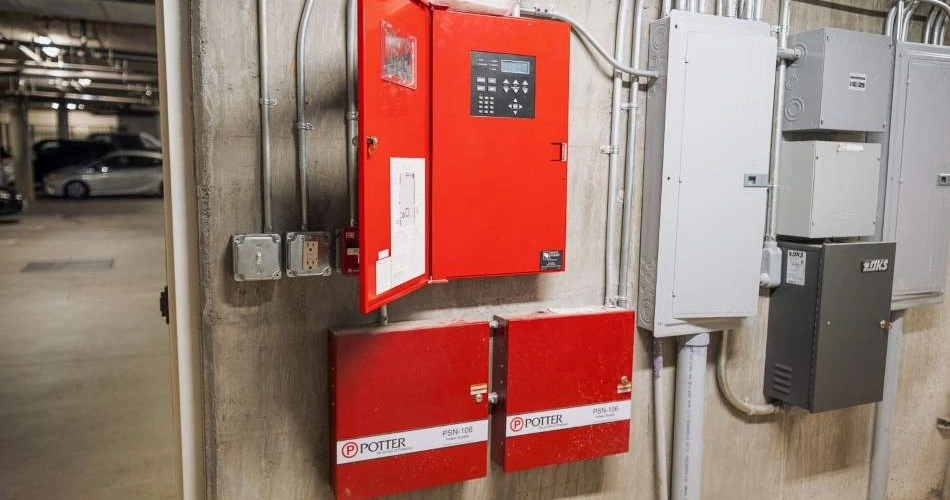
Within the first moments of a power outage, panic often moves faster than reason. That is precisely why an Emergency Safety Lighting System exists. In coastal buildings, however, salt air, humidity, and relentless storms place this system under constant pressure. When it fails, the risk multiplies. Corridors darken. Exit paths vanish. Calm disappears. Kord Fire Protection technicians often explain that coastal environments do not politely test equipment. They wage war on it. Therefore, understanding why these failures occur, how codes such as NFPA 101 address them, and what property owners can do about them becomes not just important, but essential.
Now, let us step into the glow of clarity before the lights flicker out again.
Why Coastal Buildings Face Higher Lighting Failure Rates
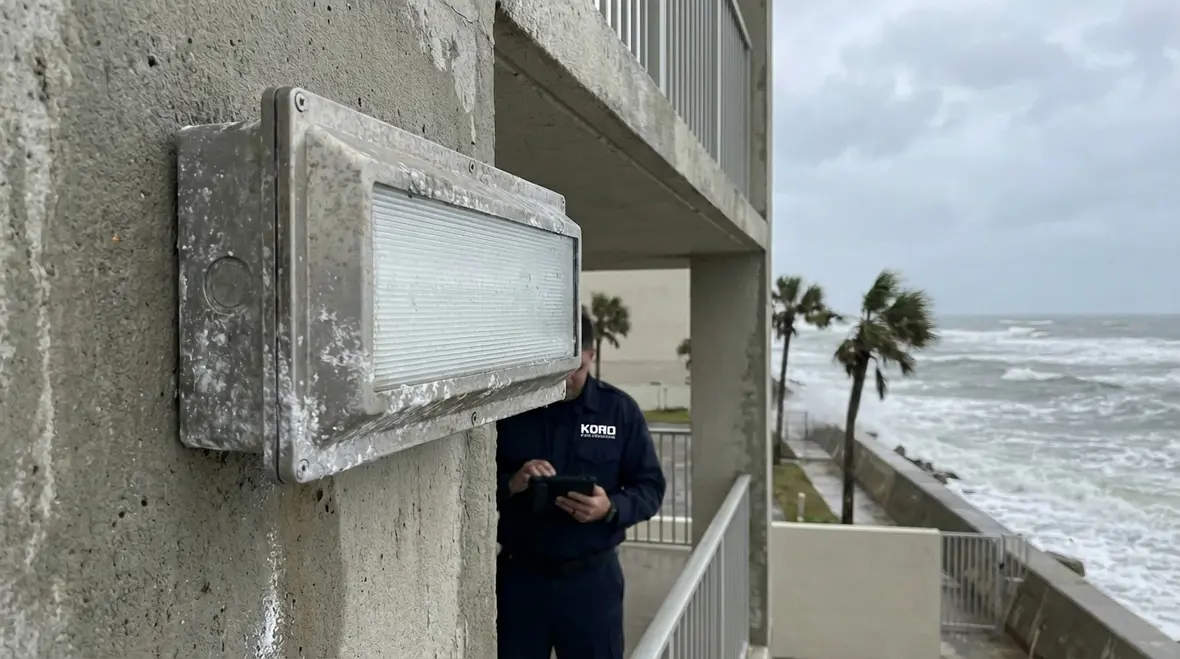
Coastal regions offer ocean views and fresh breezes. However, they also deliver salt laden air, high humidity, and intense storms. Salt corrodes metal. Moisture invades fixtures. Wind driven rain seeps into enclosures that were never meant to host a beach vacation.
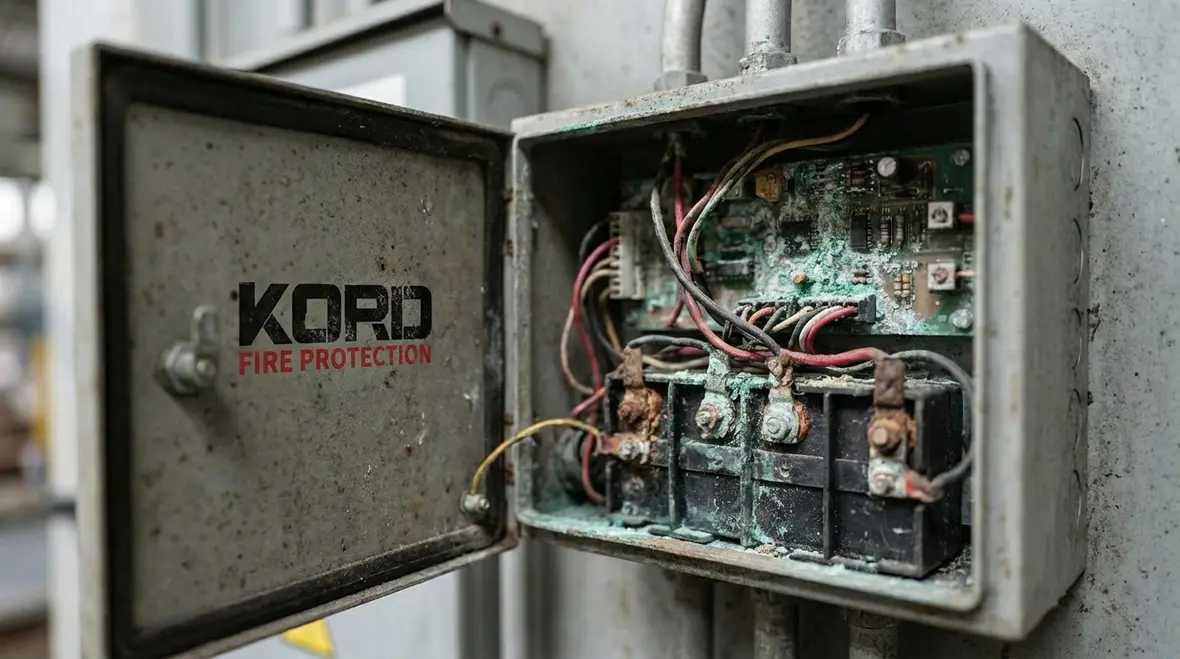
Because of these environmental pressures, emergency lighting components degrade faster near the coast than inland. Battery terminals corrode. Circuit boards develop mineral deposits. Wiring insulation weakens. Over time, this damage reduces reliability. Consequently, a system that passed inspection two years ago may silently struggle today.
Kord Fire Protection technicians often describe salt as the silent villain. It does not crash through the front door like a Hollywood monster. Instead, it creeps in quietly, like a cat that knows it is not supposed to be on the counter. By the time corrosion becomes visible, internal damage may already compromise performance.
Additionally, coastal properties often include parking garages, rooftop decks, and exterior egress paths. These areas expose lighting fixtures directly to the elements. Therefore, without proper ratings and regular testing, failures become not a possibility, but a probability.
How NFPA 101 Guides Emergency Lighting in Coastal Occupancies
NFPA 101 Life Safety Code sets clear requirements for emergency illumination in means of egress. It mandates that exit access, exit pathways, and exit discharge areas remain illuminated during power loss. Moreover, it specifies minimum illumination levels and duration requirements, typically at least 90 minutes of backup power.
However, NFPA 101 does more than demand light. It demands reliability. The code requires regular testing, both monthly functional tests and annual duration tests. These evaluations confirm that the Emergency Safety Lighting System will operate when needed. In coastal buildings, that requirement carries extra weight.
Kord Fire Protection technicians often remind property managers that code compliance is not a one time event. It is a living responsibility. They explain that coastal environments accelerate wear. Therefore, while NFPA 101 sets the baseline, coastal facilities often benefit from more frequent inspections and proactive component replacement.
Furthermore, NFPA 101 requires that emergency illumination activate automatically upon loss of normal power. In storm prone regions, outages may occur suddenly and repeatedly. As a result, systems must withstand not just a single emergency, but potentially several in one season.
To make this clearer, consider the following comparison drawn from field observations and NFPA 101 expectations.
Column One: Common Coastal Failure Factors
- Corrosion of battery terminals and internal contacts
- Moisture intrusion into fixtures and junction boxes
- UV degradation of plastic lenses in exterior units
- Improper gasket sealing around wall mounted fixtures
- Salt buildup on charging components
Column Two: NFPA 101 Related Requirements
- Minimum illumination levels along egress paths
- Automatic activation upon power loss
- Minimum 90 minute operational duration
- Monthly functional testing
- Annual full duration testing with documentation
When these two columns intersect, the message becomes clear. Environmental stress increases the need for disciplined code compliance.
What Actually Fails Inside an Emergency Safety Lighting System?
Many assume that emergency lighting simply means a light bulb with a battery. In reality, the system includes charging circuits, transfer switches, wiring, control relays, and power supply components. Therefore, failure can occur at multiple points.
Batteries represent the most common weak link. In humid coastal air, battery casings may swell. Terminals corrode. Capacity drops. As a result, even if the fixture illuminates during a brief test, it may not sustain the required 90 minutes under NFPA 101.
Charging circuits also suffer. Salt particles can settle on circuit boards. Over time, this creates conductive paths where none should exist. Consequently, chargers may overheat or fail to maintain proper battery levels.
Additionally, transfer mechanisms must detect power loss and switch instantly to backup power. In storm conditions, voltage fluctuations may confuse poorly maintained components. The lights may flicker, delay activation, or fail altogether.
Kord Fire Protection technicians often explain this with a simple analogy. A backup lighting system is like a lifeboat. Nobody plans to use it daily. Yet, when the ship takes on water, nobody wants to discover that the lifeboat has been quietly rotting in the sun.
Inspection and Testing Strategies for Coastal Facilities
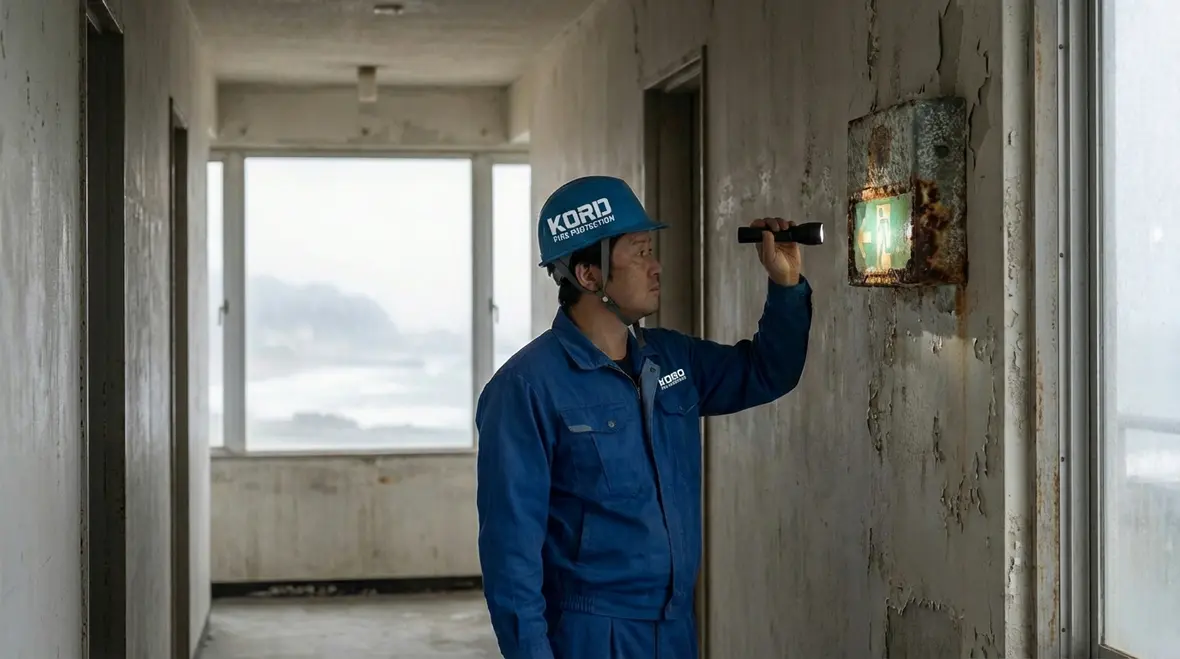
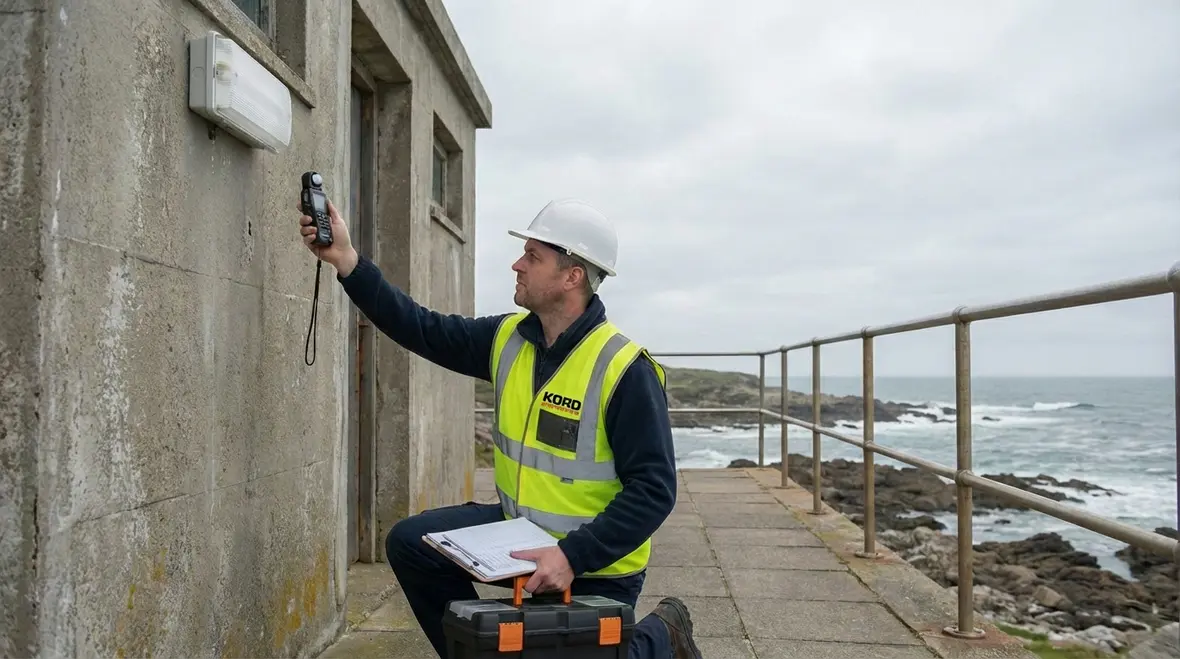
Because coastal stress accelerates wear, inspection strategies must adapt. First, technicians perform visual inspections for corrosion, cracked lenses, and loose mounting hardware. Even small rust spots can signal deeper internal damage.
Next, monthly functional tests confirm that fixtures activate during simulated power loss. However, experienced professionals do not stop at watching lights turn on. They listen for abnormal sounds from inverters or battery packs. They measure illumination levels along egress paths. They verify that no area falls below required standards.
Annually, full duration testing ensures that the Emergency Safety Lighting System sustains operation for at least 90 minutes. In coastal regions, Kord Fire Protection technicians sometimes recommend load testing batteries more rigorously. While NFPA 101 sets minimums, environmental reality often demands extra diligence.
Moreover, documentation plays a critical role. Inspectors record dates, results, deficiencies, and corrective actions. Therefore, building owners can demonstrate compliance during audits or after an incident. Good records also reveal patterns. For example, if exterior fixtures fail every two years, proactive replacement cycles can prevent surprise outages.
Finally, technicians evaluate fixture ratings. Coastal buildings benefit from corrosion resistant materials, sealed enclosures, and marine grade components. Installing inland rated fixtures near the ocean may save money upfront. However, it often costs more in repeated replacements and compliance headaches. As many facility managers learn, the ocean always collects its due.
Storm Surge, Flooding, and System Vulnerability
Coastal buildings face another challenge beyond corrosion. Storm surge and flooding threaten electrical rooms and lower level equipment. If backup lighting inverters or central battery systems sit in flood prone areas, a single event can disable them entirely.
Therefore, risk assessments should include elevation analysis. Critical components may require relocation above anticipated flood levels. Waterproof enclosures and sealed conduit connections further reduce risk.
Additionally, designers must consider post storm access. After a hurricane, debris may block exits. Emergency illumination must guide occupants through alternate routes. NFPA 101 emphasizes maintaining safe egress under emergency conditions. Consequently, lighting design should account for more than ideal floor plans.
Kord Fire Protection technicians often recount stories of buildings that survived structural impact yet failed in darkness. In those moments, even sturdy walls feel fragile without light. As one technician joked, even the bravest superhero prefers to see where he is stepping.
Human Behavior During Lighting Failures
Although equipment reliability forms the backbone of safety, human behavior shapes outcomes. In sudden darkness, people experience disorientation. Heart rates increase. Decision making slows. Therefore, consistent and evenly distributed illumination reduces panic.
NFPA 101 addresses illumination levels for this reason. Clear visibility of exit signs and pathways allows occupants to move with purpose rather than confusion. In coastal hospitality properties, such as hotels and resorts, unfamiliar guests rely entirely on visible cues.
When an Emergency Safety Lighting System fails, crowd movement can become chaotic. Individuals may rush toward perceived light sources, even if those areas do not lead to exits. Consequently, maintaining reliable backup lighting directly influences life safety outcomes.
Kord Fire Protection technicians often emphasize that lighting is not merely technical equipment. It is psychological reassurance. A softly illuminated corridor during a storm says, without words, that someone prepared for this moment.
How Coastal Property Owners Can Reduce Long Term Risk
Proactive planning remains the strongest defense against failure. First, property owners should schedule regular professional inspections that align with NFPA 101. Second, they should invest in corrosion resistant fixtures and marine grade components for exterior and semi exposed areas.
Additionally, facilities should evaluate centralized versus self contained units. In some coastal applications, distributed battery units reduce single point failure risk. If one fixture fails, others remain operational. However, centralized systems may offer easier monitoring. Therefore, design decisions should reflect building layout, flood exposure, and maintenance capabilities.
Training also matters. Maintenance staff should understand basic indicators of system distress, such as warning lights, unusual noises, or visible corrosion. Early detection prevents larger failures.
Moreover, property managers should conduct periodic emergency drills. While drills primarily address evacuation behavior, they also reveal lighting gaps. If certain corridors appear dim or shadowed during testing, adjustments can occur before a real emergency exposes the weakness.
Finally, partnering with experienced professionals strengthens overall resilience. Kord Fire Protection technicians bring field insight specific to coastal environments. They explain technical findings in plain language. They recommend practical upgrades. And yes, occasionally they deliver the message with a gentle joke that makes even a code discussion feel less intimidating.
If your property is in Santa Monica or nearby coastal areas, coordinating emergency lighting and fire protection upgrades alongside services like Santa Monica fire protection services ensures your life safety systems work together, not in isolation.
Frequently Asked Questions
Conclusion: Protecting Coastal Buildings with Confidence
Coastal beauty should never come at the cost of safety. When storms gather and power fades, dependable lighting protects lives and preserves calm. Do not wait for corrosion or flooding to reveal hidden weaknesses. Partner with experienced professionals who understand both NFPA 101 and coastal realities. Kord Fire Protection technicians stand ready to assess, maintain, and strengthen every system.
Schedule an evaluation today and ensure that when darkness falls, your building answers with steady light. To coordinate emergency lighting with your wider life safety strategy, explore Kord Fire’s full fire protection services across Southern California and keep your coastal property inspection ready, storm after storm.
Know Your Weapon Before You Fight the Flame
Kord Fire Protection is your go-to when it comes to all things fire protection. For over 20 years, we’ve been serving Southern California with the quality service and equipment to keep your home or business safe at all times. Our competitive prices reflect our unwavering commitment to protecting what matters most in the event of a fire emergency. Give us a call, send an email, or use that form!

Join Our Newsletter!
Get the latest fire safety tips delivered straight to your inbox From our Newsletter.