
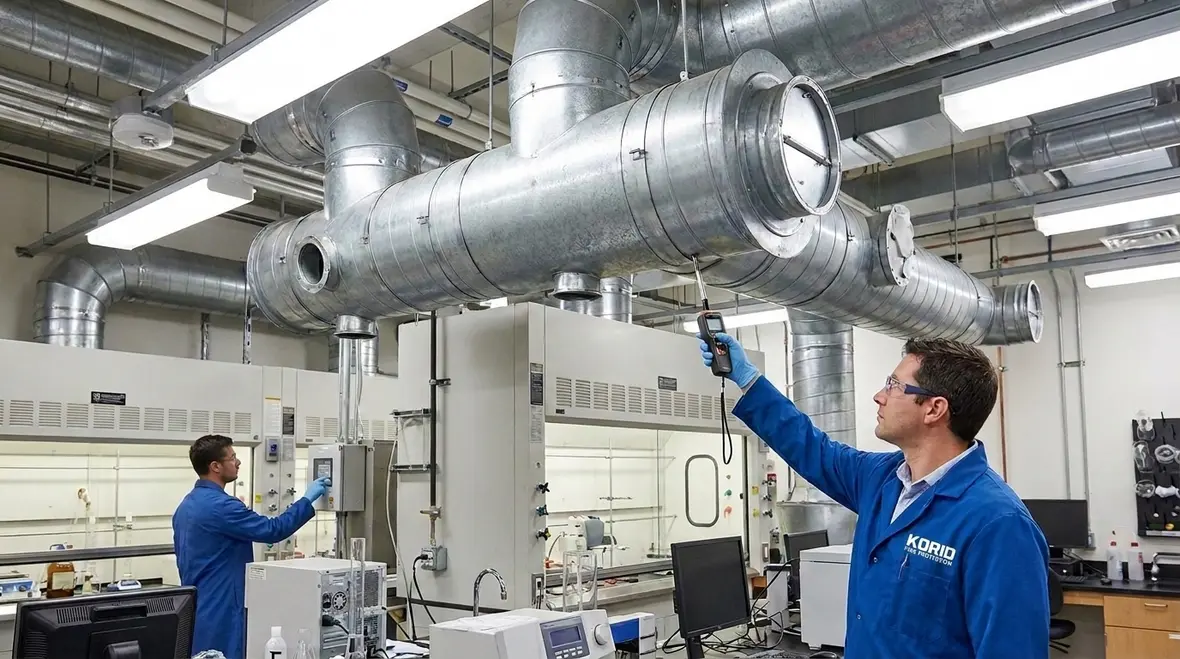
NFPA 45 Section 7.6: Duct Velocity Requirements for Lab Exhaust
Quick Answer
NFPA 45 Section 7.6 requires lab exhaust duct systems to maintain appropriate duct velocities to control transport of airborne contaminants and support safe operation. Facilities comply by selecting the correct velocity targets, verifying airflow balances, and maintaining duct integrity through inspection and ongoing maintenance.
Facilities building a broader laboratory life safety program can also review NFPA 45 Section 4.1 and laboratory unit hazard classification, since ventilation and exhaust performance work best when they are tied to the actual hazards present in the lab.
Why duct velocity matters in laboratory exhaust systems
Laboratory exhaust systems rely on air moving at sufficient velocity inside ductwork to limit settling of particulates, reduce backflow risk, and support consistent capture at hoods and enclosures. When airflow is too low, heavier contaminants can deposit within ducts, compromising system performance and increasing maintenance and exposure risk. When airflow is too high, systems may experience noise, excessive fan energy use, and poor control at the point of use.
Because NFPA 45 laboratory duct velocity requirements directly affect how contaminants move through the duct network, compliance becomes a practical engineering and operations issue, not a one time design document. The requirements must be carried through commissioning, balancing, monitoring, and repairs across the duct lifecycle.
What NFPA 45 Section 7.6 focuses on
NFPA 45 Section 7.6 establishes requirements for duct velocities in exhaust systems serving laboratories. In practice, the rule drives three core compliance outcomes: maintaining design intent airflow, preventing duct accumulation from low transport velocity, and ensuring the system can respond reliably as conditions change.
Facilities typically address these outcomes by establishing a duct velocity basis during design, confirming it during balancing, then verifying it during operational checks. In commercial and industrial settings, the biggest compliance challenge is that real operating conditions drift over time due to filter loading, damper wear, hood sash position, building static pressure changes, and modifications made by other trades.
Key compliance principle: velocity connects to capture and containment
Laboratory exhaust performance depends on the entire airflow path, from the hood or local enclosure to the terminal duct, and through branch takeoffs to the main. NFPA 45 laboratory duct velocity requirements support that concept by ensuring ducts operate at velocities that sustain contaminant transport rather than allowing accumulation.
How facilities demonstrate duct velocity compliance in the field
Compliance is demonstrated through verification of airflow and velocity at representative duct locations, consistent with the system design and balancing plan. Site teams typically follow a controlled process that aligns with commercial facility standards and minimizes disruptive retesting.
1) Establish design velocity and airflow targets
The facility engineering team or mechanical contractor documents the intended velocities and corresponding flows for each duct segment. Because duct diameter and fittings affect velocity, the verification points should reflect the actual duct layout, including elbows, transitions, and branch junctions.
2) Perform initial commissioning and balancing
During TAB, technicians measure flow rates and compute duct velocities based on the duct cross sectional area. Good practice includes documenting measurement locations, instrument calibration, and test conditions. For lab exhaust, the test should reflect expected operating modes, including normal operation and any reduced or standby modes permitted by the design.
3) Implement operational verification after changes
Any modifications that affect air balance can change duct velocities. Common triggers in commercial and retail support spaces include tenant improvements, lab reconfigurations, hood replacements, filter changes, and changes to exhaust fan speed or controls.
Kord Fire Protection supports ongoing compliance by coordinating inspection and testing programs that align with life safety requirements and facility operations. This includes helping facilities manage documentation, scheduling, and remediation workflows so velocity performance does not degrade between major service events. Teams needing broader support can review fire suppression inspection, testing, installation, and maintenance services to keep related protection systems inspection-ready.
Common failure points that reduce duct velocity over time
Even when NFPA 45 laboratory duct velocity requirements are met at commissioning, system performance often drifts. The following failure points are the most frequent causes of reduced effective duct velocity in lab exhaust systems.
Clogged or overloaded filtration components
As filters load, pressure drop increases and fans may deliver less flow if they are not properly controlled. Variable speed systems can partially compensate, but control logic and setpoints must remain accurate. A small reduction in airflow can reduce velocity enough to increase deposition risk.
Damper drift, misadjustment, or linkage failures
Dampers that stick or lose calibration may not maintain the intended distribution of airflow across branches. This often leads to one branch underperforming while another segment over-delivers, creating uneven transport and inconsistent hood performance.
Duct obstructions from construction debris or maintenance residue
Duct systems can accumulate dust and residue from normal operations. After renovations, residual debris can also restrict cross sectional area, which elevates velocity at some points while reducing effective transport in others depending on flow distribution. Either condition can lead to nonconformance and increased maintenance needs.
Undocumented system changes during tenant buildouts
In multi tenant commercial facilities, lab exhaust systems are sometimes modified by electrical, plumbing, or general construction trades without a full mechanical review. These changes include adding penetrations, relocating hoods, or changing duct routing. Without rebalancing and velocity verification, compliance can silently erode.
For additional related guidance on protecting occupants and maintaining safe exhaust performance through inspection programs, see the Kord Fire Protection resource page: Kord Fire Protection.
Inspection and maintenance practices that support ongoing compliance
Maintaining duct velocity performance requires a disciplined inspection and maintenance approach, particularly for facilities with frequent lab usage changes.
What should be on the inspection checklist
- Verify fan operation, motor condition, and speed control response in each operating mode.
- Inspect dampers for correct operation, full travel, and proper linkage alignment.
- Confirm filter status, pressure drop trends, and replacement intervals aligned with actual loading.
- Check ductwork for signs of deposition, corrosion, loose seams, and unauthorized changes.
- Review control sequences that affect exhaust flow, including scheduled setbacks and emergency overrides.
How to manage documentation for commercial facilities
Commercial facilities must manage evidence of compliance, including balancing reports, inspection forms, and corrective action records. A practical document control method ties each duct velocity verification to a system configuration and operating mode. This becomes critical when facilities face audits, insurance reviews, or code enforcement questions.
Kord Fire Protection helps facilities keep compliance documentation organized and current. This reduces the cost and disruption associated with repeat testing by ensuring that inspections, measurements, and maintenance actions remain traceable to the conditions under which the system operated.
Frequently Asked Questions
Conclusion and call to action
NFPA 45 laboratory duct velocity requirements protect lab operations by keeping duct systems effective at contaminant transport. Facilities should verify velocities at representative duct locations, document results, and maintain the system so airflow does not drift. For commercial, industrial, and retail labs, Kord Fire Protection can support inspections, testing, and maintenance planning to sustain compliance and reduce downtime from unexpected failures. Schedule a compliance review to confirm your duct velocity performance today.

Join Our Newsletter!
Get the latest fire safety tips delivered straight to your inbox From our Newsletter.



