
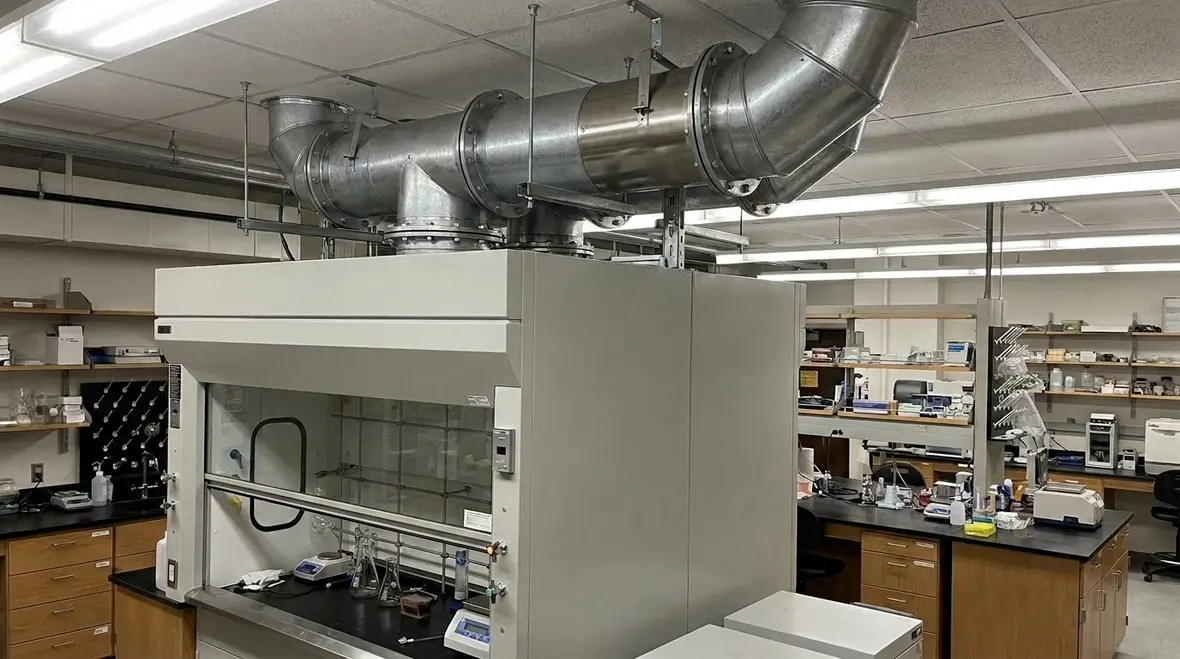
NFPA 45 Section 7.5: Duct Construction for Hoods and Local Exhaust
Quick Answer: NFPA 45 Section 7.5 sets requirements for designing and building ductwork that supports fume hoods and local exhaust systems. The goal is to maintain safe containment and airflow performance while resisting corrosion, mechanical damage, and leakage that can undermine hazardous fume control.
Facilities dealing with safety-critical exhaust pathways can also explore commercial fire suppression systems and services for broader inspection, testing, repair, and compliance support across specialized environments.
Why duct construction rules matter for fume containment
Ductwork carries hazardous vapors, fumes, and particulates away from a work zone. Even when a fume hood capture face and fan are properly selected, poor duct construction can introduce leakage, pressure loss, or chemical degradation. NFPA 45 fume hood duct construction requirements help facilities prevent these failures by addressing material suitability, installation quality, support methods, and joints. This becomes critical in commercial, industrial, and retail environments where work practices, maintenance access, and building modifications can quickly erode original system performance.
What NFPA 45 Section 7.5 expects from ductwork
NFPA 45 Section 7.5 focuses on duct construction for hoods and local exhaust, targeting reliability in the real conditions where duct systems operate. In practice, compliance means the duct system must function as an engineered containment pathway, not as a loose collection of components. Key expectations typically cover:
- Proper materials: Ducts must resist the chemical and temperature conditions associated with the process.
- Leak-resistant joints: Connections must limit escape at seams, flanges, and transitions.
- Correct sizing and flow paths: Duct routing and diameter changes must support designed capture and exhaust performance.
- Secure supports and alignment: Ductwork must maintain configuration under load, vibration, and thermal cycling.
- System integrity over time: Materials and workmanship must remain serviceable through routine maintenance and inspections.
Because facilities often retrofit equipment, relocate workstations, or add new processes, Section 7.5 compliance must extend beyond the initial build to ongoing condition monitoring and repair practices.
Common compliance challenges commercial facilities face
Operational realities introduce failure points that inspections frequently uncover. Facilities that prioritize safety engineering still encounter duct construction issues due to aging, improper repairs, or unplanned modifications. Typical problem areas include the following.
1) Material and corrosion mismatch
When duct materials are selected for nominal conditions but exposed to stronger solvents, moisture, or corrosive contaminants, degradation can start quietly. Corrosion pits create weak spots that allow seepage into the occupied area. This risk increases when duct runs include horizontal sections that collect condensate or when systems operate intermittently, creating repeated temperature cycling.
2) Leaky joints and improvised connections
Field connections often become the weakest link. Poorly sealed flange joints, gaps at transitions, or duct repairs made with incompatible sealants can create chronic leakage. These leaks may not be obvious without pressure testing, smoke testing, or targeted inspection during maintenance shutdowns.
3) Support and sagging over time
Improper hangers, inadequate spacing, or damaged supports can cause duct sag. Sagging can alter airflow, increase pressure drop, and increase condensation retention. It also increases mechanical stress at elbows and joints, accelerating failure.
4) Obstructions and build-up
Accumulated deposits can narrow ducts and disturb the intended flow distribution. Deposition severity often correlates with particulate loading, duct velocity, and whether upstream capture points were maintained. In many cases, maintenance schedules focus on the hood and fan but do not fully address duct internal condition.
5) Pressure imbalances after modifications
Adding equipment, changing hood configurations, or rebalancing airflows without updating ductwork can produce performance drift. Even if duct construction initially met Section 7.5 expectations, later changes can create conditions where flow patterns worsen and leakage becomes more likely.
To address these practical issues, facilities need a compliance program that couples duct construction verification with periodic testing and documented corrective action.
How to evaluate duct construction in the field
Meeting NFPA 45 Section 7.5 is not only about the original spec. It also relies on how the system is inspected, operated, and maintained. A strong evaluation approach typically includes the following.
Visual and workmanship inspection
- Verify joint integrity at flanges, slip joints, and transitions.
- Check that ductwork is properly aligned and fully supported.
- Look for signs of corrosion, cracking, warping, and missing insulation or liners where required.
- Confirm that modifications used compatible materials and sealing methods.
Performance verification aligned to local exhaust function
Duct construction affects system pressure loss and distribution. Facilities should use measurement approaches consistent with their safety management plan, such as checking airflow performance and ensuring the exhaust system meets intended capture conditions at the hood face. Where appropriate, smoke visualization, leak checks, or pressure testing can validate enclosure integrity.
Maintenance planning that protects the duct system
Effective duct maintenance reduces the likelihood of gradual performance degradation. A typical program includes:
- Scheduled inspections of duct runs, especially near elbows, joints, and transitions.
- Cleaning plans based on process loading and observed build-up rates.
- Repair protocols that return the system to its approved configuration using compatible components.
- Documented handoff between operations and maintenance to prevent undocumented duct changes.
For many facilities, the most efficient way to sustain compliance is to treat duct systems as safety-critical infrastructure, not as static building components.
Installation and repair practices that prevent future failures
Ductwork performance depends on installation details that can be overlooked during construction or fast turnarounds. NFPA 45 fume hood duct construction requirements are most effectively met when design intent is preserved through every installation and repair step.
Use compatible materials and sealing methods
Repairs should match duct material properties and maintain chemical compatibility. Sealants, gaskets, and liners used on ductwork must align with the process exposure and temperature range.
Minimize unnecessary transitions and routing changes
Every change in geometry affects velocity and pressure. Facilities should avoid ad hoc routing and should revalidate performance when duct routing is altered.
Support design should match load conditions
Hangars, bracing, and anchors must prevent sag and allow safe thermal expansion where applicable. Support failures frequently show up first at offsets, elbow regions, and near service access areas.
Document modifications and confirm results
When facilities document duct layouts and revision history, they reduce the risk of repeating noncompliant repair methods. Documentation also improves audit readiness and helps technicians troubleshoot systematically.
If your facility needs an organized path for inspections and repairs across multiple systems, Kord Fire Protection supports ongoing compliance through practical commercial testing and maintenance planning. For related guidance, facilities can reference Clean Agent Fire Suppression for Labs by Kord Fire Protection and broader support resources at Kord Fire Protection.
Frequently Asked Questions
Call to action
Ensure your fume hood ductwork remains compliant as processes and facilities change. Kord Fire Protection can help commercial owners and safety teams validate duct integrity, identify degradation early, and document corrective actions for ongoing readiness. Contact Kord Fire Protection to schedule an inspection and maintenance plan tailored to NFPA 45 duct construction expectations and your operational risk profile.

Join Our Newsletter!
Get the latest fire safety tips delivered straight to your inbox From our Newsletter.



