
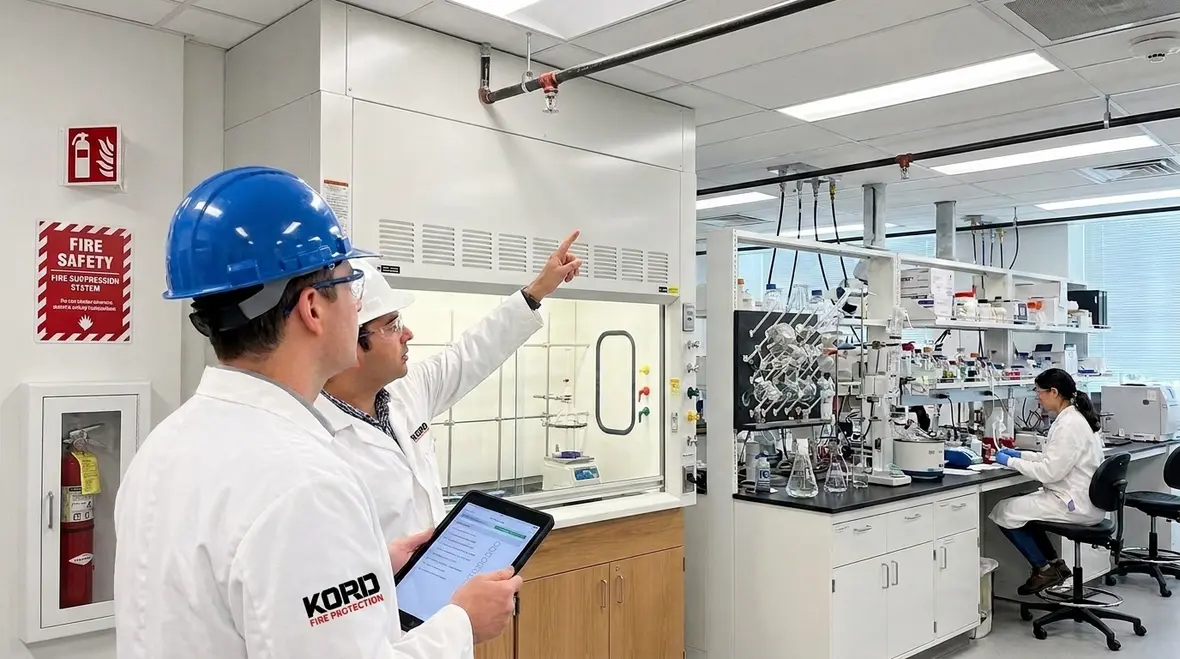
NFPA 45 Section 1.5 Equivalency: Alternative Compliance for Laboratories
Quick Answer
NFPA 45 Section 1.5 allows a laboratory to pursue NFPA requirements through alternative means when the proposed design, installation, operation, or maintenance provides an equivalent level of protection. The process demands documentation, approval, and ongoing verification through testing and inspection.
What does NFPA 45 Section 1.5 require?
NFPA 45 Section 1.5 establishes the framework for NFPA 45 equivalency alternative compliance in facilities where strict adherence to a specific provision is impractical, technically infeasible, or would negatively impact overall fire and life safety performance. In practice, the authority having jurisdiction (AHJ) evaluates whether the alternative approach delivers an equivalent level of safety through comparable fire protection effectiveness.
For commercial laboratories, this often arises during tenant fit outs, retrofits, changes in occupancy loads, equipment substitutions, or modernization of suppression and detection systems. The key requirement is not flexibility for its own sake. The requirement is demonstrated equivalency backed by engineering rationale, reliable hardware performance, and verifiable operational controls.
Facilities working through these questions often also review broader fire suppression inspection, testing, installation, and maintenance services to make sure the alternative strategy still stays inspection ready after approval.
When does a facility typically need an equivalency strategy?
Most equivalency requests begin with a specific constraint. Typical scenarios in commercial, industrial, and retail laboratory environments include:
- Unique lab workflows and hazards where standard configurations do not align with the process sequence, ventilation patterns, or storage practices.
- Existing building limitations such as structural constraints, routing conflicts, or limitations on ceiling spaces that affect placement of fire protection components.
- Alternative detection or suppression technology used to better match the laboratory’s ignition sources or suppression needs.
- Equipment or material substitution where traditional code prescriptive solutions do not reflect actual hazards.
- Tenant turnover and phased construction where interim life safety measures must remain effective until a full installation is complete.
Under NFPA 45 equivalency alternative compliance, the facility must show that these deviations do not reduce protection below the level intended by the applicable NFPA requirements. This includes real-world impacts during normal operation, abnormal conditions, and maintenance states.
How equivalency is evaluated in the real world
NFPA 45 Section 1.5 equivalency is not a paper exercise. It requires a defensible basis that the AHJ can audit. A typical review expects the equivalency submittal to address the intent of the prescriptive requirement and to prove comparable performance.
1) Define the prescriptive gap and safety intent
The submittal should clearly identify which NFPA 45 provision cannot be followed as written. It should also explain the safety intent behind that provision, such as controlling ignition sources, limiting fire spread, providing timely detection and notification, or ensuring effective suppression and safe evacuation conditions.
2) Specify the alternative means and how it performs
The facility must describe the alternative design, installation method, operation sequence, and maintenance approach. For example, when an alternative detection strategy is used, the documentation should address sensitivity, placement rationale, environmental conditions, alarm processing, and coordination with suppression or shutdown actions.
When suppression equivalency is proposed, the submittal typically includes coverage expectations, discharge characteristics, protection of equipment and storage areas, and assurance that valves, piping, and release mechanisms remain capable during inspection and impairment scenarios.
3) Prove equivalency through documented testing and safeguards
Equivalency evaluations frequently rely on performance evidence and operational safeguards. Practical proof often includes:
- Commissioning records for the specific installation
- Functional testing results for detection, alarm, and control interfaces
- Maintenance procedures that preserve performance over time
- Mitigation of known failure points, such as disabled devices, poor access for inspection, clogged nozzles, or unverified test circuits
4) Plan for impairment, maintenance, and continued compliance
Laboratories change often. The most common equivalency failure mode is not the original design decision. It is drift after installation due to equipment changes, workforce practices, and incomplete maintenance documentation. A durable equivalency strategy includes an ongoing verification plan and an impairment management approach aligned with commercial facility expectations.
That ongoing verification mindset lines up well with Kord Fire Protection’s guidance on the full lifecycle of fire protection servicing, especially where inspection records, testing routines, and service history need to stay useful long after the initial approval letter lands on someone’s desk.
What documentation and testing usually matter most?
A strong NFPA 45 equivalency alternative compliance package is structured for AHJ review and internal operational use. The facility should prepare documents that connect the alternative system’s design intent to measurable performance outcomes.
Core submittal elements
- Engineering narrative describing the constraint, the intent of the prescriptive requirement, and the alternative approach.
- System description identifying components, detection zones, actuation logic, suppression methods, and interfaces with laboratory controls.
- Risk and scenario coverage outlining the credible ignition and fire growth pathways relevant to the laboratory’s chemicals and equipment.
- Maintenance and inspection plan including access requirements, schedules, and acceptance criteria.
- Testing evidence for commissioning and periodic operational checks.
Operational inspection standards and common failure points
Commercial labs often experience predictable issues that weaken equivalency over time. Teams typically focus on:
- Coverage and placement drift after furniture, racks, or process equipment changes.
- Detection nuisance or insensitivity from dust, aerosols, ventilation turbulence, or uncorrected calibration drift.
- Control interface failures such as alarm routing changes, software updates, or unintended bypass states.
- Suppression readiness affected by valve tampering, inadequate access for testing, or delayed corrective actions.
- Maintenance documentation gaps where work orders exist but performance records do not.
Consistent verification reduces AHJ friction at inspection time and strengthens the facility’s defensibility if the alternative approach is challenged.
How Kord Fire Protection supports ongoing equivalency compliance
Equivalency under NFPA 45 Section 1.5 depends on sustained performance, not one-time approvals. Kord Fire Protection helps commercial facilities maintain evidence of protection by supporting commissioning follow up, scheduled inspection readiness, and functional testing of life safety systems that labs rely on day to day.
For teams responsible for continuous compliance, Kord Fire Protection can also support documentation organization and proactive maintenance practices that address the most common operational failure points. If you are building a compliance plan or preparing for an AHJ visit, consider aligning your inspection and test scope to the same performance attributes used in your equivalency submittal.
To explore related compliance guidance, review Kord Fire Protection services and how ongoing testing and maintenance help keep systems reliable.
Frequently Asked Questions
Conclusion and next step
NFPA 45 Section 1.5 equivalency alternative compliance can reduce prescriptive constraints, but only when the facility proves equivalent protection and maintains that performance over time. A successful pathway starts with a clear gap statement, a defensible alternative design, and a testing and maintenance plan aligned to real laboratory operations. Engage your AHJ early and partner with Kord Fire Protection to plan inspections and functional tests that preserve equivalency after approval.

Join Our Newsletter!
Get the latest fire safety tips delivered straight to your inbox From our Newsletter.



