
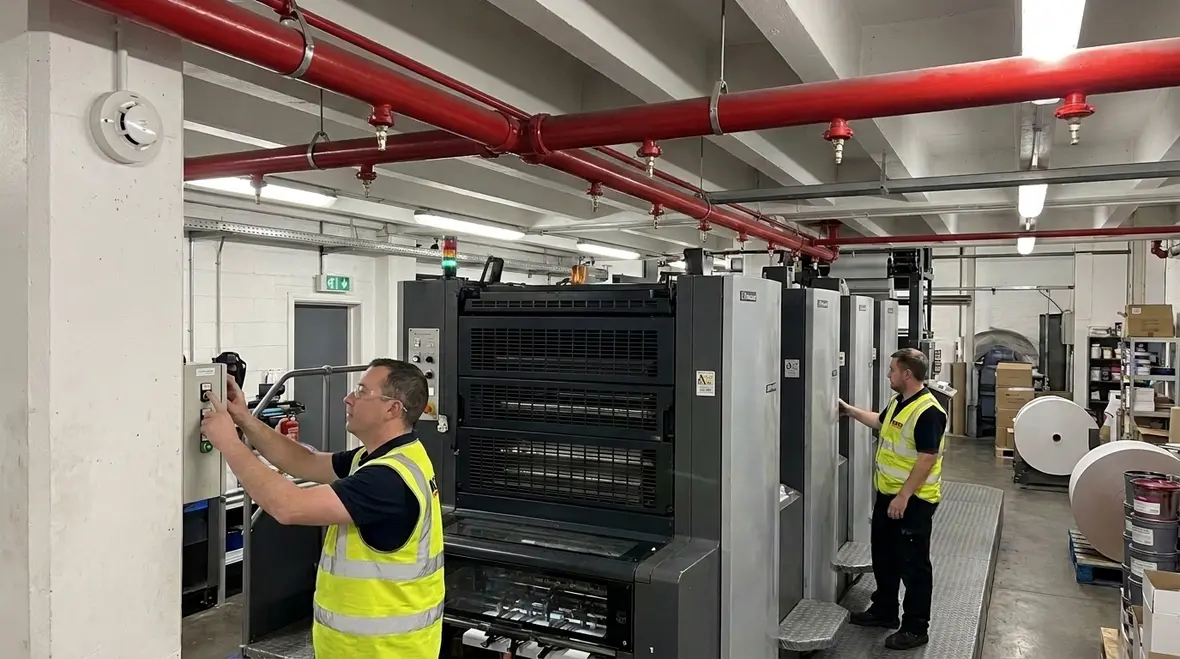
NFPA 34 Section 9.10: Automatic Fire Protection for Printing Processes
Quick Answer
NFPA 34 Section 9.10 requires automatic fire protection systems sized and installed to control risks created by printing process hazards such as combustible dust, paper, solvents, and heat sources. Compliance depends on correct detection, protected coverage, listed components, and a documented inspection and maintenance program.
What NFPA 34 Section 9.10 actually demands for printing operations
In printing facilities, ignition sources range from hot work and electrical faults to friction and overheating equipment, while fuel sources include paper, coated materials, inks, binders, and residues. NFPA 34 printing process automatic fire protection focuses on applying automatic detection and suppression arrangements that limit fire growth and protect egress and life safety.
For facilities aligning to NFPA 34 Section 9.10, the compliance objective is not just “having a system.” It is ensuring the system matches the process, the hazard, the enclosure configuration, the fuel package, and the operational realities of production and maintenance. Kord Fire Protection supports commercial facilities with practical system review, inspection readiness, and recurring testing so the protection strategy remains effective over time.
Facilities that need broader inspection, testing, and maintenance support can also explore fire protection services in Southern California to keep code-driven work coordinated with day to day operations.
How Section 9.10 connects printing process hazards to system design
Printing processes vary significantly by technology and material handling. Section 9.10 expectations typically tighten around where ignition is most likely to occur and where fire could spread rapidly before staff can respond.
Key hazard drivers in printing
- Combustible solids: paper, cardboard, press components with dust loading, and accumulated waste.
- Combustible residues: ink and coating overspray, drips, and buildup on ledges and equipment surfaces.
- Volatile or combustible liquids: solvents and cleaning agents that can contribute to fire spread when vapors or residues are present.
- Hot surfaces and machinery: dryers, heaters, and mechanical friction points.
- Ventilation and enclosures: airflow patterns can move heat and products of combustion away from detectors if coverage is not properly engineered.
From a compliance standpoint, the most common gap is hazard misunderstanding: facilities sometimes treat the press line as a single protected unit rather than an interlinked system of localized risk zones. A correct approach identifies the likely ignition location, the expected plume and heat signatures, and the fire growth trajectory before selecting the protection method.
What “automatic fire protection” means in day to day operations
Automatic fire protection in printing environments typically uses a combination of detection, alarm notification, and fire control. The design goal is to achieve early intervention with a reliable activation path.
Detection performance and coverage
Detectors must be positioned and selected so that they respond to the conditions produced by credible initial fires, such as heat rise, smoke obscuration, or flame, depending on what the standard and engineering analysis require for the process area. Coverage must account for:
- production airflow that can delay smoke movement to sensors
- mechanical obstructions created by ducting, guards, or press components
- environmental conditions such as humidity, dust loading, and steam near dryers
- operational modes, including start up, shutdown, and cleaning cycles
Suppression and control strategy
Suppression arrangements are selected and installed based on the hazard geometry and process configuration. A compliant system considers how extinguishing agent delivery interacts with the enclosure or hooding arrangement and how it supports fire confinement rather than just surface wetting.
Where applicable, design details include:
- protected zones aligned with ignition likelihood
- proper piping, nozzles, and distribution layout
- effective interface with alarms, shut down controls, or isolation valves
- clearances and maintenance access for guards, ducting, and service panels
Compliance does not end at installation: inspection readiness and submittals
NFPA 34 printing process automatic fire protection is only as strong as its documentation and ongoing operability. Commercial facilities often pass initial inspections but lose compliance later due to configuration drift, modified ductwork, or untracked production changes.
Common compliance risk points
- Unauthorized modifications: adding equipment, changing hood layout, or rerouting cables without updating drawings or protection coverage.
- Detector contamination: dust and residue buildup can mask sensing performance or trigger nuisance issues that lead to improper workarounds.
- Obstructed agent pathways: maintenance activities can block nozzles, discharge points, or access panels.
- Alarm and interlock failures: alarm annunciation delays or disabled shutdown sequences that compromise response objectives.
- Inadequate maintenance access: systems that cannot be serviced safely often drift out of specification.
To reduce inspection friction, facilities benefit from a structured acceptance and maintenance package that includes current as built drawings, device listing compatibility, and a testing schedule aligned to operational risk. Kord Fire Protection assists customers by coordinating inspection and maintenance activities that help keep equipment functional and documentation current.
If the facility also manages life safety and smoke handling practices, teams often review broader fire protection context through related guidance such as Kord Fire Protection resources for practical insights on maintaining readiness.
Inspection, testing, and maintenance: how systems stay compliant in production
A printing facility operates in cycles, and protection systems must tolerate heat, dust, and routine cleaning while maintaining detection reliability and agent delivery performance.
What ongoing maintenance typically targets
- Detector health: verify response functionality, cleanliness, and correct placement relative to the process.
- Alarm and notification: confirm audible and visual notification performance and proper control panel status.
- System operability: check valves, tamper conditions, device supervision, and emergency readiness.
- Suppression equipment: verify components, check for obstructions, and confirm inspection intervals are met.
- Housekeeping and residue control: ensure that accumulated combustible debris does not overwhelm detection or increase growth rate beyond design assumptions.
Where maintenance teams often get tripped up
- Production changes without engineering review: dryer upgrades, ducting modifications, or airflow changes can alter detection conditions.
- Seasonal operational differences: humidity, solvent use variations, and cleaning schedules can change hazard profiles.
- “Temporary” overrides: recurring bypass practices during troubleshooting become long term operational habits.
- Documentation gaps: missing service records and incomplete test reports delay corrective actions and audit readiness.
Kord Fire Protection helps commercial, industrial, and retail facilities manage these risks with recurring service, condition verification, and documentation support that aligns with the operational workflow of printing sites.
Practical checklist for NFPA 34 printing process automatic fire protection
Use the checklist below to structure internal review and reduce audit and inspection surprises.
| Area | Verification Point | What to document |
|---|---|---|
| Hazard zoning | Zones match the process, airflow, and ignition likelihood | Process map, protection coverage diagrams, design basis notes |
| Detection | Devices are correctly located and operational under production conditions | Device listing data, inspection results, cleaning and calibration records |
| Suppression delivery | No obstructions, proper alignment, and correct interfacing | Valve and component checks, distribution verification, test reports |
| Alarms and control | Alarm notification and any required process shutdown or isolation functions operate | Sequence of operations, control panel test records |
| Maintenance access | Crews can safely service equipment without defeating protection | Maintenance procedure notes, access audit results |
| Change management | Equipment changes trigger protection review and documentation updates | Change logs, as built drawing updates, re inspection triggers |
Frequently Asked Questions
Get printing line protection that stays inspection ready
NFPA 34 Section 9.10 places real responsibility on detection placement, suppression operability, and sustained maintenance. Kord Fire Protection helps printing and commercial production facilities validate system performance, manage service intervals, and keep documentation current through recurring inspections and testing. If your facility is modifying equipment, changing production materials, or preparing for an authority having jurisdiction review, contact Kord Fire Protection to assess compliance readiness and eliminate preventable gaps.

Join Our Newsletter!
Get the latest fire safety tips delivered straight to your inbox From our Newsletter.



