
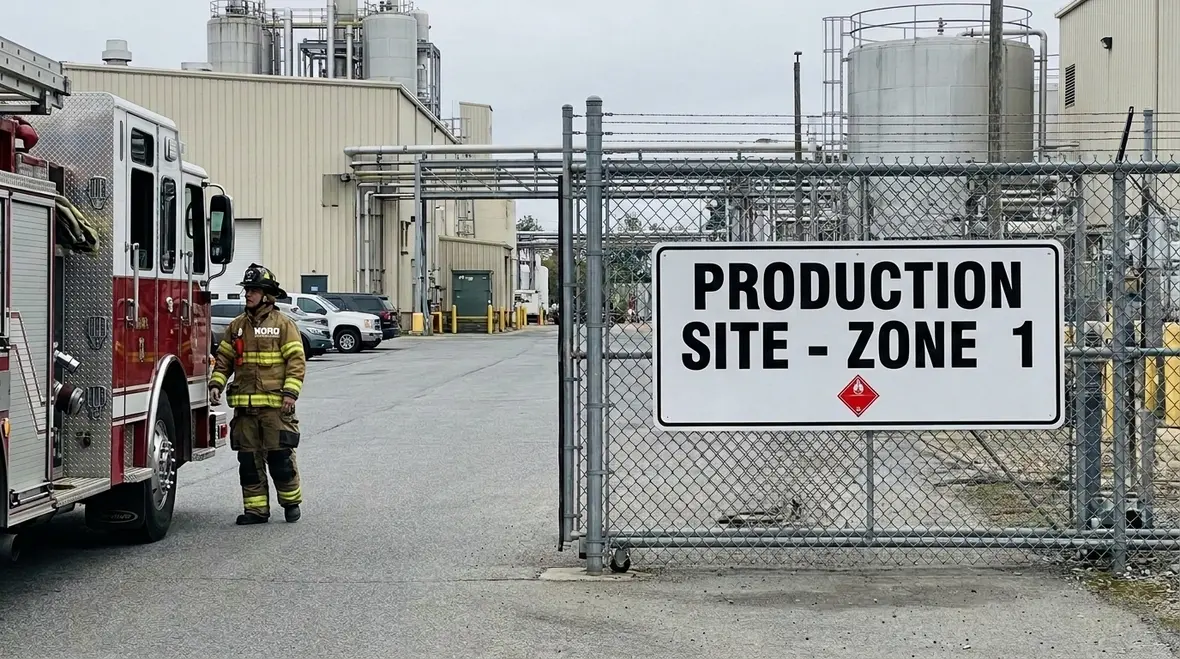
NFPA 30 Section 26.4: Identifying Production Sites for Responders
Quick Answer: NFPA 30 Section 26.4 emergency responder identification directs facilities to clearly identify production sites so responding personnel can locate hazards and apply the correct protective actions quickly. Compliance requires consistent signage, maintained site markings, and coordination that remains accurate as operations and layouts change.
Why NFPA 30 Section 26.4 emergency responder identification matters on the first arrival
In incident response, seconds determine safety. When a commercial or industrial site experiences a fire, leak, or vapor-related emergency, responders must rapidly confirm where the production process is occurring, which areas contain flammable liquid hazards, and how those hazards are arranged relative to access routes and water supply.
NFPA 30 Section 26.4 emergency responder identification focuses on reducing ambiguity for first arriving units. In practice, it requires that the production site can be identified reliably, even when an incident location is reported vaguely, when dispatch information is incomplete, or when responders arrive during shift changes and layout variations.
Facility teams also benefit from this requirement because it aligns operational reality with emergency planning documentation. That alignment reduces the likelihood of delayed evacuations, incorrect fire attack zones, and ineffective isolation due to uncertain hazard location.
Facilities reviewing emergency responder identification alongside broader compliance planning may also find it helpful to look at Kord Fire Protection Australia’s fire suppression systems support, especially where production hazards, extinguishing strategy, and access planning need to stay aligned over time. ([kordfire.com.au](https://kordfire.com.au/fire-suppression-systems/?utm_source=openai))
What Section 26.4 is trying to prevent
Most compliance failures are not caused by missing documentation alone. They stem from operational drift and inconsistent field information. Common risks include:
Inconsistent site naming between dispatch records, emergency plans, and physical markings.
Missing or faded identifiers on buildings, perimeter points, or critical intersections used by arriving units.
Changes in equipment layout during turnarounds, expansions, or temporary works that are not reflected in responder-facing identifiers.
Hazard area confusion where flammable liquid production zones are adjacent to utilities, warehouses, or retail display areas, but only one is clearly marked.
For commercial, industrial, and retail occupancies that store or produce with flammable liquids, the production site identifier becomes a safety-critical interface between the facility and emergency services.
What “production site identification” looks like in the field
NFPA 30 Section 26.4 emphasizes the need for clear, observable identification that responders can use immediately. A practical compliance program usually covers more than one location type, so responders can confirm the incident area even when approaching from different directions.
1) External identifiers responders can see before entering
Correct site or production area labels at facility boundaries and primary access points.
High-visibility identifiers near gate locations, building fronts, and access roads that lead to flammable liquid hazard zones.
Clear, consistent naming that matches the emergency planning documents and dispatch information.
2) Operational identifiers that remain accurate as processes change
Area identifiers tied to production processes, not just building numbers.
Location markings that reflect where flammable liquids are produced, handled, or transferred under normal operations.
Process-based labeling that remains valid after seasonal changes, container swaps, or temporary piping modifications.
3) Access and navigation support for responders
Identification must connect to actionable navigation. A responder identifier that points to a place they cannot reach due to locked gates, obstructed travel paths, or unclear wayfinding fails operational intent even if it technically exists. Many facilities address this by coupling identifiers with maintainable access controls, posted turning plans, and protected routes that do not change without a compliance update.
How facilities implement compliance without creating new failure points
Commercial facilities often rely on shared responsibility across operations, maintenance, and safety teams. That structure can work, but it can also create gaps if updates are handled informally. A robust implementation approach uses controlled change management and inspection-driven verification.
Control changes that impact production identification
Whenever the site layout changes, the facility should treat responder identification as a safety element that must be reviewed. This includes:
Temporary works and outage periods
Equipment relocation and new process trains
Warehouse or retail area reconfiguration adjacent to hazard storage or handling
Permanent construction that affects access routes and building entry points
Inspect identifiers like life safety equipment
Identifiers should not be verified only after an incident or audit. A practical inspection program includes:
Visual checks for legibility, reflectivity, and weather damage
Verification that signage and markings still match current floor plans and hazard maps
Confirmation that access routes are unobstructed and that gates or barriers align with emergency plan procedures
Because signage can degrade from UV exposure, chemical residues, high traffic, and repainting cycles, the inspection standard must include cleaning and replacement thresholds. This approach reduces “paper compliance” where plans remain correct but physical identification becomes unreliable.
Align physical markings with broader flammable liquid compliance
Responders interpret identifiers in the context of the facility’s broader flammable liquid safety strategy. Facilities that strengthen identification also benefit from tightening flammable liquid compliance systems, including inspection routines, risk controls, and documentation alignment.
For related guidance on how flammable liquid requirements shape operational risk controls, review this resource: how NFPA 30 regulates flammable liquids.
Common compliance gaps seen during audits and revalidations
Teams frequently discover that NFPA 30 Section 26.4 emergency responder identification needs a more disciplined validation approach. The most common gaps include:
Identifiers exist but do not match emergency documentation, causing responders to confirm the wrong process area.
Signage is installed during commissioning but not maintained after refurbishments, repainting, or contractor changes.
Temporary markings become permanent informally, creating outdated identifiers that persist beyond the project scope.
Identifiers cover the building, not the hazard zone, leaving responders uncertain about the production area boundaries where flammable vapors or transfer operations occur.
Route confusion due to obstructed driveways, incorrect gate signage, or access paths that conflict with posted wayfinding.
Each gap increases the odds of delayed hazard recognition, slower suppression setup, and inconsistent emergency decision-making. A structured revalidation cycle reduces the probability of these failures returning after upgrades or staffing changes.
How Kord Fire Protection supports ongoing emergency responder identification readiness
NFPA 30 Section 26.4 emergency responder identification succeeds when it stays accurate over time. Kord Fire Protection supports commercial, industrial, and retail operators by helping maintain a compliance-ready safety interface between the site and responding agencies.
Operational support typically includes:
Compliance review coordination aligned to current site layout and hazard mapping
Inspection planning and verification schedules that account for maintenance cycles, renovations, and seasonal changes
Practical recommendations for signage and identifier upkeep so identifiers remain visible, legible, and correct
For more support and fire safety compliance services, visit Kord Fire Protection Australia. ([kordfire.com.au](https://kordfire.com.au/?utm_source=openai))
Frequently Asked Questions
Conclusion: Make responder identification a maintained safety control
NFPA 30 Section 26.4 emergency responder identification improves safety by removing uncertainty for first arrivals. Facilities should verify that site and production area identifiers remain visible, accurate, and aligned with current layouts, maps, and access routes. Kord Fire Protection can help you keep the system compliant over time through practical reviews and maintenance oriented assurance. Schedule a compliance check to confirm your responder identifiers stay dependable through every operational change.

Join Our Newsletter!
Get the latest fire safety tips delivered straight to your inbox From our Newsletter.



